
Key Takeaway:
Delphi-2M, (a GPT-style generative transformer trained on longitudinal health records and lifestyle data from 400,000 UK Biobank participants and externally evaluated on ~1.9–1.93 million individuals in Denmark), forecasts the likelihood, and expected timing, of 1,000+ disease risks up to 20 years ahead. It unifies multi-disease risk estimation with event-time prediction, often matching or exceeding single-disease tools and enabling earlier, targeted prevention at scale.
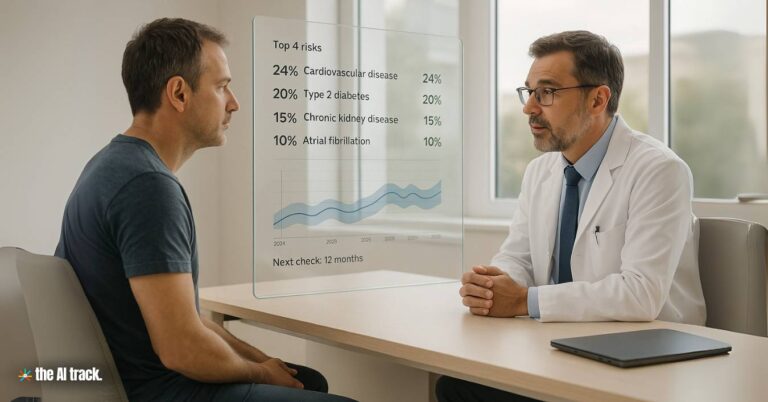
AI Model Delphi-2M Predicts Disease Risks – Key Points
Extensive Training on Dual Datasets
Built by EMBL-EBI, DKFZ, University of Copenhagen, and UK/Swiss collaborators, Delphi-2M was trained on 0.4M UK Biobank records and validated without parameter changes on ~1.9–1.93M Danish patients. Cross-system testing showed modest performance degradation, indicating portability across healthcare systems and data regimes.
Predictive Scope: 1,258 Diseases with Competing Risks
Coverage spans cancer, cardiovascular disease, diabetes, respiratory disease, sepsis, skin and immune conditions. The model explicitly learns competing risks across ICD-10 top-level diagnoses and includes death as an outcome, replacing dozens of siloed calculators (e.g., QRISK3) with one coherent framework for individual and population burden.
Time-Based Forecasting and Daily Hazards
Beyond which conditions may occur, Delphi-2M estimates when via daily hazard rates and time-to-event predictions over 10–20-year horizons. These outputs provide a timeline of disease risks, resembling weather forecasts with probabilities and projected timelines, supporting proactive screening and follow-up planning.
Integration of Lifestyle, Demographics, and Medical Events
Inputs include ICD-10 diagnosis sequences with age at first occurrence, sex, BMI, smoking, alcohol use, and other “medical events.” This integration strengthens the ability to identify personalized disease risks. Gaps in records are handled with placeholders to preserve continuity and stability of predictions.
Generative Design, Synthetic Trajectories, and Explainability
A GPT-style transformer treats life events as tokens, enabling sampling of synthetic future health trajectories to estimate potential disease burden and to pre-train downstream AI without exposing real data. Explainable-AI methods highlight clusters of co-morbidities across ICD chapters and how past diagnoses influence future risks, while also surfacing data biases.
Benchmark Accuracy, Calibration, and Disease Patterns
Delphi-2M matched or exceeded specialized models for many conditions, with particularly strong performance for cardiovascular disease, diabetes, and short-term mortality. Accuracy was lower for rare congenital disorders or diseases shaped heavily by external factors. Predictions remained stable at 10-year horizons, showing long-term reliability in modeling disease risks.
Applications, Timeline, and System Planning
Near-term: public-health forecasting and regional burden estimation; mid-term: individual risk guidance in clinics pending 5–10 years of validation/regulatory review. Roadmap: integrate genomics/proteomics, expand training data/models, and refine fairness/interpretability for diverse demographics.
Limitations, Biases, and Fairness
UK Biobank skews toward healthier adults aged ~40–70; very old and ethnically diverse groups are underrepresented. Diagnoses from mixed sources (self-reports, hospitals, primary care) can bias predictions, for example, hospital-coded sepsis was predicted ~8× more often in those with prior hospitalization history. The authors stress that disease risks should be interpreted as guidance, not certainties, and must always complement clinical judgment.
Macro Context for Planning
Rising global disease burdens underscore the need for tools like Delphi-2M: cancer cases are projected to rise 77% by 2050, while UK working-age major illnesses could increase from 3M to 3.7M by 2040. Accurate modeling of disease risks will be critical for healthcare planning and economic sustainability.
Why This Matters:
Delphi-2M combines breadth (1,258 conditions) with calibrated timing, providing a new paradigm for forecasting disease risks. With validation across national datasets, explainability methods, and bias safeguards, it has potential to shift healthcare toward proactive prevention, resource efficiency, and improved long-term outcomes.
This article was drafted with the assistance of generative AI. All facts and details were reviewed and confirmed by an editor prior to publication.

This curated collection highlights the most important recent AI breakthroughs in health, driving advancements in diagnostics, treatments, and operations.
The Revolution of AI in Healthcare: From Workflow Optimization to Personalized Medicine

The AI Track’s extensive analysis of the impact of AI in medical technology – how it is transforming healthcare by streamlining workflows, facilitating personalized medicine, and beyond. Explore the profound impact of AI in the medical field.
Read a comprehensive monthly roundup of the latest AI news!