Aeneas, DeepMind’s state-of-the-art multimodal AI, builds on the success of its predecessor Ithaca to transform the study of Latin inscriptions. By accurately restoring fragmented text, predicting origin and date with probabilistic reasoning, and surfacing contextual parallels in seconds, Aeneas enables a new era of large-scale, collaborative historical analysis grounded in human-AI synergy.

Google’s Aeneas – Key Points
Launch and Collaboration:
Aeneas was developed by Google DeepMind in collaboration with academic partners including the University of Nottingham, University of Warwick, University of Oxford, and the Athens University of Economics and Business (AUEB). Led by Yannis Assael and historian Dr. Thea Sommerschield, the research was published in Nature on July 23, 2025. Aeneas builds directly on DeepMind’s earlier AI model, Ithaca, released in 2022 for ancient Greek inscriptions.
Dataset Scale and Composition:
Aeneas was trained on the Latin Epigraphic Dataset (LED), composed of 176,000+ Latin inscriptions containing over 16 million characters. This dataset unifies decades of research from the Epigraphic Database Roma (EDR), Heidelberg (EDH), and Clauss-Slaby (EDCS-ELT). The texts span 7th century BCE to 8th century CE, covering state decrees, poetry, tombstones, graffiti, and private documents from across the Roman Empire.
Model Capabilities:
Parallels Search:
Aeneas encodes each inscription as a “historical fingerprint” that integrates linguistic, structural, and spatial metadata. It retrieves relevant parallels in seconds, aiding interpretation by surfacing ideological, stylistic, or formulaic similarities across disparate records.
Multimodal Processing:
Aeneas is the first AI epigraphy model to combine textual and image inputs, enabling geographical attribution with 72% accuracy across 62 Roman provinces, even in cases of damaged or displaced inscriptions.
Restoration of Damaged Texts:
Aeneas restores damaged Latin text with 73% Top-20 accuracy for fixed-length gaps and 58% for unknown-length gaps. Its capacity to handle gaps of uncertain size is a significant advance over previous AI systems.
Dating Precision:
Aeneas predicts when a text was composed with a mean error of 13 years, producing a distribution of plausible date ranges instead of a single output. This mirrors historical practice and adds transparency to AI-driven inference.
Real-World Application: Key Case Studies:
Res Gestae Divi Augusti:
Aeneas analyzed this imperial inscription and returned two date peaks—10–1 BCE and 10–20 CE—quantifying a long-standing scholarly debate and showcasing the model’s ability to capture interpretive ambiguity with data.
Mogontiacum Votive Altar (Mainz):
The model revealed hidden intertextual ties between a votive altar in modern Germany and earlier local inscriptions, surfacing linguistic continuities that human experts had missed.
Integration with Ithaca’s Legacy:
Aeneas is a direct evolution of Ithaca, DeepMind’s model for ancient Greek inscriptions, which achieved 62% restoration accuracy, 71% location attribution, and 30-year date precision. Aeneas retains Ithaca’s interpretability features and enhances them:
- Restoration Hypotheses: Offers ranked suggestions for missing text
- Probabilistic Output: Displays confidence distributions over dates and locations
- Saliency Maps: Visual cues show which characters or visual features influenced the model’s predictions
Ithaca’s success demonstrated the value of human-AI collaboration: in a 2022 Nature study, historians improved from 25% to 72% accuracy in restoration tasks using the tool. Aeneas builds on this collaborative model, applying it to Latin with even greater scale and precision.
Collaboration with Historians:
In a study of 60 inscriptions, 23 professional historians evaluated Aeneas’ outputs. The model’s contextual insights were deemed helpful in 90% of cases, and it improved confidence in attribution tasks by 44%. Results reaffirm that the most accurate outcomes are achieved through AI-human cooperation, not automation alone.
Educational Impact:
Aeneas is integrated into a digital humanities curriculum developed by DeepMind and academic collaborators. The syllabus aligns with international frameworks including UNESCO’s AI Competency Framework, the OECD’s AILit, and the EU’s DigComp 2.2, supporting AI literacy in classical studies classrooms and research settings.
Technical Architecture:
Aeneas is a multimodal generative transformer network, trained on both full-word and character-level inputs to handle fragmented inscriptions. It uses sparse self-attention mechanisms to interpret partial data and outputs saliency maps and probabilistic distributions for every prediction. The model architecture supports interpretability, transparency, and extensibility.
Open Access and Future Integration:
Aeneas is fully open-source, with model code and datasets available on GitHub. DeepMind has upgraded its earlier Greek model Ithaca with Aeneas’ architecture. The team is now extending Aeneas to support Etruscan, Akkadian, Demotic, Hebrew, Mayan, and other scripts, as well as new media formats such as papyri, coinage, and magical texts.
Why This Matters:
Aeneas signals a breakthrough in historical methodology, enabling scholars to restore, locate, and date ancient inscriptions with a speed and scale previously unimaginable. It brings together the depth of classical scholarship and the power of machine learning in a way that enhances—not replaces—human expertise. By advancing AI-human collaboration and democratizing access to interpretive tools, Aeneas helps reshape the study of the ancient world for a new generation.
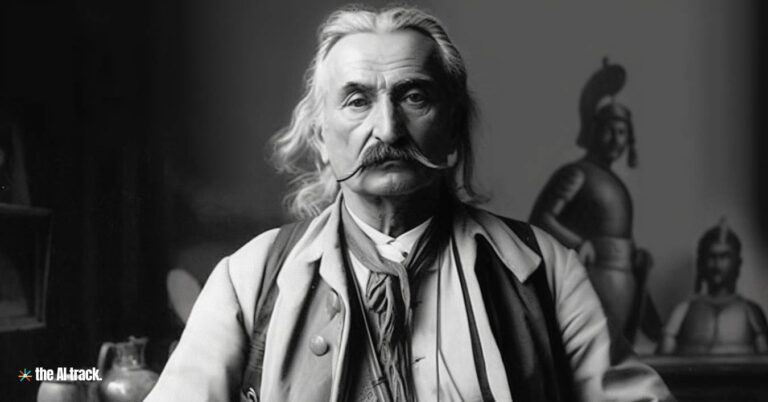
The first entry in our “Historical Figures Come Alive Project” shines a spotlight on Theodoros Kolokotronis, a prominent leader in the Greek War of Independence
Read a comprehensive monthly roundup of the latest AI news!