Key Takeaway:
Google expands AI Mode to support five additional languages: Hindi, Indonesian, Japanese, Korean, and Brazilian Portuguese, marking the first time it moves beyond English and significantly widening global accessibility.
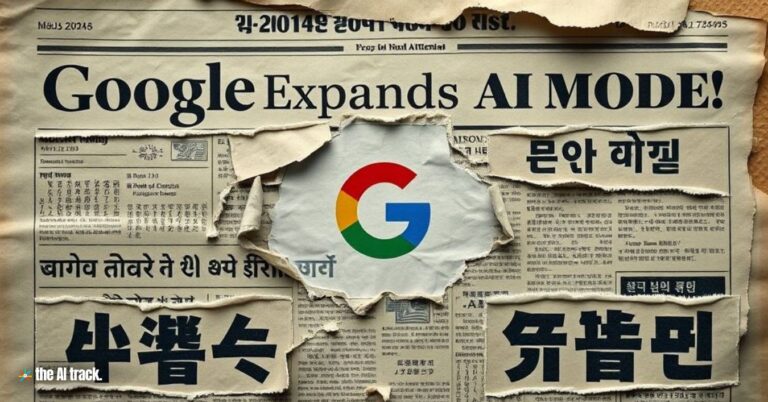
Google Expands AI Mode – Key Points
First Multilingual Expansion
On September 8, 2025, Google enabled five new languages: Hindi, Indonesian, Japanese, Korean, and Brazilian Portuguese, after more than six months of English-only availability. Google expands AI Mode to accept text, voice, and image uploads (via Google Lens in the Google app) to handle complex, multi-step questions; Indian outlets highlighted a Hindi example involving balcony-garden planning to demonstrate nuanced, localized responses.
Global Rollout and Reach
AI Mode debuted in the U.S. (March 2025), reached the U.K. and India (June 2025), and expanded to ~180 countries in August 2025. The new language support rides on that footprint, broadening access across Asia and Latin America.
Powered by Gemini 2.5
AI Mode uses a customized Gemini 2.5 with multimodal reasoning; in July 2025 Google added Gemini 2.5 Pro support and Deep Search inside AI Mode for more advanced queries.
Agentic Features for Premium Users
In August 2025, Google introduced agentic capabilities (e.g., restaurant reservations now; local service appointments and event ticket bookings planned). These are limited to Google AI Ultra subscribers in the U.S., accessible via the “Agentic capabilities in AI Mode” experiment in Labs; Ultra is $249.99/month.
Leadership Statement
Hema Budaraju (VP, Product Management, Search) framed the expansion as going “far beyond translation,” stressing local context and multimodal understanding for each new language.
How to Access
AI Mode remains available via a dedicated tab on results and a button in the search bar; Google’s help page lists supported countries and languages and notes Lens-based image queries in the Google app.
Criticism & Traffic Concerns
Publishers warn AI-led summaries reduce clicks. In August 2025, Google said overall organic clicks were “relatively stable,” yet a September court filing acknowledged the “open web is already in rapid decline,” underscoring industry tension as AI Mode scales.
Future Positioning
Google employees have hinted that AI Mode may become the default interface “soon,” signaling a deeper shift toward AI-led search experiences.
Why This Matters:
Google expands AI Mode to a multilingual scale, making it a global benchmark for AI-assisted search. This boosts competition with Perplexity and ChatGPT Search, shifting user habits from link-driven exploration to direct task completion. While end-users benefit from localized, faster answers, publishers face growing pressure from reduced referral traffic, challenging the long-term health of the open web.
This article was drafted with the assistance of generative AI. All facts and details were reviewed and confirmed by an editor prior to publication.

Autonomous AI agents are redefining automation. Learn how major tech players are leading the development of this transformative technology.

Google Translate adds AI practice and Gemini-powered live translation in 70+ languages, launching first in the US, India, and Mexico.

Google enhances Gemini Live with object highlighting, app integration, and natural speech features, starting on Pixel 10 and expanding to Android and iOS.

Google launches Guided Learning with free AI Pro for students, invests $1B in training, but early tests show ChatGPT delivers stronger study results.
Read a comprehensive monthly roundup of the latest AI news!