Key Takeaway
The IMF chief warns that artificial intelligence is hitting entry-level jobs “like a tsunami,” with early evidence from IMF analysis and labor-market research showing that routine tasks common to junior roles face high exposure to AI disruption. According to IMF Managing Director Kristalina Georgieva, while AI technologies can boost productivity, without faster reskilling and stronger workforce preparedness the risk is concentrated job transformation, hiring slowdowns for graduates, and uneven effects across skill levels and economies.
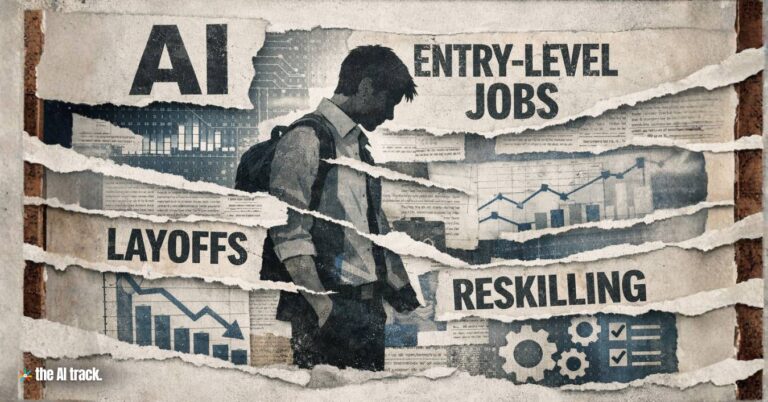
IMF Chief Warns AI Is Hitting Entry-Level Jobs Hard – Key Points
IMF warning at Davos (January 2026):
At the World Economic Forum in Davos, the IMF chief warns that AI is reshaping labor markets faster than policy frameworks can adapt. Kristalina Georgieva described AI as a “tsunami hitting the labour market” and highlighted that 60% of jobs in advanced economies and 40% globally could be affected through enhancement, transformation, or elimination as AI spreads across sectors. She noted that many of the displaced tasks are concentrated in entry-level work, making initial job placements harder for young workers.
In parallel remarks to CNBC, she described AI as a “major factor for economic growth,” estimating a potential 0.8% boost to global growth over the coming years, while stressing that most countries and companies remain unprepared for the labor-market consequences.
Scale of potential disruption (IMF research):
IMF analysis shows that employment levels in occupations vulnerable to AI exposure are lower in regions with high demand for AI skills, with some studies indicating a 3.6% drop in employment after five years in high AI-skill demand regions. This aligns with wider research showing that AI automation disproportionately affects routine, low-skill tasks while increasing demand for skills such as critical thinking and technical capabilities.
IMF research shows that in advanced economies, roughly one in ten jobs already requires new AI-related skills, suggesting that some roles are being enhanced by AI — with corresponding gains in productivity and pay — even as other positions face heightened disruption due to automation and task substitution.
Routine task exposure and job transitions
Another published research reveals that jobs with high AI exposure tend to involve repetitive and principle-based tasks. According to labor market research, accelerated adoption of AI can decrease demand for these roles even as it boosts productivity in augmented positions. Regions with strong demand for AI skills have seen employment patterns shift, with routine job categories losing relative share.
Layoffs and corporate restructuring linked to AI (Challenger, 2025):
Consulting firm Challenger, Gray & Christmas reported that AI was cited as the reason for 54,836 announced U.S. layoff plans in 2025 (their “AI” category in the Job Cut Announcement Report). Company leaders also publicly linked restructuring to AI adoption in some cases, including Salesforce, where CEO Marc Benioff said the company cut about 4,000 customer support roles as AI agents handled around half of customer interactions/workload. CNBC’s Davos coverage also cited examples of firms referencing AI in restructuring, including Amazon, Accenture, and Lufthansa, while noting that some executives and analysts caution “AI” can be used as a convenient headline explanation for broader cost-cutting.
Survey evidence on worker perceptions:
A Randstad Workmonitor survey of over 27,000 workers and 1,225 employers across 35 markets found that 80% of workers believe AI will affect their daily tasks, and job vacancies requiring AI-related competencies have surged, indicating notable shifts in demand and worker concern.
Graduate job openings and hiring trends:
In the UK, primary data from Adzuna, which tracks millions of job listings, show a sharp contraction in entry-level hiring following the widespread adoption of generative AI tools. According to Adzuna’s Job Market Report (June 2025), entry-level vacancies—including graduate roles, internships, apprenticeships, and junior positions—fell by 31.9% between November 2022 and mid-2025. The share of entry-level jobs in the overall market declined from 28.9% to 25% over the same period. While this evidence is market-specific rather than global, it provides concrete context for why the IMF chief warns that young workers are facing reduced access to traditional early-career entry points as employers reassess routine work and hiring needs.
Related to this, a Stanford Digital Economy Lab / SIEPR working paper using high-frequency U.S. payroll data reports that since the widespread adoption of generative AI, early-career workers ages 22–25 in the most AI-exposed occupations experienced a 13% relative decline in employment, even after controlling for firm-level shocks.
Skill polarization and job quality:
Broader scholarly reviews of AI’s impact on labor markets indicate that while technology can create high-skill, high-wage roles (especially those complementing AI), low-skill and routine work face heightened displacement pressure. The need for multidisciplinary and higher-order skills (critical thinking, analytical reasoning) has been repeatedly documented in recent labor research.
Why This Matters
When the IMF chief warns that AI is eroding entry-level jobs, the concern is structural and supported by emerging research on labor market transformation. Routine tasks that characterize early career roles are precisely those that AI systems are most able to automate, leading to shifts in hiring patterns and greater emphasis on higher-order capabilities. While many jobs will evolve rather than disappear, the transition pressures underscore the need for rapid reskilling, adaptable education systems, and policies that ensure inclusive workforce transitions.
This article was drafted with the assistance of generative AI. All facts and details were reviewed and confirmed by an editor prior to publication.
Discover the transformative role of AI in work, from job enhancement to ethical considerations and the need for continual upskilling

Generative AI is poised to unleash a new wave of global productivity, potentially adding an annual global productivity growth of $4.4 trill.

Discover the top 6 free AI Resume Builders. Explore how these AI tools are transforming the art of resume crafting, making job applications more effective.

A curated collection of the most important recent AI breakthroughs in business and manufacturing, optimizing processes and driving innovation.
Read a comprehensive monthly roundup of the latest AI news!