
Key Takeaway:
Nvidia will invest in Intel with a $5 billion equity purchase at $23.28 per share, entering a strategic partnership to co-develop custom AI data center chips and PC processors.
The agreement follows a Trump administration-backed 10% U.S. government stake in Intel and additional private-sector backing, signaling a historic realignment in the semiconductor sector.
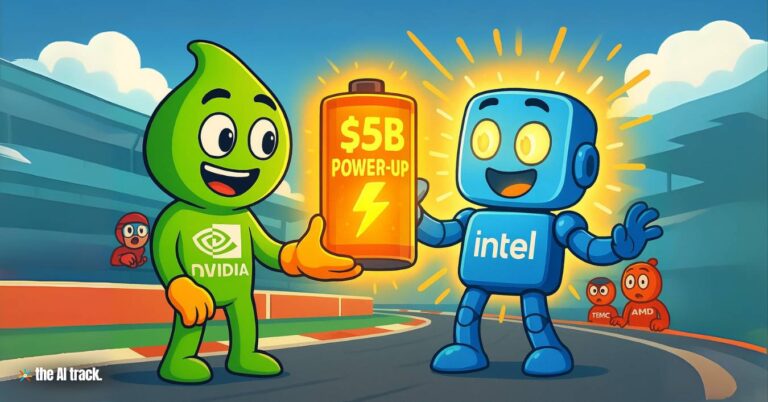
Nvidia will Invest in Intel $5 Billion – Key Points
$5 Billion Equity Investment
Nvidia will invest in Intel through a $5 billion common stock purchase at $23.28 per share, pending regulatory approval. The move follows the Trump administration’s 10% stake in Intel, one of the most direct White House interventions in corporate America. Nvidia’s commitment positions it as a central player in Intel’s turnaround strategy.
Intel’s newsroom confirms the equity purchase is subject to “customary closing conditions,” including Hart-Scott-Rodino (HSR) antitrust clearance.
The deal would make Nvidia one of Intel’s largest shareholders with an estimated ~4% stake, once closed
Intel Stock Surge
Intel shares surged nearly 23% after the announcement (largest one-day gain since 1987). Nvidia rose ~3%, lifting its market capitalization above $4 trillion. Analysts read the market reaction as validation of both the deal’s significance and Nvidia’s dominance in AI.
Intel’s market value has hovered around $100 billion versus Nvidia’s $4+ trillion.
Custom AI and PC Chips
Intel will design chips tailored for Nvidia’s AI data center platforms and develop PC processors integrating Nvidia GPU technology with Intel CPUs. For data centers, Intel will build NVIDIA-custom x86 CPUs that Nvidia integrates into its infrastructure platforms. For PCs, Intel will produce x86 SoCs with NVIDIA RTX GPU chiplets, the new x86 RTX SoCs aimed at client markets. This collaboration demonstrates the practical outcome of why Nvidia will invest in Intel: to secure future CPU-GPU integration across markets.
Architecture Integration & Interconnect
The companies will connect their architectures using NVIDIA NVLink, uniting Nvidia’s CUDA-centric AI stack with Intel CPUs and the x86 ecosystem. Intel’s process technology, manufacturing, and advanced packaging will play a complementary role.
Multi-Generation Roadmap & Market Scope
The collaboration covers multiple generations of data center and client products across hyperscale, enterprise, and consumer markets, signaling long-term strategic planning.
Leadership Statements & Governance Notes
Jensen Huang called the stake “an incredible investment” and framed the collaboration as foundational for the “next era of computing.” Intel CEO Lip-Bu Tan emphasized Intel’s data center/client platforms and manufacturing/packaging as complementary to Nvidia’s AI leadership, noting appreciation for Nvidia’s confidence via the equity stake. Both firms issued standard forward-looking statements and risk disclosures.
Intel’s Decline and Turnaround Attempt
Intel, once a global leader, has struggled since missing the mobile shift triggered by Apple’s iPhone in 2007. Losses reached $19 billion in 2024 and $3.7 billion in H1 2025. The company plans a 25% workforce reduction by end-2025. Analysts suggest Nvidia’s entry, alongside government support, could finally halt years of decline.
Additional Investor Backing
Japan’s SoftBank invested $2 billion in Intel in August 2025 for a 2% stake, strengthening Intel’s access to capital and signaling renewed foreign interest in U.S. semiconductor production.
U.S. Government Support and Trump Policy
Alongside the 10% equity stake, President Trump has championed measures including threatened 100% tariffs on imported chips and negotiated limited export deals allowing Nvidia and AMD to sell lower-spec AI chips to China with a 15% revenue cut to the U.S. Treasury, bolstering domestic production while shaping global flows.
Geopolitical Context
The agreement comes amid escalating competition: China barred major firms from buying Nvidia chips while Huawei accelerated AI chip development. Nvidia’s potential use of Intel fabs could lessen reliance on TSMC. Huang recently expressed disappointment at Chinese restrictions on Nvidia products, underlining the geopolitical stakes.
Why This Matters:
The Nvidia-Intel alliance reshapes semiconductor competition by giving Intel a revival path and Nvidia a U.S.-based supply option. Nvidia will invest in Intel not only to strengthen American technological independence but also to build a multi-generation NVLink-coupled x86/RTX roadmap that increases customer lock-in and reduces supply chain vulnerability. With AI infrastructure spending expected to reach $4 trillion by 2030, execution and regulatory clearance will determine its transformative impact on data center and PC markets.
This article was drafted with the assistance of generative AI. All facts and details were reviewed and confirmed by an editor prior to publication.

All you need to know about the critical components of AI infrastructure, hardware, software, and networking, that are essential for supporting AI workloads.

Explore the vital role of AI chips in driving the AI revolution, from semiconductors to processors: key players, market dynamics, and future implications.
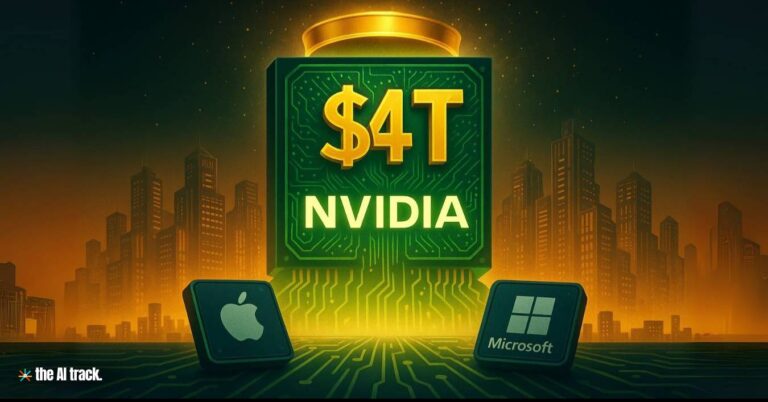
Nvidia Reaches 4 Trillion Milestone during intraday trading, fueled by AI chip dominance, record profits, and unmatched growth across global infrastructure.
Nvidia unveils NVLink Fusion for hybrid AI systems and launches DGX Cloud Lepton to link developers to global GPU infrastructure.
Read a comprehensive monthly roundup of the latest AI news!