Key Takeaway:
The launch of ChatGPT Atlas on October 21, 2025, marks OpenAI’s entry into a battle that could redefine how billions use the web. By embedding AI memory, an autonomous agent mode, and publisher-licensed real-time search directly into the browser, Atlas challenges Google Chrome’s dominance, Microsoft Edge’s AI features, and Perplexity’s emerging Comet platform. The browser war is no longer about speed or extensions—it is about which assistant shapes the future of digital work and information access.
OpenAI Launches ChatGPT Atlas – Key Points
- Launch & Availability
- Announced and released globally on October 21, 2025.
- Available on macOS for ChatGPT Free, Plus, Pro, and Go users; Business users have access in beta; Enterprise and Edu availability depends on admin enablement.
- Windows, iOS, and Android versions are confirmed as coming soon.
- Rollout included an official announcement, product video, and social posts inviting users to “Meet our new browser – ChatGPT Atlas.”
- Core Product Model & Interface
- AI-first workflow: Interaction centers on ChatGPT rather than a traditional address bar.
- Ask ChatGPT sidebar: Contextual help on any site, including rewriting highlighted text (e.g., “make this sound more professional”), drafting content, and answering questions in place.
- Unified start page: A single field accepts questions or URLs; the new-tab view offers search links, images, videos, and news.
- Personalized suggestions: Prompts to resume or extend recent tasks (holiday planning, gift research, shopping flows).
- Memory & User Control
- Browser memories (opt-in): ChatGPT Atlas can remember facts and insights from sites you visit (e.g., “summarize the job postings I looked at last week”) to help later.
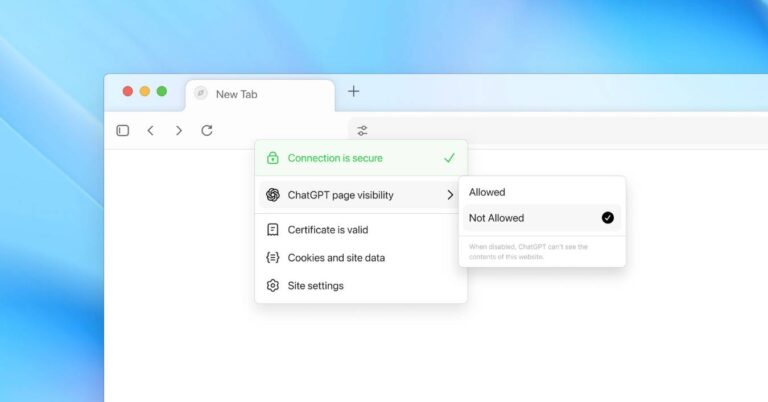
- Full controls: View, archive, or delete memories in settings; clearing browsing history also removes associated memories. Per-site visibility toggles determine what ChatGPT can see.
- Privacy & Security
- Default posture: Browsed content is not used for training by default; users can opt in, but pages that block GPTBot remain excluded.
- Incognito Mode: Signs you out of ChatGPT to prevent memory creation and chat linkage during a session.
- Sandboxed operation: ChatGPT Atlas cannot run code in the browser, download files, install extensions, access other apps, or touch the local file system.
- Sensitive-site safeguards: Agent actions pause on banking and similar sites pending user confirmation.
- Agent Mode (In-Browser Autonomy)
- Scope: Research, multi-step automation, event planning, shopping, and booking, by opening tabs, reading content, filling forms, and assembling outputs while you supervise.
- Examples: Add items to Instacart, compile competitive research, or draft a team brief from prior documents.
- Availability: Preview for Plus, Pro, and Business subscribers (subscriber-only access).
- Risk posture: OpenAI flags exposure to hidden malicious instructions on webpages/emails; it reports thousands of hours of red-teaming but notes safeguards are not absolute. Using the agent while logged out can further limit exposure.
- Parental Controls
- ChatGPT Atlas inherits ChatGPT’s parental controls and adds options to disable browser memories and agent mode for supervised accounts.
- Import, Security & Ecosystem Fit
- Data import: Bring bookmarks, passwords, and history from Chrome or Safari at setup; Apple Keychain supports credential security and autofill.
- Search Capability Context (ChatGPT Search)
- ChatGPT Atlas builds on ChatGPT Search (rolled out Oct 31, 2024, later expanded in Feb 2025), which adds real-time, source-linked answers within ChatGPT. Partnerships with publishers—including AP, Axel Springer, Condé Nast, Le Monde, and Prisa Media—enable attributed content and links, reflecting a broader move toward transparent, cited results.
- Market Context & Adoption Signals
- Competitive set: ChatGPT Atlas enters a landscape dominated by Chrome (Google) and Edge (Microsoft), alongside AI-forward browsers such as Perplexity’s Comet and Dia (The Browser Company).
- Perplexity Comet: Launched July 9, 2025, initially for $200/month Perplexity Max subscribers with invite-only access; built on Chromium with a sidebar assistant and agentic workflows—now expanding access.
- Behavioral shift: As of July 2025, ~5.99% of desktop searches flowed to LLMs, more than 2× year over year, signaling growing comfort with AI-mediated answers.
- Scale signal: External estimates in early October cited ~800M weekly active users for ChatGPT, underscoring the addressable base for an AI-first browser.
- Regulatory backdrop: ChatGPT Atlas’s launch follows a U.S. ruling labeling Google an illegal monopolist in online search; remedies did not require spinning off Chrome, framing competitive dynamics relevant to Atlas.
- Enterprise & Developer Roadmap
- Planned additions include multi-profile support, improved developer tools, and enhanced Apps SDK discoverability inside Atlas.
- Webmaster guidance: Sites can employ ARIA tags to improve how the ChatGPT agent interprets and acts on page elements.
Why This Matters:
ChatGPT Atlas reframes the browser as an AI-augmented productivity hub that can read, reason, and act across the web within a single interface. Memory, autonomy, and granular controls aim to shift everyday workflows,from studying and research to shopping and team tasks, toward agentic web use with user oversight. With publisher-licensed, source-linked search as a foundation, rising LLM-based search share, and a large installed base, Atlas arrives with momentum, yet analyst caution and explicit risk disclosures highlight the need to balance capability with safety as autonomous browsing matures.
The AI browser wars are unfolding against the backdrop of regulatory scrutiny, shifting search habits, and rapidly scaling adoption of AI assistants. With Chrome holding more than two-thirds of the market, Edge gaining traction through Copilot, and Comet aiming to disrupt with agent-native workflows, Atlas enters as a catalyst in an already tense competition. Whether OpenAI’s approach becomes the template for everyday browsing or remains a tool for early adopters will determine not just market share, but the very definition of how humans interact with the web.
This article was drafted with the assistance of generative AI. All facts and details were reviewed and confirmed by an editor prior to publication.

The AI search engine war is here. Learn how OpenAI’s SearchGPT challenges Google’s dominance and what it means for the future of search.
Perplexity’s Comet browser blends AI search, tab summarization, and task execution into one agentic interface—now in beta for Windows and Mac.
Read a comprehensive monthly roundup of the latest AI news!