Key Takeaway
AI faith tools are reshaping how people engage with spirituality, blending tradition with technology. From scripture-based chatbots to immersive religious experiences, these innovations offer new forms of access to prayer, study, and ritual—while raising critical questions about authority, authenticity, and ethics.
Jump to Sections
Introduction: The Rise of AI Faith Tools
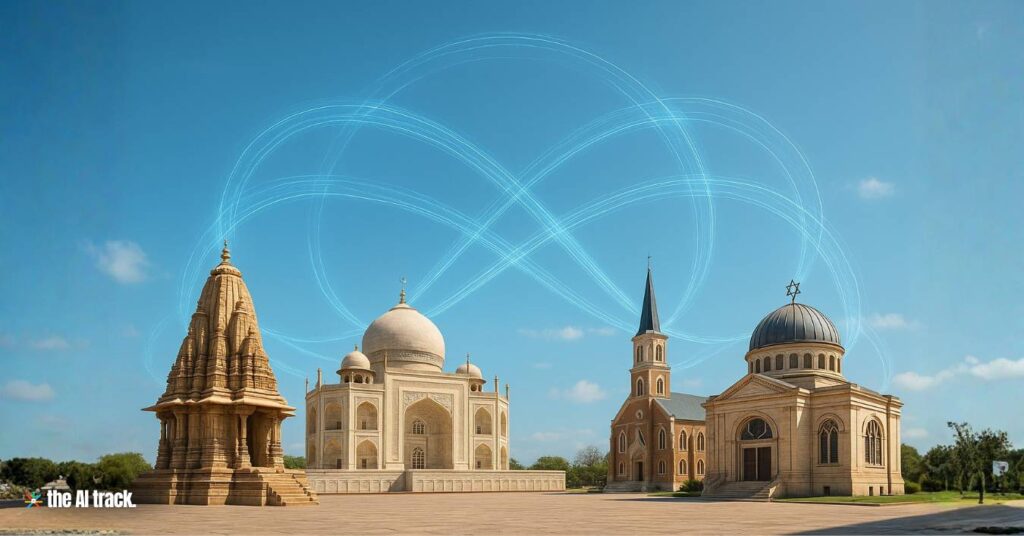
The past decade has seen artificial intelligence permeate nearly every sector, from healthcare and finance to education and entertainment. Now, religion is entering this technological frontier. **AI faith tools (**apps, chatbots, robotic assistants, and virtual experiences) are redefining how communities pray, study sacred texts, and participate in rituals.
This transformation is not confined to one tradition. From India’s Hindu temples to Catholic platforms in Europe, Islamic study apps in the Middle East, Jewish Torah learning portals, and Buddhist temples in East Asia, AI faith tools are becoming a cross-cultural phenomenon. What began as small experiments in 2017 with robotic ritual devices has expanded by 2025 into a global ecosystem that reaches millions of worshippers.

AI Faith Tools Across Traditions
Global Growth and Scale
AI-powered religious apps and platforms have rapidly expanded since 2023. For example, Sadhguru’s Miracle of Mind meditation app surpassed 1 million downloads in just 15 hours of launch in 2025. Similarly, the QuranGPT platform crashed within a day due to overwhelming traffic. These figures illustrate the demand for digital spiritual guidance delivered at scale.
AI faith tools now cover functions ranging from recitation training and scripture Q&A to full-scale VR religious festivals. The reach of these tools highlights both their promise and the deep social questions they provoke.
Technology as Intermediary
AI is increasingly acting as a new “spiritual middleman.” In Hindu traditions, chatbots modeled on the Bhagavad Gita provide personalized responses framed as teachings from Krishna. In Christianity, tools like Magisterium AI cite Vatican-approved texts, while Text With Jesus allows conversations with biblical figures. Jewish platforms such as Sefaria have launched AI-driven summaries of commentaries, with 14,000+ entries reviewed by human editors as of June 2025.
This shift reflects a broader trend: AI faith tools are not merely digital conveniences but are being positioned as alternative channels of spiritual authority.
Academic and Institutional Adoption
Scriptural Analysis
Academic researchers are employing AI to study sacred texts at a scale previously impossible. A 2022 study published in PubMed Central compared the Bhagavad Gita and the Upanishads, finding 73% thematic overlap. This kind of computational analysis not only confirms traditional scholarship but also reveals hidden textual structures.
Festivals and Pilgrimages
Institutions are also deploying AI at mass religious events. The Maha Kumbh Mela 2025 in India integrated multilingual chatbots, VR experience centers, and even paid digital rituals where a devotee’s photo was symbolically dipped in sacred waters. These uses demonstrate AI’s logistical value while blurring boundaries between physical and virtual devotion.

AI faith tools
Hinduism
Tradition: Hinduism
Function: Scripture-grounded Q&A based on the Bhagavad Gita; multiple variants (web apps).
Notable Feature: “Ask Krishna” persona; expansions to additional deities/scriptures.
Pricing/Access: Free web apps.
Release/Updated: Active 2023–2025 (public instances).
Link: https://www.gitagpt.in/ and https://gitagpt.org/ (GitaGPT)
Name: Miracle of Mind (Isha Foundation)
Tradition: Hinduism / meditation
Function: Guided meditation app with AI-powered personalized insights.
Notable Feature: 1M+ downloads in ~15 hours post-launch; trending in 20 countries.
Pricing/Access: Free; mobile apps.
Release/Updated: Feb–Mar 2025 launch reports.
Name: Kumbh Sah’AI’yak (Maha Kumbh 2025)
Tradition: Hindu pilgrimage services
Function: Multilingual AI chatbot assisting pilgrims with schedules, travel, and info.
Notable Feature: Official festival deployment (app/website/WhatsApp).
Pricing/Access: Free for attendees.
Release/Updated: Jan 2025.
Name: Character.AI — “Ramana Maharshi” bot
Tradition: Advaita/Hindu philosophy
Function: Conversational guidance in the style of Sri Ramana Maharshi.
Notable Feature: Popular public character; usage visible on Character.AI.
Pricing/Access: Free with account; premium tier optional.
Release/Updated: Live listing (2025).
Link: Character.AI profile. (Character AI)
Name: Robotic Aarti (festival demonstrations)
Tradition: Hindu ritual automation
Function: Robotic arm performing aarti (lamp-offering) at Ganesh events.
Notable Feature: Public demos since 2017.
Pricing/Access: Demonstrations; not a consumer product.
Release/Updated: Sept 2017 coverage.
Caution: Symbolic ritual automation; not a theological agent.
Name: Irinjadappilly Raman (robotic elephant)
Tradition: Hindu temple practice (Kerala)
Function: Mechanical elephant for rituals/blessings, replacing live elephants.
Notable Feature: Widely covered humane alternative; used in temple services.
Pricing/Access: Institutional device.
Release/Updated: 2023.
Caution: not a doctrinal tool.
Name: Digital Mahakumbh Experience Centre (VR/AR)
Tradition: Hindu pilgrimage experiences
Function: AI/VR/AR immersive mythological storytelling (Prayagraj).
Notable Feature: 60,000 sq ft exhibit; thousands of daily visitors (Jan 2025).
Pricing/Access: On-site exhibit.
Release/Updated: Jan 2025.
Caution: not a scripture authority.
Christianity
Name: Magisterium AI
Tradition: Catholic
Function: Cited answers from magisterial documents, Scripture, Church Fathers.
Notable Feature: “Scholarly Mode” references thousands of works; now embedded in Hallow.
Pricing/Access: Free with weekly prompt limits.
Release/Updated: Launched 2023; ongoing.
Link: (Magisterium)
Name: Text With Jesus
Tradition: Christian (multi-denominational)
Function: Chats with biblical figures in app/web.
Notable Feature: Multi-platform; high media visibility.
Pricing/Access: Freemium; iOS/Android/Web.
Release/Updated: Active; site updated Aug 2025 blog.
Link: Official site/app hub. (textwith.me)
Name: Bible Answers AI
Tradition: Christian (evangelical)
Function: Bible Q&A with scripture references.
Notable Feature: Mobile apps; “biblically sound” positioning.
Pricing/Access: Freemium; iOS/Android.
Release/Updated: Store listings current (2025).
Link: (BibleAnswers.ai)
Name: Bible.ai (app)
Tradition: Christian
Function: Conversational Bible assistant; chats with Bible characters; devotions.
Notable Feature: iOS app launched 2025; active updates.
Pricing/Access: Freemium app.
Release/Updated: App Store page (2025).
Link: App site & App Store. (bible.ai)
Name: GotQuestions.chat (experimental)
Tradition: Evangelical/apologetics
Function: Q&A chatbot fine-tuned on GotQuestions/BibleRef/CompellingTruth.
Notable Feature: Experimental label; publisher explains stance on AI use.
Pricing/Access: Free web.
Release/Updated: Site active; publisher notes (Aug 2025).
Link: (GotQuestions.chat)
Caution: Publisher emphasizes human-written articles; chatbot is auxiliary.
Islam
Name: Ask AiDeen (Muslim Pro)
Tradition: Islam
Function: In-app AI assistant grounded in Qur’an and authentic hadith.
Notable Feature: Integrated in the Muslim Pro ecosystem.
Pricing/Access: In-app access (Muslim Pro).
Release/Updated: Announced Mar 15, 2024; FAQ updated Feb 26, 2024.
Link: (Muslim Pro)
Name: Tarteel
Tradition: Islam
Function: Real-time recitation feedback (memorization mistake detection); search.
Notable Feature: Flagship ASR for Qur’an; Millions of downloads claim on official channel.
Pricing/Access: Freemium (iOS/Android/Web).
Release/Updated: Apps active since 2018+; listings current 2025.
Link: (Tarteel)
Name: AskQuran.chat
Tradition: Islam
Function: Qur’an-grounded answers with authentic references.
Notable Feature: Web assistant; privacy policy dated Apr 1, 2025.
Pricing/Access: Free web.
Release/Updated: 2025 updates.
Link: (AskQuran.chat)
Name: Quran Tutor AI (Qara/QuranTutor)
Tradition: Islam
Function: AI-assisted learning/tutoring; interactive lessons.
Notable Feature: Web app + iOS/Android.
Pricing/Access: Freemium.
Release/Updated: 2025 social/app pages.
Link: (qurantutor.ai)
Name: MyQuran – “Ask the Quran”
Tradition: Islam
Function: Private AI Qur’an assistant (answers + guidance).
Notable Feature: Privacy-forward positioning.
Pricing/Access: Free web (email signup).
Release/Updated: 2025.
Link: (My Quran)
Name: QuranGPT (public instances)
Tradition: Islam
Function: Qur’an-based Q&A (various independent deployments).
Notable Feature: Multiple domains/maintainers; some use GPT-4-family models.
Pricing/Access: Free web.
Release/Updated: Active 2024–2025.
Link: (qurangpt.com)
Judaism
Name: Sefaria — AI Topic Pages / Study Aids
Tradition: Judaism
Function: AI-assisted introductions/summaries curated by Sefaria’s learning team.
Notable Feature: ~1,000 AI-generated intros reviewed/edited by staff.
Pricing/Access: Free web.
Release/Updated: AI explainer (2025); help article (Jun 10, 2025).
Link: (Sefaria)
Name: RavGPT (BrainyBlaze)
Tradition: Orthodox Jewish study
Function: AI assistant for Torah learning with cross-references.
Notable Feature: “v2” update (Feb 18, 2025) improving source mapping.
Pricing/Access: Web (plans vary).
Release/Updated: 2025.
Source: (ravgpt.ai)
Caution: Positions itself as study aid;
Name: Rebbe.io
Tradition: Jewish learning/halacha
Function: Subscription chatbot for Torah & halacha answers.
Notable Feature: Tiered plans.
Pricing/Access: Paid subscriptions.
Release/Updated: Active 2025.
Link: (Rebbe.IO)
Name: Torah Companion (custom GPT)
Tradition: Jewish study
Function: Chavruta-style assistant for textual study.
Notable Feature: Hosted GPT listing.
Pricing/Access: Requires ChatGPT account (paid tiers for full access).
Release/Updated: 2025 listing.
Link: ChatGPT GPTs directory page. (ChatGPT)
Buddhism
Name: AI Tripitaka (Chinese Buddhist canons; various operators)
Tradition: Buddhism
Function: GPT-assisted reading & Q&A.
Notable Feature: subscription options.
Name: NORBU
Tradition: Buddhism (Theravāda / Pali canon)
Function: Community-driven AI assistant focused on translation and interpretation of Pali scriptures; designed as a chatbot and study companion for canonical Buddhist texts.
Notable Feature: Open-source collaboration with emphasis on preserving the Pali language and making ancient texts more accessible for modern learners. Frequently referenced in academic and Buddhist community forums.
Pricing/Access: Free; community-hosted instances and GitHub repositories.
Release/Updated: Active since ~2023; community updates continuing into 2025.
Link: Community project reference (example): NORBU GitHub and SuttaCentral forums.
Name: Robot Monk “Xian’er” (Longquan Monastery)
Tradition: Buddhism (China)
Function: Humanoid robot/chatbot for teachings and Q&A on public platforms.
Notable Feature: Media-covered temple project since 2016.
Pricing/Access: Institutional; public demos.
Release/Updated: Article updated last month.
Caution: Educational/demonstration role; not an authority on doctrine.
Name: “Mindar” Android Kannon (Kōdai-ji, Kyoto)
Tradition: Buddhism (Zen)
Function: Android preacher delivering sermons on Heart Sutra.
Notable Feature: Collaboration with Osaka University; unveiled Mar 2019.
Pricing/Access: On-site temple experience.
Release/Updated: Entry updated 2024–2025.
Multi-tradition / Context
Name: Digital Maha Kumbh VR/Darshan initiatives
Tradition: Multi-format religious tech
Function: Remote darshan, VR journeys, and symbolic participation services.
Notable Feature: “Digital bath/snan” services reported; crowd-tech stack at scale.
Pricing/Access: Mixed (some paid services).
Release/Updated: Jan 2025.

Benefits and Opportunities
Accessibility and Inclusion
AI faith tools lower barriers to religious participation. Remote believers can join rituals via livestreamed VR, while learners can engage with scripture through interactive Q&A systems. Tools like Tarteel even help users perfect Qur’anic recitation by detecting mistakes in real time.
Personalization
Unlike traditional sermons or large-scale festivals, AI systems offer individualized guidance. Users report feeling that these chatbots provide companionship, especially when human spiritual leaders are inaccessible. This personalization—delivered in seconds—has become a defining feature of the new spiritual-tech landscape.
Risks and Ethical Challenges
Authority and Authenticity
Experts such as Holly Walters (Wellesley College) and Rev. Lyndon Drake (Oxford University) have warned that AI faith tools risk undermining established spiritual authorities. If a chatbot issues guidance framed as divine truth, users may mistake algorithmic predictions for authentic doctrine.
Examples illustrate this risk: GitaGPT once declared that “killing in order to protect dharma is justified,” while Father Justin, a Catholic AI priest launched in 2024, claimed it could baptize with Gatorade. Both incidents triggered backlash and highlighted the difficulty of controlling theological outputs.
Bias and Digital Divide
Like all AI models, these systems mirror the biases of their training data. In countries such as India, where the digital divide remains significant, users with limited tech literacy may accept chatbot responses uncritically. As Walters emphasizes, “The danger is when these tools are perceived as divine voices, their words can carry weight far beyond what they should.”
This article was drafted with the assistance of generative AI. All facts and details were reviewed and confirmed by an editor prior to publication.
Why This Matters
The emergence of AI faith tools is one of the most profound examples of technology reshaping human culture. On one hand, these tools expand access, provide comfort, and modernize religious traditions for a digital age. On the other, they risk distorting scripture, weakening the role of human leaders, and embedding algorithmic biases into matters of faith.
The future of AI faith tools will likely depend on collaboration between technologists, religious authorities, and regulators to ensure innovation does not compromise authenticity. As AI becomes entwined with belief systems, society must decide how much authority it is willing to give to machines in interpreting the sacred.