
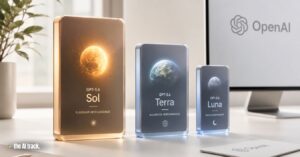
OpenAI GPT 5.6 Launches With Sol, Terra and Luna Under U.S. Review Pressure
The GPT 5.6 launch introduces Sol, Terra and Luna in a limited preview, with broader access shaped by U.S. review of advanced cyber capabilities.
The GPT 5.6 launch introduces Sol, Terra and Luna in a limited preview, with broader access shaped by U.S. review of advanced cyber capabilities.

The European Commission selected the Domyn-led EUROPA consortium to build an open-source frontier AI model for all 24 official EU languages.

Anthropic suspended Fable 5 and Mythos 5 after a U.S. export-control directive restricted access by foreign nationals.
Google’s DiffusionGemma is an experimental open model that uses text diffusion to generate blocks of text in parallel for faster local AI workflows.

Google Gemini 3.5 Live Translate supports real-time speech translation across more than 70 languages, with rollout across Translate, Meet, and developer tools.

Anthropic has launched Claude Fable 5 for general users and Claude Mythos 5 for trusted access, bringing stronger coding, research, vision, prototyping, and long-context capabilities with stricter safeguards.

Apple introduced Siri AI at WWDC 2026, adding conversational responses, personal context, onscreen awareness, Visual Intelligence, Writing Tools and deeper app actions across its ecosystem.

OpenAI is rolling out a ChatGPT memory update built on Dreaming, a new architecture designed to keep user context fresher, more relevant, and easier to manage.

OpenAI expands Codex with Sites, Annotations, and plugins for enterprise workflows, moving the agent beyond coding into business work.