
Key Takeaway
China announces five-year plan priorities centered on high-tech manufacturing, AI infrastructure, and technological self-reliance while also trying to address weak domestic consumption and broader structural economic pressures.
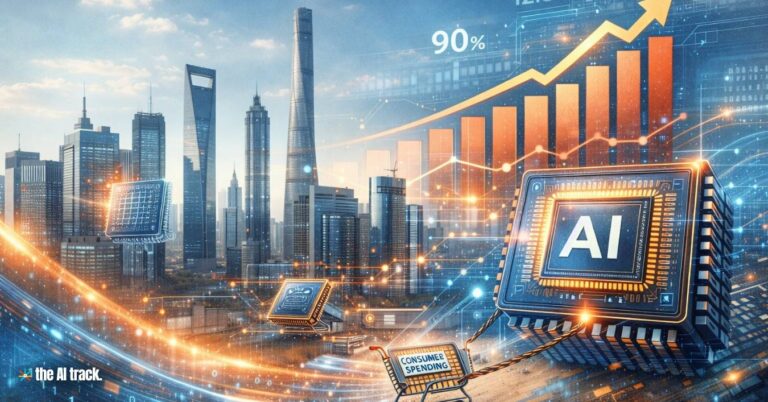
China Announces Five-Year Plan – Key Points
The Story
China’s Communist Party leadership met in Beijing for a closed-door plenary session to shape the country’s next social and economic roadmap. In March 2026, China announces five-year plan details for the 2026–2030 period, with a strong focus on semiconductors, AI infrastructure, and digital economy development. The plan also makes AI a more explicit national priority, pairing support for chips and foundation models with language around safe and orderly development.
The Facts
Five-year roadmap for 2026–2030 unveiled
China’s 15th five-year plan covering 2026–2030 was presented to the country’s top legislature as part of the annual parliamentary session in Beijing in March 2026.
Economic model facing structural challenges
China’s economy has historically relied on export trade and large infrastructure investment. Domestic consumption, the third pillar of economic growth, has received far less emphasis, creating an imbalance between strong supply and weak demand.
Domestic consumption remains weak
Private consumption currently accounts for roughly 40% of China’s economic output, compared with about 60% in Western economies and around 70% in the United States.
Lower growth target reflects structural pressures
China set an economic growth target of 4.5–5% for the current year, slightly lower than the previous year’s 5% growth, which was supported by a record $1.2 trillion trade surplus.
AI has become a more explicit policy priority
The plan elevates the AI Plus initiative, first announced in 2024, with a target of integrating AI into 90% of China’s economy by 2030. AI appears 52 times in the draft plan, up from 11 mentions in the 14th five-year plan released in 2021.
Analysts expect stronger support for high-tech sectors
Researchers expect the policy framework to continue emphasizing high-tech research, industrial development, and manufacturing capacity as key drivers of economic growth.
Semiconductor access remains a strategic concern
China faces restrictions on advanced chips from the United States. US companies such as Nvidia produce the most advanced processors, and export controls have limited Chinese access to high-performance chips used in AI and advanced computing.
Technological sovereignty is a national priority
Beijing is expanding investment in strategic technologies to reduce dependence on foreign supply chains and strengthen domestic capabilities in areas such as semiconductors, advanced manufacturing, and AI foundation models.
Digital economy targets introduced
The plan aims to raise the value added by core digital economy industries to 12.5% of GDP, alongside new policies to build a national data market and introduce systems for AI security risk prevention.
Large-scale computing infrastructure planned
China plans to develop “hyper-scale” computing clusters supported by abundant electricity to expand AI and data-processing capacity.
Government measures to support households already introduced
Beijing has introduced policies including consumer subsidies, pension increases, childcare support, education spending, and social security improvements, though many measures remain limited in scale.
Demographic and economic pressures driving policy shifts
Aging demographics, a persistent real estate crisis, high local government debt, and trade barriers are increasing pressure to rebalance the economy toward domestic demand.
Large fiscal cost for rebalancing the economy
Citigroup estimates China would need to invest 20 trillion yuan (about $2.81 trillion) over five years to significantly address the imbalance between supply and demand.
Investment likely to favor industry first
Analysts expect Beijing to prioritize technology and industrial sectors in the near term, betting that technological breakthroughs will generate future growth and tax revenues.
Numbers that Matter
- 40% – share of China’s GDP driven by domestic consumption
- 60% – typical consumption share in Western economies
- 70% – consumption share in the United States
- 12.5% of GDP – target contribution from core digital economy industries
- 90% by 2030 – AI Plus target for integration across China’s economy
- 52 vs 11 – AI mentions in the 15th plan draft versus the 14th five-year plan
- 20 trillion yuan ($2.81 trillion) – estimated investment needed to rebalance China’s economy over five years
Background / Context
China is already a global leader in sectors such as electric mobility and renewable energy, and has built nearly complete domestic supply chains in many industries. Remaining gaps, particularly advanced semiconductors and commercial aviation, have become strategic priorities as the country seeks technological independence amid rising geopolitical competition. As China announces five-year plan priorities, it also places greater emphasis on ensuring AI development is both rapid and orderly, reflecting concern over the disruptive effects of the technology.
Why This Matters
China announces five-year plan goals that make clear Beijing is pursuing technological sovereignty, AI infrastructure, and industrial policy over a consumer-led growth model. The stronger emphasis on AI Plus, chips, foundation models, and AI risk controls shows that China announces five-year plan ambitions with AI at the center of economic upgrading, national security, and competitiveness.
This article was drafted with the assistance of generative AI. All facts and details were reviewed and confirmed by an editor prior to publication.

China bans foreign AI chips from all state-funded data centres (accorging to Reuters), reshaping AI supply chains and hurting Nvidia, AMD, Intel while boosting Huawei.

China mandates AI education in schools, starting in Beijing 2025 and expanding nationwide by 2025 to boost tech skills.

China reported 1509 large AI models at WAIC 2025, showcasing leadership in robotics, model innovation, video AI, and industry standards.
Chinese organizations have launched a total of 79 large-language models (LLMs) since 2020, a significant increase from 2020
Read a comprehensive monthly roundup of the latest AI news!