Key Takeaway
Google released Nano Banana Pro, a Gemini 3 Pro–powered image generation and editing tool (the Gemini 3 Pro Image model from Google DeepMind). It expands Google’s AI ecosystem across consumer, enterprise, and developer products, targeting production-grade uses like marketing, presentations, and ads, while the original Nano Banana remains for quick, casual edits.
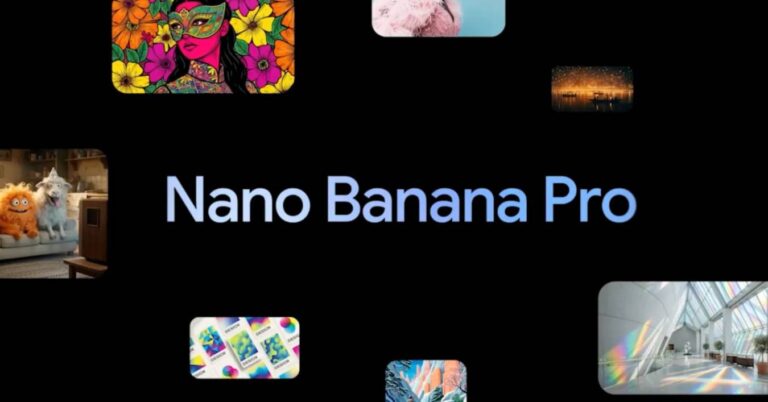
Google Launches ‘Nano Banana Pro’ – Key Points
Google released Nano Banana Pro on 20 November 2025.
Formally introduced as Nano Banana Pro (Gemini 3 Pro Image), the tool is built on Gemini 3 Pro, launched on 18 November 2025 and associated with a 4% jump in Alphabet’s stock. It succeeds the original Nano Banana (Gemini 2.5 Flash Image, released August 2025) and uses Gemini 3 Pro’s reasoning and real-world knowledge, including Google Search, to generate visuals from live data such as recipes, weather, and sports. Early integrations into Google Slides and Google Ads are designed around business presentations and advertising.
The tool creates infographics, slide decks, diagrams, and consistent multi-image outputs.
According to Josh Woodward, VP of Google Labs and Gemini, Nano Banana Pro can process up to 14 images or five characters, preserving visual consistency. It turns handwritten notes into diagrams, converts structured or unstructured data into infographics, and supports storyboards like “Urban Astronaut” with coherent framing. Because it is connected to Search, it can incorporate real-time information (for example, a specific airport’s Thanksgiving weather), with tests showing the most useful output comes when users explicitly ask for an infographic.
Internal testers used code snippets and LinkedIn résumés to generate infographics.
Internal teams have used Nano Banana Pro to turn code and résumé text into visual explainers and professional infographics. The model helps designers and product teams rapidly mock up UIs, layouts, and marketing assets directly from text, narrowing the gap between raw content and finished visuals. Reviewers have produced step-by-step guides, such as a turkey deep-frying infographic that pulls in safety advice from the US Fire Administration, demonstrating how institutional guidance can be embedded directly into the design.
The original Nano Banana attracted 13 million new users in four days.
In a September X post, Woodward said the original Nano Banana brought 13 million new users to Gemini in four days, thanks to viral trends turning user and pet photos into hyperrealistic 3D figurines. Nano Banana Pro builds on that momentum by focusing on higher-fidelity, professional workflows while keeping the original model for fun, lightweight experimentation.
Nano Banana Pro is optimized for accurate, legible, multilingual text in images.
Nano Banana Pro is presented as Google’s best model for on-image text, from short slogans to full paragraphs. Using Gemini 3’s stronger language understanding, it produces posters, mockups, and typographic layouts with varied fonts and textures, and can localize or translate text (for example, English–Korean packaging) for international campaigns. Nicole Brichtova, product lead at Google DeepMind, notes that even small text errors stand out—comparing them to the “six-finger hands” problem—and attributes cleaner text rendering, including correct diacritics in languages like Czech, to the move to Gemini 3 Pro.
Nano Banana Pro delivers high-fidelity visuals and studio-style creative controls.
The model blends up to 14 images while preserving the likeness of up to 5 people, making it suitable for turning sketches into product images, fashion scenes, or architectural 3D renders. Users can refine local regions, adjust camera angles and focus, change lighting (e.g., day to night, bokeh), and apply color grading. It supports multiple aspect ratios and 2K/4K resolution for social, web, and print. Early tests show it can generate detailed flyers and web banners with full sentences and multiple typefaces from a single prompt, then refine them via follow-up prompts, although some outputs still carry a recognizable “AI” aesthetic.
Availability spans free and premium Google ecosystems across multiple user segments.
For consumers and students, Nano Banana Pro appears in the Gemini app (“Create images” with the “Thinking” model); free-tier users have limited quotas before falling back to the original Nano Banana, while Google AI Plus, Pro, and Ultra subscribers receive higher limits. Many Google One subscribers can also try it with extra generations included. In AI Mode in Search, it is available in the U.S. for Google AI Pro and Ultra subscribers, and it is offered globally to NotebookLM subscribers. For professionals, Google Ads is being upgraded to Nano Banana Pro for higher-quality ad creatives, and Workspace customers can use it directly in Google Slides and Vids. For developers and enterprises, Nano Banana Pro is rolling out via the Gemini API, Google AI Studio, Google Antigravity (for UX layouts and mockups), and Vertex AI, with Gemini Enterprise support coming soon. For creatives and filmmakers, it is arriving in Flow, Google’s AI filmmaking tool, for Google AI Ultra subscribers. Outside Google, it is also a partner model in Adobe Firefly and Photoshop, with Creative Cloud Pro and Firefly-plan subscribers receiving unlimited Nano Banana Pro generations in Firefly through December 1.
The tool will roll out to Flow, Google’s AI filmmaking tool, for Ultra users alongside Genie.
Integration with Flow gives creatives detailed scene and frame control and fits into Google’s wider multimodal strategy that includes Genie, a “world-building” model in limited research preview. Nano Banana Pro supplies high-quality frame imagery, while Genie focuses on interactive environments, together targeting marketers, filmmakers, and studios that need fast iteration on storyboards and visual concepts.
Google introduced AI image detection in the Gemini app using SynthID and visible watermarks.
All media from Google’s tools carries SynthID, an imperceptible watermark from Google DeepMind. Users can upload an image into the Gemini app and ask if it was generated by Google AI; Google plans to extend this from images to audio and video. A visible Gemini “sparkle” watermark appears on outputs for free and Google AI Pro users, making AI content easy to spot. For Google AI Ultra subscribers and Google AI Studio, the visible mark is removed to keep a clean canvas, but SynthID remains embedded so provenance checks still work.
Early external testing shows strong gains in text-heavy infographics but ongoing limits in fine labeling.
Reviewers report that Nano Banana Pro generates clear, step-by-step infographics with coherent instructions and correct institutional references (such as US Fire Administration safety warnings). However, in tests that require precise labeling of complex scenes—like a full Thanksgiving table—some elements are misnamed (for example, a spoon labeled “autumn leaves” or a bare spot called “dinner rolls”). This points to a gap between improved layout and text rendering and still-imperfect semantic alignment in dense, real-world scenes, reinforcing the need for human review in high-stakes or data-rich visuals.
Google continues competing with OpenAI amid rising user numbers.
Google reports that the Gemini app has over 650 million monthly active users and AI Overviews reach 2 billion monthly users in Search. Sam Altman said in October 2025 that ChatGPT hit 800 million weekly active users. Recent GPT-5 updates focus on warmer, more conversational behavior and efficiency, underscoring the rivalry between ecosystems. Commentators frame Nano Banana Pro’s multilingual text and infographic strengths as key to competing with image tools tied to ChatGPT, with on-image text quality emerging as a core differentiator.
Demand for Gemini subscriptions is rising strongly across tiers and products.
Woodward points to sustained growth in paid upgrades for higher limits and access to models like Nano Banana Pro, and Google is scaling infrastructure to keep pace across Search, Workspace, Ads, developer platforms, and creative tools. Google One quotas, Google AI Pro/Ultra bundles, and premium access in Flow, Ads, and Workspace serve as monetization levers around Nano Banana Pro. The split between original Nano Banana for speed and Nano Banana Pro for complex, high-quality work reflects a dual-track strategy that serves casual users and professionals, while the Adobe Firefly integration extends Google’s reach into existing creative pipelines.
Why This Matters
Nano Banana Pro shows how Google is using Gemini 3 Pro and Google DeepMind’s image modeling to move from simple filters to reasoning-aware visual generation that can work with real-world data, multilingual text, and professional-grade requirements. Embedded across the Gemini app, Search, Workspace, Ads, Vertex AI, and creative tools like Flow, and integrated into Adobe Firefly and Photoshop, it turns image generation into a shared capability across consumer, productivity, and enterprise environments. For office workers, this means more AI-generated infographics, marketing assets, and slide decks built from a single prompt and quickly refined. The combination of SynthID, visible watermarks for lower tiers, and built-in detection aims to keep this rapid scale-up of synthetic images, audio, and video traceable, while leaving room for human oversight on meaning, safety, and brand alignment.
This article was drafted with the assistance of generative AI. All facts and details were reviewed and confirmed by an editor prior to publication.

See which AI image generator is the best in this epic showdown among the top 12 and discover which one can create the most realistic, creative, or surreal images
Explore 50+ viral ChatGPT 4o image prompts—from memes to comic strips to pet makeovers. Try them now and unleash your visual creativity.
Read a comprehensive monthly roundup of the latest AI news!