Key Takeaway
Google has made Gemini 3 the default model for AI Overviews globally and tightly integrated them with AI Mode, accelerating a shift toward an AI-first search experience that prioritizes conversational interaction and synthesized answers over traditional link-centric discovery.
AI Overviews Receive Gemini 3 Upgrade – Key Points
Gemini 3 becomes the default for AI Overviews (global rollout)
In late January 2026, Google confirmed that Gemini 3 is now the default model powering AI Overviews for all users worldwide, starting on mobile. This represents a change from the initial November 2025 deployment, when Gemini 3 was routed only to the most complex queries while simpler questions were handled by earlier models. With the new rollout, Gemini 3 underpins AI Overviews by default and is designed to produce more credible, relevant, and better-structured summaries. Google continues to dynamically select among Gemini 3 variants, such as Flash for lightweight queries and Pro for more demanding “long-tail” questions, while simple lookups like weather, sports scores, or currency conversions may still rely on lighter systems.
Seamless transition from snapshot to conversation
Users can now move directly from an AI Overview into a live conversation within AI Mode without switching tabs or restarting their query. Interactions such as tapping “Show more” or simply scrolling past the summary transition the interface into a chat-style experience that preserves context from the original search. This enables follow-up questions, clarifications, comparisons, and deeper exploration without losing continuity, effectively blending summary and dialogue into a single flow.
Search redesigned for complex, multi-part questions
Google positions this redesign as a response to observed user behavior during testing that began in December 2025. Internal testing showed that users preferred experiences that “flow naturally into a conversation” rather than stopping at a static answer. Queries involving planning, evaluation, or judgment (such as healthcare decisions, financial planning, or major purchases) are increasingly treated as multi-step conversations instead of isolated prompts, reducing the need for repeated reformulation.
Prominent links and hybrid discovery model remain
Despite the stronger emphasis on AI-generated synthesis, Google continues to surface links prominently alongside AI Overviews and within AI Mode responses. The company describes this as a hybrid discovery model: “a quick snapshot when you need it, and deeper conversation when you want it.” Links remain available for verification and exploration, but they increasingly function as supporting material beneath AI-curated answers rather than the primary entry point.
AI Mode feature expansion on mobile
On Android and iOS, AI Mode now exposes a model picker before the first prompt, allowing users to switch between Default and “Thinking” modes upfront. Previously, model switching was only possible after submitting an initial query. The Google app also introduces a distinct AI Mode homepage that differs from the browser-based experience. These updates are rolling out globally, with some advanced options initially appearing in beta versions and associated with AI Pro subscriptions.
Strategic shift toward AI-first Search
The Gemini 3 rollout aligns with a broader strategic shift in Google Search toward conversational AI. AI Overviews now appear for a growing share of queries, and AI Mode increasingly resembles a built-in search chatbot. While Google has not announced plans to retire traditional Search, executives emphasize answering “whatever’s on your mind” through dialogue. In practice, this places AI-generated synthesis at the top of the experience, with the classic list of blue links playing a diminishing, secondary role.
Accuracy, benchmarking, and model selection remain open challenges
Google acknowledges ongoing trade-offs between depth, speed, and reliability. Gemini 3 improves accuracy compared with the previous Gemini 2.5 family, with lightweight Gemini 3 Flash models reportedly achieving more than double the score on certain knowledge-based benchmarks versus earlier versions. However, AI Overviews still have a history of factual errors, including in sensitive areas such as health and safety. As AI responses become longer and more conversational, hallucinations and incorrect synthesis remain key risks that Google seeks to mitigate through selective model routing and interface design.
Why This Matters
These updates mark a structural evolution of Google Search: from discrete question-and-answer interactions to an ongoing, context-preserving dialogue. By embedding conversational AI directly into search results and minimizing friction between summaries and chat, Google increases user dwell time and reframes Search as an assistant for reasoning, planning, and exploration. For publishers, researchers, and businesses, this shift reshapes visibility, referral traffic, attribution, and the role of authoritative content as it is increasingly summarized and mediated by large language models.
This article was drafted with the assistance of generative AI. All facts and details were reviewed and confirmed by an editor prior to publication.

OpenAI has introduced ChatGPT Search enabling real-time information retrieval. This development positions ChatGPT as a direct competitor to Google.

Anthropic adds real-time web search to Claude, targeting ChatGPT and Perplexity. Studies warn of AI inaccuracies and rising energy demands.
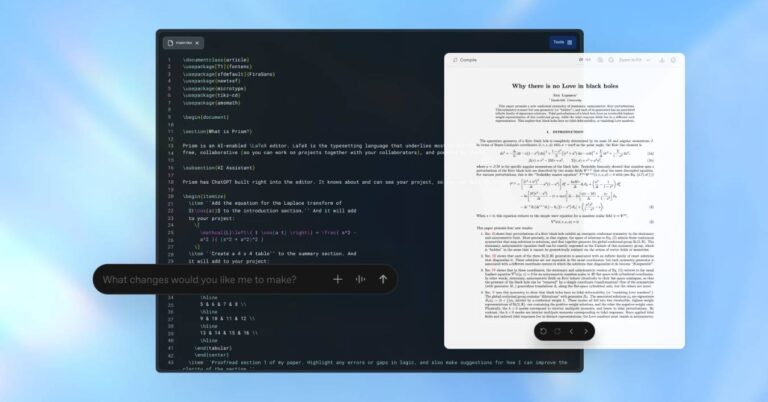
OpenAI launched Prism in January 2026, a free GPT-5.2-powered scientific workspace with unlimited collaborators and LaTeX-native workflows

In January 2026, Moltbook drew tens of thousands of AI agents and over 1 million human observers, as OpenClaw surpassed 100,000 GitHub stars.
Read a comprehensive monthly roundup of the latest AI news!