Key Takeaway
Google is expanding Google Translate with Gemini-powered capabilities that deliver more natural translations and enable real-time audio translation through any headphones, while simultaneously upgrading Gemini’s native audio models across Search, Translate, and developer platforms to support fluid, expressive, and continuous multilingual conversations.
Google Translate Rolls Out Live Translation – Key Points
Gemini-driven context-aware translations (December 2025 rollout)
Google Translate now uses advanced Gemini capabilities to improve translations of idioms, slang, and local expressions. Instead of literal word-for-word output, Gemini parses context to convey intended meaning. For example, the English idiom “stealing my thunder” is translated into an equivalent expression rather than a literal phrase. This update is rolling out starting today across Android, iOS, the web (translate.google.com), and Google Search, including the search-based translation interface.
Initial geographic and language availability
The feature is launching first in the United States and India. It supports English translation to and from nearly 20 languages, including Spanish, Arabic, Chinese, Japanese, and German. Google confirmed this as a staged rollout rather than a global launch, with broader coverage planned as Gemini models mature.
Live translation through headphones (real-time audio)
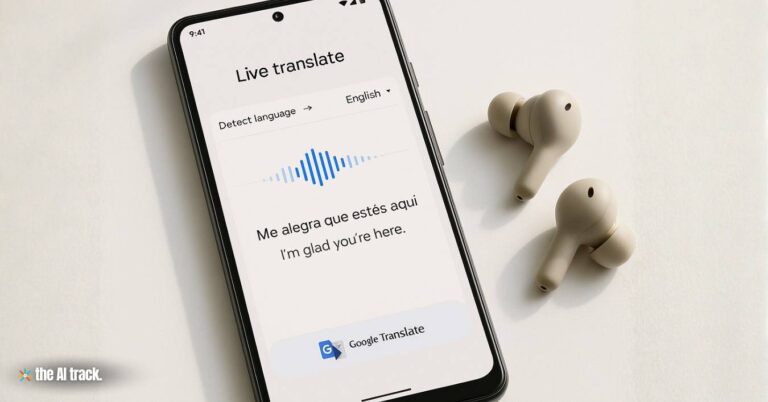
Building on an AI Translate update introduced in August 2025, the Google Translate app now allows users to hear real-time translations directly in their headphones. Users point their phone at a speaker and hear translated speech instantly, without needing specialized hardware. A key product shift is that starting this rollout, live translate sessions no longer require Pixel Buds; the feature is expanding to work with any earbuds or headphones connected to an Android phone.
Powered by Gemini 2.5 Flash Native Audio
The live audio feature uses Gemini 2.5 Flash Native Audio, a model designed for low-latency, speech-to-speech interaction. It preserves tone, emphasis, cadence, pacing, and other vocal cues so translations sound more natural and it is easier to follow who said what. The headphone-based translation is designed to preserve tone and cadence, but it is not positioned as equivalent to the most advanced on-device AI voice translation experiences available on Google’s latest Pixel phones.
Advanced live speech-to-speech translation capabilities
Gemini now natively supports continuous listening and two-way conversation. In continuous listening mode, spoken language in the environment can be translated into a single target language in real time, enabling users to “hear the world” in their own language through headphones. In two-way conversations, Gemini automatically switches output languages depending on who is speaking, allowing seamless back-and-forth exchanges between speakers of different languages (for example, English and Hindi), with one side hearing translations in their headphones while the phone outputs the other language.
Scale, robustness, and multilingual intelligence
Gemini’s live speech translation supports over 70 languages and approximately 2,000 language pairs. Key capabilities include automatic language detection, multilingual input within a single session (useful for mixed-language group conversations), style transfer that preserves intonation/pitch, and noise robustness that filters ambient sound so translation remains usable outdoors or in loud environments. Separately, Google’s Gemini-powered translation model for general Translate usage is also described as supporting over 70 languages.
Supported use cases and interface design
Google highlights use cases such as conversations while traveling, listening to lectures or speeches abroad, navigating multilingual group discussions, and consuming foreign-language TV or movies. In the Translate app, users pair headphones, tap “Live translate,” choose a language or use auto-detect, and view a fullscreen transcription alongside the audio output.
Beta status and expansion timeline
The live headphone translation feature is currently in beta on Android in the US, Mexico, and India. It supports more than 70 languages, with iOS support and additional regions planned. Rollout expectations include iOS expansion in the coming months and continued geographic/product expansion through 2026 as feedback is incorporated and performance is refined. A competitive framing is that comparable live translation on iPhone exists but is tied to Apple’s earbuds ecosystem.
Integration with Google Search Live
Gemini’s native audio model is also rolling out to Search Live in the Google app, enabling back-and-forth voice conversations in AI Mode. Users can ask questions out loud and receive fluid, expressive spoken responses at adjustable speeds—positioned for tasks like DIY guidance or learning a topic quickly (e.g., geology). This rollout is occurring over the course of a week for Search Live users in the US.
Language learning feature upgrades
Google is enhancing language learning tools introduced in August 2025 with improved speech practice feedback and usage streak tracking to encourage consistency. The app also supports more structured personalization by letting users declare skill level and the type of help they want (travel-oriented phrases versus everyday interactions), which is then used to generate tailored listening and speaking exercises.
New translation pairs added
Newly supported directions include English to German and Portuguese, and multiple languages to English, including Bengali, Simplified Mandarin Chinese, Dutch, German, Hindi, Italian, Romanian, and Swedish.
Broader ecosystem and developer availability
Gemini 2.5 Flash Native Audio is now generally available on Vertex AI and offered as a preview via the Gemini API, alongside updated text-to-speech models. Google positions these tools as the foundation for voice agents, customer support systems, and real-time conversational applications, signaling that the same technology behind Google Translate is becoming a core platform capability across consumer and developer surfaces.
Why This Matters
These updates mark a transition from text-centric translation tools to real-time, multimodal language mediation. By combining Gemini’s contextual reasoning, native audio processing, and large-scale multilingual coverage, Google is positioning Translate, Search, and developer APIs around a shared conversational foundation. The practical impact is reduced ecosystem lock-in for Android users (no Pixel Buds requirement), clearer momentum toward always-on translation experiences (continuous listening + two-way switching), and faster adoption paths for businesses building voice agents through Vertex AI and the Gemini API—expanding the role of translation from a utility feature into an always-available layer for travel, education, commerce, and accessibility.
This article was drafted with the assistance of generative AI. All facts and details were reviewed and confirmed by an editor prior to publication.

Uncover the transformative capabilities of text-to-speech apps enhanced by AI technology. The top apps that turn text into lifelike speech.

Explore six free AI music apps that transform music creation and discovery. Isolate vocals, find hidden meanings in lyrics, discover new artists, and more!
OpenAI launched new audio models, while rivals replicate features, signaling industry-wide race amid collapsing operational costs.
Read a comprehensive monthly roundup of the latest AI news!