Key Takeaway
OpenAI introduced Prism, a free, AI-native scientific writing and collaboration workspace powered by GPT-5.2, designed to reduce friction in day-to-day research work by unifying drafting, reasoning, collaboration, and publication workflows—while keeping humans fully in control of scientific judgment.
OpenAI Launches Prism – Key Points
- Product launch and access
- On January 27, 2026, OpenAI launched Prism, a web-based scientific workspace.
- Prism is free for anyone with a ChatGPT personal account and offers unlimited projects and unlimited collaborators.
- OpenAI confirmed that Prism will become available to organizations using ChatGPT Business, Enterprise, and Education plans.
- OpenAI also indicated Prism is planned for ChatGPT Team customers, expanding the organizational rollout beyond Business/Enterprise/Education.
- Prism is positioned as a dedicated “workspace” layer for science, analogous to agent-like coding environments, with emphasis on integrating AI directly into research workflows rather than running separately beside them.
- Core capabilities and model integration
- Prism is deeply integrated with GPT-5.2, OpenAI’s most advanced model for scientific and mathematical reasoning.
- Core functions include:
- Claim assessment and logical consistency checks
- Prose revision with awareness of surrounding text, equations, and citations
- In-context search and incorporation of prior research (including sources such as arXiv)
- GPT-5.2 operates inside the document context, rather than as a detached chat interface.
- Prism adds workflow-native assistance for publication tasks, including finding relevant literature and automating bibliography construction within the manuscript context, while retaining the requirement that researchers verify references and citations.
- Prism is explicitly not designed to conduct autonomous research and requires human guidance, prompting, and verification.
- Strategic positioning and vision
- Kevin Weil, VP of Science at OpenAI, stated during a press call that “2026 will be for AI and science what 2025 was for AI and software engineering.”
- Prism is positioned as a scientific analogue to modern AI coding environments, emphasizing workflow integration, context retention, and reduced cognitive overhead rather than model novelty alone.
- OpenAI frames Prism as its first step toward fully integrated scientific workflows, replacing fragmented toolchains.
- In product demonstrations and interviews, OpenAI emphasized concerns around volume, quality, and trust in scientific outputs as AI becomes more capable, arguing the practical response is direct integration that preserves accountability and keeps researchers in control, rather than invisible background automation.
- Rising scientific usage of ChatGPT
- OpenAI reports that ChatGPT currently receives an average of 8.4 million messages per week related to advanced hard-science topics.
- The company acknowledges that it is difficult to determine what proportion of this usage comes from professional researchers versus students or non-specialists.
- Internally, this growth in scientific usage informed the decision to move beyond generic chat and into purpose-built research environments.
- Evidence of AI-assisted research momentum
- AI models have recently been used in mathematics to address long-standing Erdős problems, combining large-scale literature review with novel applications of existing proof techniques.
- A statistics paper published in December 2025 on arXiv demonstrated the use of GPT-5.2 Pro to generate new proofs for a foundational axiom of statistical theory, with human researchers primarily prompting and verifying results.
- OpenAI highlighted this work in an official blog post as a template for future human–AI collaboration in domains with axiomatic or formal foundations.
- OpenAI also pointed to prior work where advanced reasoning systems helped accelerate analysis in human immune-cell experiments and speed up iteration in molecular biology wet-lab workflows, using these as examples of AI’s broader role across scientific domains beyond writing alone.
- Technical workflow enhancements
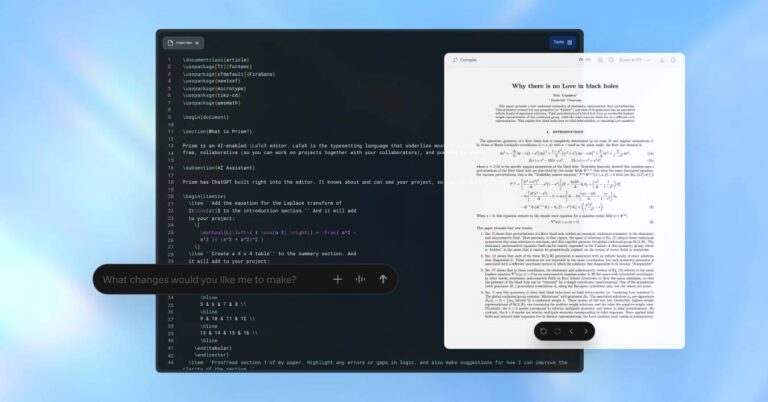
- Prism is LaTeX-native, integrating directly with the dominant open-source standard for scientific typesetting while eliminating the need for local LaTeX installations.
- The platform is cloud-based, reducing environment setup, version conflicts, and manual merging.
- GPT-5.2’s visual reasoning capabilities allow researchers to:
- Convert whiteboard equations or hand-drawn diagrams directly into LaTeX
- Refactor equations, citations, and figures with awareness of how they relate across the entire paper
- Prism is designed to reduce known LaTeX bottlenecks, including time-consuming diagram work (often handled through tools like TikZ), by enabling faster conversion from sketches or whiteboard artifacts into publishable structures.
- A defining feature is full-project context awareness: when users interact with ChatGPT inside Prism, the model has access to the document’s structure, equations, references, figures, and prior edits.
- Prism supports in-place editing (direct document modifications without copying text between tools), reinforcing the “single workspace” design goal.
- Collaboration and scale
- Prism supports real-time collaboration among co-authors, students, advisors, and research teams across institutions and geographies.
- There are no seat limits, lowering barriers for large or distributed research groups.
- Real-time edits, comments, and revisions are reflected immediately, reducing the mechanical overhead of file-based collaboration.
- The design explicitly targets collaboration pain points such as version conflicts and manual merges, shifting effort away from file management toward substantive research and writing.
- Product design emphasis
- Prism builds on Crixet, a mature cloud-based LaTeX collaboration platform that OpenAI acquired and evolved into Prism as a unified product.
- The integrated assistant experience shifted from Crixet’s earlier built-in agent to GPT-5.2 Thinking, bringing scientific reasoning and structured editing directly into the LaTeX-native environment.
- OpenAI emphasizes that while many individual features are possible with advanced prompting in GPT-5.2, deep integration into the writing environment materially changes usability and adoption.
- Optional features such as voice-based editing allow simple document changes without interrupting writing or review.
- Prism’s broader scope extends beyond paper writing into adjacent academic workflows shown in demos, including generating course materials such as graduate-level lesson plans and problem sets, framed as time-saving support for scientists who also teach.
- Crixet is not positioned as a standalone offering going forward, reinforcing Prism as the consolidated product.
Why This Matters
Prism represents a shift from general-purpose AI assistance toward domain-specific, workflow-native scientific tools. By consolidating drafting, reasoning, collaboration, literature handling, and publication preparation into a single context-aware environment, OpenAI is targeting one of the main bottlenecks in modern research: fragmented tooling and constant context switching. If broadly adopted, Prism could shorten research cycles, reduce mechanical overhead, and expand access to high-quality scientific workflows—while preserving human authority over scientific conclusions and maintaining accountability for citations, references, and claims.
This article was drafted with the assistance of generative AI. All facts and details were reviewed and confirmed by an editor prior to publication.

Google’s CURIE, SPIQA, and FEABench set new standards for evaluating LLMs in scientific reasoning, image grounding, and physics-based simulations.

The EU launches €1B AI plans — Apply AI and AI in Science — to boost adoption in industry, science, and public services while strengthening sovereignty.

Dr. Andrew Barto and Dr. Richard Sutton win the Turing Award for their groundbreaking reinforcement learning work that reshaped AI.

AI pioneers Geoffrey Hinton and John Hopfield win the Nobel Prize 2024 for their contributions to artificial neural networks: All you need to know
Second Nobel for AI This Year! The 2024 Nobel Prize in Chemistry goes to Demis Hassabis, John M. Jumper, and David Baker. Everything you need to know.
Read a comprehensive monthly roundup of the latest AI news!