Key Takeaway:
Nvidia becomes first company in history to achieve a $5 trillion market valuation, driven by unprecedented global demand for AI chips, strategic partnerships across industries, and escalating investments in AI infrastructure, 6G, and supercomputing. The milestone reinforces Nvidia’s dominance at the heart of the AI revolution while intensifying concerns of a speculative bubble in technology markets.
The milestone marked also the formal arrival of the Compute Economy. In this new era, computational power has become the world’s most strategic asset, shaping nations’ industrial policy, corporate competition, and the very foundations of productivity. What oil was to the 20th century, compute is to the 21st – and Nvidia now stands at the center of that transformation.
Nvidia Becomes First Company to Reach $5 Trillion Market Value – Key Points
Historic Market Milestone
Nvidia becomes first company to reach a $5.03–$5.05 trillion market capitalization on 29 October 2025, with shares closing at $207.04 and peaking intraday at $207.86. This came just three months after surpassing $4 trillion – the fastest trillion-dollar growth ever recorded. Nvidia’s valuation now exceeds the GDP of India, Japan, and the UK according to IMF data. The company’s stock has risen more than 50% year-to-date, highlighting the scale of investor enthusiasm driving the AI sector.
AI-Driven Growth and Chip Dominance
The surge stems from the global hunger for Nvidia’s graphics processing units (GPUs), originally designed for gaming but now powering the world’s leading AI systems, including ChatGPT and image generators. Since 2023, Nvidia’s chips have become indispensable to AI training and inference infrastructure across industries. CEO Jensen Huang stated that generative AI, once “an interesting experiment,” is now an engine of real profitability for enterprises and governments.
Major Partnerships and Expanding Investments
Huang recently disclosed $500 billion in AI chip orders, revealing multiple large-scale projects:
- A $1 billion investment in Nokia to co-develop 6G technology infrastructure.
- A robotaxi partnership with Uber, integrating Nvidia’s chips into autonomous vehicles.
- A collaboration with the U.S. Department of Energy to build seven AI supercomputers for national research initiatives.
- A $5 billion investment in Intel, supporting the rival’s turnaround while shoring up the U.S. semiconductor supply chain.
Deepening Alliance with OpenAI
Nvidia will invest $100 billion in OpenAI, expanding global compute capacity by at least 10 gigawatts of Nvidia-powered data centers. This partnership creates a tight interdependence, OpenAI’s growth drives Nvidia chip demand, and Nvidia’s capital accelerates OpenAI’s scaling, forming a self-sustaining feedback loop that dominates the AI ecosystem.
Political and Geopolitical Dimensions
U.S. President Donald Trump, who owns up to $1.3 million in Nvidia stock, praised Jensen Huang as an “incredible guy” during the APEC summit in Gyeongju, South Korea. Trump suggested allowing exports of lower-spec Blackwell chips to China and confirmed plans to discuss AI chip trade with Xi Jinping. In August 2025, Trump negotiated a 15% revenue-sharing agreement with Nvidia and AMD to permit advanced chip exports to China and announced a 10% U.S. government stake in Intel valued at $11 billion, signaling a deeper government role in semiconductor strategy.
Broader Market Context and Supply Chain Signals
As Nvidia becomes first company to cross the $5 trillion threshold, the achievement came amid a broader rally in U.S. markets, with the Dow, S&P 500, and Nasdaq all reaching new highs driven by AI investment. Apple and Microsoft each surpassed $4 trillion in valuation, while Amazon launched an $11 billion AI data center project in Indiana. Meanwhile, key supplier SK hynix confirmed that its AI memory chips are fully sold out through 2026, underscoring severe supply constraints.
Bubble Concerns and Systemic Risks
The Bank of England and International Monetary Fund have both warned of a possible AI bubble, warning that inflated stock valuations could destabilize markets if sentiment shifts. The circular flow of capital (Nvidia investing in OpenAI, which buys Nvidia’s chips) is cited as a structural risk. Reports from Axios and Fortune suggest 95% of corporate AI pilots are failing to produce measurable returns. Yet Cathie Wood of ARK Invest, speaking at Saudi Arabia’s Future Investment Initiative, argued that the world is still in the early phase of a “technology revolution,” while acknowledging a near-term risk of correction.
Why This Matters
As Nvidia becomes first company to achieve a $5 trillion valuation, the milestone marks a global inflection point, signaling the shift of economic power from energy and manufacturing to computing power and algorithmic intelligence. It cements U.S. leadership in AI infrastructure, but also highlights growing market fragility, concentration of power, and geopolitical dependencies. Nvidia’s trajectory embodies both the promise of an AI-driven future and the financial risks of speculative overreach in the world’s most transformative industry.
This article was drafted with the assistance of generative AI. All facts and details were reviewed and confirmed by an editor prior to publication.

Explore the vital role of AI chips in driving the AI revolution, from semiconductors to processors: key players, market dynamics, and future implications.

Everything you need to know about the AI chip business and the geopolitical factors shaping the global race for AI (chip) dominance

All you need to know about the critical components of AI infrastructure, hardware, software, and networking, that are essential for supporting AI workloads.
Explore the U.S. government’s strategic push in semiconductor manufacturing, featuring TSMC’s and Samsung’s major investments and technological leaps.
Read a comprehensive monthly roundup of the latest AI news!
The AI Track News: In-Depth And Concise

Alibaba and Nvidia integrate Physical AI into Cloud PAI, expand data centers worldwide, and grow AI spending despite China’s chip restrictions.
Nvidia Reaches 4 Trillion Milestone during intraday trading, fueled by AI chip dominance, record profits, and unmatched growth across global infrastructure.
Nvidia will manufacture AI chips and supercomputers in the U.S., investing $500B through 2029. New factories, robotics, and Omniverse tech power the move.
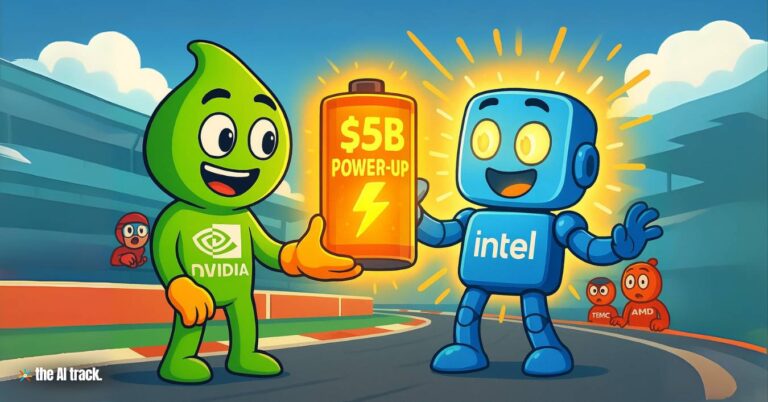
Nvidia will invest in Intel with a $5B stake to co-develop NVLink CPUs and RTX SoCs, strengthening U.S. chip leadership as Intel shares surge 23%.