
Key Takeaway
OpenAI loses three senior executives at the same time it moves to shut down or absorb projects outside its core business. The exits sharpen the picture of a company prioritising enterprise AI, cost control, and execution around ChatGPT and the API.
OpenAI loses three senior executives – Key Points
The Story
OpenAI loses three senior executives in the latest sign of a deeper internal reshaping. Kevin Weil, Bill Peebles, and Srinivas Narayanan all announced their departures on Friday as OpenAI prepared to discontinue Sora and fold OpenAI for Science into other research groups. Together, the moves show a company narrowing its focus around products tied more directly to revenue, especially ChatGPT and the API, while preparing for a possible IPO. The change comes as OpenAI grows rapidly but still expects major losses this year.
The Facts
Three senior OpenAI leaders left on the same day.
Kevin Weil, who had served as chief product officer before moving to OpenAI for Science, Bill Peebles, the head of Sora, and Srinivas Narayanan, the CTO of B2B applications, all announced their exits on Friday.
Kevin Weil joined OpenAI in 2024 and later launched OpenAI for Science.
He previously held leadership roles at Meta and Twitter. OpenAI for Science was positioned as an AI-powered platform aimed at accelerating scientific discovery, and GPT-Rosalind was released one day before Weil’s departure was announced.
OpenAI for Science is no longer continuing as a standalone initiative.
The company said it is decentralizing the unit to bring its work closer to teams building leading model capabilities, products, and infrastructure. Its work is being absorbed into other research groups rather than operating independently.
Sora is being shut down as OpenAI cuts high-cost side projects.
The web and app versions are set to close on 26 April, while the API is scheduled to end on 24 September. OpenAI is also reallocating compute resources as it tightens focus around core products.
Sora struggled to justify its cost despite a high-profile launch.
It reached around one million users at its peak, later fell to fewer than 500,000, and cost roughly $1 million per day to operate. Peebles helped lead the launch that pushed Sora to the top of Apple’s App Store.
Sora also faced intellectual property pressure.
The Motion Picture Association had reported intellectual property infringement on the platform.
OpenAI is cutting what it internally called “side quests.”
These were consumer-facing moonshot projects that no longer fit the company’s sharper enterprise direction or its push to concentrate resources on higher-priority products.
The company is consolidating around ChatGPT, the API, and enterprise growth.
OpenAI is shutting down or restructuring projects that do not contribute directly to its core revenue business, even as it also works toward a broader consumer and enterprise product strategy.
The triple exit extends a much larger leadership exodus.
Of OpenAI’s 11 co-founders, only Sam Altman and Greg Brockman remain.
A long list of senior figures has already left.
Departures named here include Ilya Sutskever, Mira Murati, Bob McGrew, Barret Zoph, John Schulman, Hannah Wong, Julia Villagra, and Lawrence Summers. At least 12 senior executives left in 2025 alone.
Much of that talent has gone to competitors or new startups.
John Schulman moved to Anthropic. Tim Brooks moved to Google DeepMind and then Meta Superintelligence Labs. Shengjia Zhao became chief scientist at Meta Superintelligence Labs, while around seven more researchers also went to Meta. Liam Fedus left to co-found Periodic Labs.
OpenAI says growth is strong, but the cost base remains heavy.
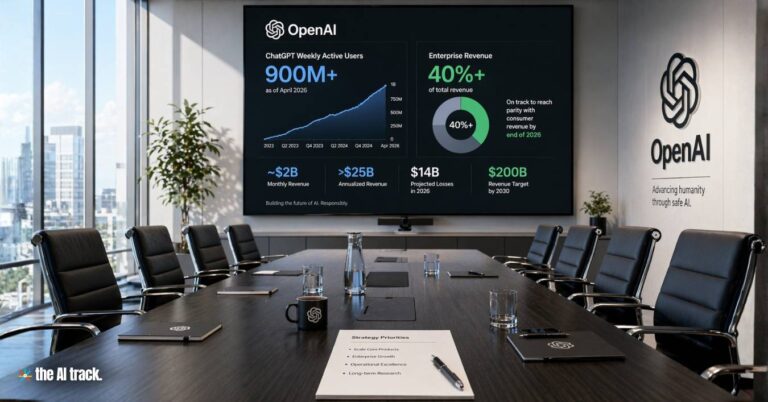
Monthly revenue has reached about $2 billion, annualised revenue is above $25 billion, and ChatGPT has more than 900 million weekly active users. Enterprise revenue now makes up more than 40% of total revenue, but OpenAI still projects $14 billion in losses this year on $25 billion in revenue.
Timeline
- 2023: Bill Peebles joined OpenAI.
- 2024: Kevin Weil joined OpenAI from outside leadership roles at Meta and Twitter.
- 2025: Weil launched OpenAI for Science.
- OpenAI for Science released GPT-Rosalind one day before Weil’s departure was announced.
- Early April: Fidji Simo took medical leave, and Greg Brockman temporarily took over product oversight.
- Earlier this month: Kate Rouch stepped down to focus on cancer recovery, and Brad Lightcap shifted to a role focused on special projects.
- Friday: Kevin Weil, Bill Peebles, and Srinivas Narayanan announced their exits.
- 26 April: Sora web and app versions are scheduled to shut down.
- 24 September: Sora API is scheduled to shut down.
- End of 2026: enterprise revenue is expected to reach parity with consumer revenue.
- 2029: OpenAI expects to become cash-flow positive.
- 2030: OpenAI targets $200 billion in revenue.
Numbers that Matter
- 3 senior executives departed on the same day
- 11 co-founders originally, 2 still remain
- 12 senior executives left in 2025 alone
- ~1 million peak Sora users
- <500,000 later Sora users
- ~$1 million per day to run Sora
- ~$2 billion monthly revenue
- >$25 billion annualised revenue
- >900 million weekly active ChatGPT users
- >40% of revenue now comes from enterprise
- $14 billion projected losses this year
- $115 billion projected cumulative spending through 2029
Industry Reaction
The exits come as competition intensifies across enterprise AI and developer tools. Anthropic is gaining ground with Claude and Claude Code, Google is pushing Gemini across its enterprise suite, and Meta is hiring heavily from OpenAI to staff its superintelligence effort.
Why This Matters
OpenAI loses three senior executives at a moment when the company is becoming a more conventional large technology business built around revenue concentration, product execution, and enterprise customers. That shift will shape which products survive, where resources go, and how OpenAI competes in the next stage of the AI market.
This article was drafted with the assistance of generative AI. All facts and details were reviewed and confirmed by an editor prior to publication.

Mira Murati, CTO of OpenAI, has resigned from her position to pursue personal explorations. Her departure marks a significant shift within the company.

OpenAI debuts GPT-5.3-Codex and Frontier, a centralized agent platform. Features mid-turn steering, 25% speed boost, and a $10M cyber defense fund.
OpenAI followed GPT-5.3 Instant with GPT-5.4 Thinking, adding stronger reasoning, computer use, spreadsheet performance, and professional-work benchmarks.
Read a comprehensive monthly roundup of the latest AI news!