Key Takeaway
Gemini 3 Flash meaningfully upgrades Google’s AI Mode in Search by combining near-instant responses with structured, context-aware synthesis and links, but it still does not replace traditional Google Search for work that depends on primary sources, granular verification, or exhaustive browsing, even as Google positions Flash as a “frontier intelligence” model optimized for speed, efficiency, and broad availability.
Google Launches Gemini 3 Flash – Key Points
- Gemini 3 Flash becomes the default AI engine across Gemini and Search
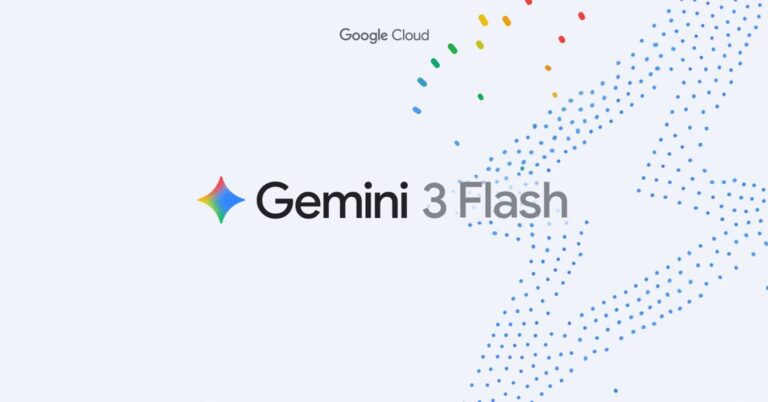
- Google introduced Gemini 3 Flash on 17 December 2025 as part of the Gemini 3 family, framing it as “frontier intelligence built for speed” and rolling it out globally across Google products.
- Gemini 3 Flash becomes the default model for everyday users in the Gemini app (replacing Gemini 2.5 Flash) and begins rolling out as the default model for AI Mode in Google Search worldwide.
- The release builds on Gemini 3’s earlier launch the prior month (including Gemini 3 Pro and a “Deep Think” mode). Google states that, since launch day, its API has been processing over 1 trillion tokens per day, suggesting high demand at scale.
- Access spans consumer, developer, and enterprise channels: Gemini app and AI Mode for consumers; developer preview via Gemini API in Google AI Studio, plus Gemini CLI and Android Studio integrations; enterprise availability through Vertex AI and Gemini Enterprise.
- Product tiering becomes clearer in Search: Gemini 3 Flash is the free default for AI Mode, while additional models can appear as selectable options via dropdowns depending on subscription tier and region.
- Budget-based decision making improves with AI Mode
- A practical comparison using the query “$200 home office upgrades three options” shows the core difference in value.
- Traditional Search surfaces a wide spread of Reddit threads and listicles that can be useful but require manual filtering and price reconciliation to stay within budget.
- AI Mode with Gemini 3 Flash generates three curated bundles (for example: ergonomics, lighting, desk upgrades), each packaged with brief rationale and links, delivering an actionable shortlist instead of an open-ended reading task.
- This is aligned with Google’s framing of AI Mode as a system that parses nuance, breaks goals into components, and returns visually digestible outputs (often with tables and structured sections) while keeping links available for follow-up.
- Technical troubleshooting becomes faster and more actionable
- For troubleshooting queries like “iPhone slow apps on home Wi-Fi troubleshooting,” classic Search provides strong raw materials, official support pages, forum threads, and videos, but the user must hunt for the right sequence of steps.
- AI Mode condenses the likely causes (for example: DNS issues, router congestion, background activity) into a structured checklist with suggested fixes, reducing the time cost of interpreting multiple pages.
- Google positions AI Mode as particularly strong for multi-factor problems because it can consider each part of the question and assemble a coherent action plan while still offering links for verification.
- Qualitative comparisons benefit most from AI summaries
- For subjective, tradeoff-heavy decisions such as “iCloud vs Google Photos vs external drive,” classic Search often yields fragmented perspectives, mixed recency, and advice that assumes one ecosystem choice.
- Gemini 3 Flash produces side-by-side comparisons plus use-case guidance (casual users vs professionals with large photo libraries) and avoids forcing a single universal recommendation.
- The same “organize my options” pattern extends into multimodal workflows: Gemini 3 Flash is positioned to interpret images, audio, and video and turn them into plans or analyses quickly (for example: summarizing video content, analyzing an audio recording, or extracting key points from visual material).
- AI Mode complements but does not replace classic Search
- Traditional Google Search remains superior when the job is source-first: reading primary materials directly, cross-checking contentious claims, or exploring the full breadth of perspectives.
- AI Mode is strongest when time, clarity, and context matter most, especially for planning, troubleshooting, and decision support where a synthesized answer and a clear “next steps” path beats scrolling.
- The practical outcome is a split workflow: AI Mode for speed and structure; classic Search for depth, attribution, and verification.
- Performance and cost claims explain why AI Mode can feel “fast and smart”
- In Google’s institutional release (17 December 2025), Gemini 3 Flash is presented as a model that pushes the quality–speed–cost trade space, with benchmark figures including GPQA Diamond (90.4%), Humanity’s Last Exam (33.7% without tools), and MMMU Pro (81.2%), described as comparable to top-tier models in key areas.
- Google claims Gemini 3 Flash can be 3× faster than Gemini 2.5 Pro (citing third-party benchmarking) and can use 30% fewer tokens on average than Gemini 2.5 Pro on typical traffic—suggesting lower total compute usage for many everyday tasks.
- Published API pricing emphasizes affordability at scale: $0.50 per 1M input tokens and $3.00 per 1M output tokens, with audio input at $1 per 1M input tokens.
- For agentic coding, Google reports a 78% score on SWE-bench Verified, positioning Flash as strong for coding agents and iterative development. Coverage of the family also highlights coding and multimodal workflows such as video analysis, data extraction, and visual Q&A—use cases where quick turns matter.
- In an interview with CNET, Josh Woodward (VP, Google Labs and Google Gemini) framed the goal as landing on the “Pareto frontier” where models are both fast and capable, reducing the usual tradeoff between a slow “big” model and a fast but weaker one. He also described upcoming modes: a slower “thinking” variant and an “auto” mode that switches between fast and thinking behavior based on the query.
Why This Matters
Search is shifting from “find links” to “get a structured answer you can act on.” Gemini 3 Flash accelerates this shift by making AI Mode fast enough to feel like classic Search while adding organization, context, and decision-ready packaging. The model’s reported benchmark strength, token efficiency, and low per-token pricing help explain how Google can scale this experience broadly. The tradeoff remains clear: AI Mode is a productivity accelerator for low-to-medium stakes tasks, while classic Search is still the better tool when correctness depends on reading, comparing, and validating original sources.
This article was drafted with the assistance of generative AI. All facts and details were reviewed and confirmed by an editor prior to publication.
Google launches Nano Banana Pro, a Gemini 3 Pro Image model with accurate infographics, multilingual text, and SynthID AI image verification.

OpenAI has introduced ChatGPT Search enabling real-time information retrieval. This development positions ChatGPT as a direct competitor to Google.
Read a comprehensive monthly roundup of the latest AI news!