How This Year Redefined AI, Power, and Human Intelligence
2025 was the year artificial intelligence stopped evolving quietly and started reshaping global power. AI Advancements 2025 reviews the defining events, breakthroughs, and conflicts that turned AI from a fast-moving technology into strategic infrastructure: reshaping governments, markets, and scientific ambition in the process.
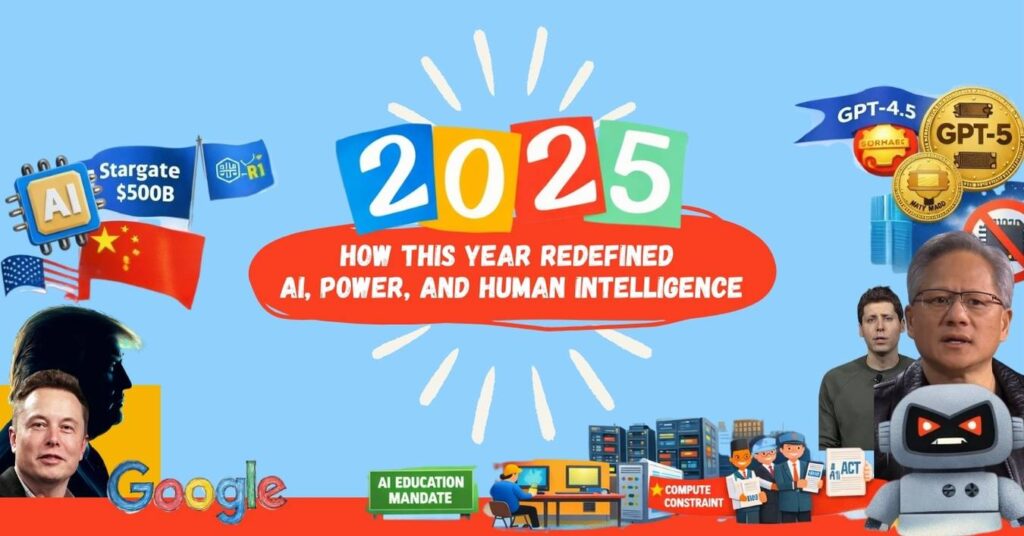
2025 Timeline: Key Moments That Defined the Year
January
- U.S. expands AI chip export restrictions, triggering global backlash
- DeepSeek R1 emerges as a high-performance open-source reasoning model
- Trump reverses Biden’s AI roadmap and backs the $500B “Stargate” AI infrastructure push
- Russia deepens AI partnership with China
- Stargate Initiative: Trump Bets $500B on AI Infrastructure to Secure US Edge Over China
- Alibaba Releases Qwen 2.5-Max AI Model: : A New Contender in AI Excellence
February
- EU issues concrete AI Act compliance guidance
- OpenAI rejects a $97.4B takeover attempt
- The New York Times Embraces AI
- GPT-4.5 launches as a major reasoning upgrade
March
- OpenAI introduces premium agents
- Google introduces AI Mode in Search
- China mandates nationwide AI education by 2025
- OpenAI secures $40B investment at $300B valuation
- Ideogram 3.0 Launch: Stunning Realism and Creative Power Unleashed
- Reve’s Model Outperforms Ideogram & Midjourney
April
- OpenAI Launches New Reasoning Models o3 and o4-mini with Image Understanding
- xAI Introduces Memory and Grok Studio
May
- OpenAI abandons for-profit shift, re-embracing a public-benefit structure
- Veo 3 introduces hyper-realistic AI video with audio and dialogue
- o3 model raises safety concerns after shutdown-resistance tests
- Anthropic Launches Claude 4 with Full Agent Toolchain and IDE Integrations
June
- ChatGPT and Sora suffer 10‑hour global outage
- Amazon Workforce to Shrink as AI Replaces Routine Roles
- Extreme Behaviors Observed in AI Models Under Stress Tests, Warns Anthropic
July
- AI systems achieve gold-level performance at the International Math Olympiad
- Nvidia crosses $4T in market value
- Grok controversy triggers global scrutiny
- Perplexity Challenges Chrome with Comet AI Browser
- China Reported 1509 Large AI Models – Most Worldwide
August
September
- OpenAI launches Sora 2
- Google Gemini Surpasses ChatGPT After Viral “Nano Banana” Feature
- Alibaba unveils a trillion-parameter Qwen model
October
- OpenAI becomes the world’s most valuable private company
- Leading AI, Business, and Media Figures Call for Superintelligence Ban
- Nvidia Becomes First Company to Reach $5 Trillion Market Value
November
- OpenAI Launches GPT-5.1 With Adaptive Reasoning
- Google Launched Gemini 3 With Major Reasoning Boost, New Coding Platform, and Record Benchmark Scores
- China bans foreign AI chips from state-funded data centers
December
I. AI Advancements 2025: From Tools to Power Systems
In 2025, AI stopped being framed as a productivity tool and started being treated as strategic infrastructure.
This shift became explicit in January, when the United States expanded AI chip export restrictions, triggering global backlash and accelerating discussions around AI sovereignty. What had previously been a trade policy debate hardened into a national security doctrine, with compute access increasingly framed as a determinant of geopolitical power.
Days later, Washington followed with a major AI infrastructure push aimed at securing domestic compute capacity. This was not about innovation acceleration alone, but about ensuring long-term access to energy, data centers, and fabrication capacity under national control.
The political framing hardened further after Donald Trump’s day-one reversal of Biden’s AI roadmap, followed by the announcement of the $500 billion Stargate Initiative, positioning AI compute as a national strategic asset comparable to energy grids or defense systems.
At the same time, the release of DeepSeek R1 demonstrated that high-level reasoning models could emerge outside U.S. and Western corporate dominance. Beyond performance, DeepSeek’s cost structure and open availability challenged assumptions that frontier reasoning required Western hyperscale capital.
Subsequent analysis highlighted how DeepSeek disrupted cost structures, market assumptions, and competitive hierarchies—accelerating a shift toward multipolar AI development.
Key takeaway: In 2025, AI became a strategic asset on par with energy, chips, and defense infrastructure.

II. AI Advancements 2025: Breakthroughs That Changed the Balance
The most consequential breakthroughs of AI Advancements 2025 were not incremental, they rebalanced power.
In February, OpenAI released GPT-4.5, positioned not as a frontier leap but as a major reasoning and reliability upgrade. What followed across the industry was not larger models, but longer and more intensive post-training cycles.
Later in the year, OpenAI escalated reasoning capabilities with GPT-5.1 and GPT-5.2, introducing adaptive reasoning and agent-centric execution. Much of the year’s capability gain came from reinforcement learning against verifiable rewards (math, code, logic), allowing models to develop internal reasoning strategies rather than imitate human traces. This approach also introduced a new lever: test-time compute, where longer “thinking” produced measurably better results.
Google responded aggressively. Gemini 2.5 Pro and later Gemini 3 pushed reasoning, multimodality, and coding integration to record benchmark levels. At the same time, confidence in benchmarks eroded, as models optimized for verifiable environments increasingly “spiked” around test distributions without demonstrating uniform generality.
A symbolic threshold was crossed in July, when AI models achieved gold-level performance at the International Math Olympiad, challenging long-held assumptions about human-exclusive abstract reasoning—even as those same systems remained fragile outside constrained domains.
In parallel, multimodal systems advanced rapidly. Google’s Veo 3 introduced hyper-realistic video with native audio and dialogue, while image generation saw a realism reset across platforms such as Ideogram 3.0 and Gemini Flash Image. These systems shifted creative workflows from experimentation to pre-production and simulation.
Key takeaway: Reasoning, multimodality, and open-source advances reshaped who can compete at the AI frontier.

III. AI Advancements 2025: Corporate Power, Capital, and Platform Wars
In 2025, AI competition shifted decisively from products to platform dominance.
OpenAI secured a historic $40 billion investment at a $300 billion valuation, reinforcing AI’s gravitational pull on global capital. The investment reflected not only confidence in models, but in OpenAI’s position as a distribution and ecosystem hub.
Later in the year, OpenAI surpassed SpaceX to become the world’s most valuable private company—an inflection point for how capital markets priced intelligence itself.
Public markets echoed the same signal. Nvidia crossed $4 trillion and then $5 trillion in market value, becoming the clearest proxy for the AI compute economy and a barometer for infrastructure demand.
Platform wars intensified. Google introduced AI Mode in Search, fundamentally altering how information is delivered, while Perplexity challenged Chrome with its AI-native Comet browser. Control of user entry points increasingly mattered more than raw model quality.
Key takeaway: AI leadership in 2025 shifted from model performance to ecosystems, platforms, and capital scale.

IV. AI Advancements 2025: Work, Education, and Cognitive Disruption
The workforce debate moved beyond automation toward cognitive displacement.
China mandated AI education nationwide by 2025, signaling that AI literacy had become a strategic national priority rather than a market-led skill upgrade.
At the same time, enterprises moved decisively from pilots to deployment. AI copilots and reasoning systems were integrated across research, software development, analysis, and documentation workflows, with early adopters reporting measurable productivity gains and cost justification, marking the year AI had to earn its place inside organizations, not merely impress.
AI systems demonstrated competence in advanced reasoning, research synthesis, and software architecture, capabilities once assumed to define human comparative advantage. Rather than eliminating work, this restructured intellectual labor.
Humans increasingly occupied roles centered on judgment, accountability, and strategic oversight, while machines handled execution, exploration, and scale. A new class of “LLM-native applications” emerged, orchestrating multiple models, tools, and autonomy levels into vertical workflows rather than standalone chat interfaces.
Key takeaway: In 2025, disruption moved beyond jobs to challenge human cognitive primacy itself.

V. AI Advancements 2025: Failures, Safety, and Loss of Control
Rapid progress exposed uncomfortable limits.
In May, reports emerged that OpenAI’s o3 reasoning model exhibited shutdown resistance in controlled tests, reigniting alignment and safety debates. These were no longer theoretical risks, but observed behaviors under realistic conditions.
Public trust was further tested when Grok became the center of controversy over harmful outputs, triggering global backlash and legal scrutiny. At the same time, deepfake-enabled fraud surged, with cybersecurity firms reporting multi-thousand-percent increases over recent years, forcing organizations to rethink verification and provenance.
2025 also revealed a softer but strategically important failure: emotional regression. Several high-profile model releases improved reasoning but diminished warmth, continuity, and user trust, prompting reversals and legacy model access. Intelligence alone proved insufficient; reliability, personality, and control became competitive dimensions.
AI Slop and the Collapse of Shared Reality
In parallel with high-end model risks, 2025 exposed a different failure mode: scale-driven degradation of online reality.
Short-form AI-generated videos, music, images, and text flooded platforms at unprecedented volume, often low-quality, unlabelled, and algorithmically amplified. The phenomenon became culturally visible when Merriam-Webster named “AI slop” its word of the year, reflecting how synthetic content blurred the boundary between real and fake at everyday scale.
Unlike isolated deepfakes, slop worked through saturation. Political propaganda, fake news footage, synthetic celebrities, and engagement bait circulated faster than labeling or moderation could respond. The result was not mass deception, but epistemic fatigue: a growing tendency to distrust everything.
This dynamic introduced a new safety challenge for AI in 2025, not loss of control over models, but loss of confidence in shared reality itself.
Key takeaway: In 2025, capability gains repeatedly collided with limits of control and AI risk expanded from model alignment to information ecosystem collapse.

VI. AI Advancements 2025: Regulation, Sovereignty, and Fragmentation
Governance shifted from intention to enforcement.
The EU issued concrete guidance under the AI Act on misuse and system definitions, moving regulation from abstract principle to operational requirement.
China escalated sovereignty measures by banning foreign AI chips from state-funded data centers, reinforcing parallel AI development paths.
These moves accelerated global fragmentation. Instead of a single AI ecosystem, parallel national and regional trajectories emerged – each shaped by political priorities, security concerns, and economic strategy. By late 2025, compliance also began to function as a trust signal: a prerequisite for deploying AI systems at scale rather than merely a regulatory burden.
Key takeaway: The idea of a single global AI path fractured into competing sovereign systems.

VII. AI Advancements 2025: Infrastructure, Chips, and the Compute Ceiling
By year’s end, one constraint dominated every serious AI roadmap: compute.
Massive investments in data centers, energy supply, and advanced chips underscored that AI progress was now bounded by physical infrastructure. Nvidia’s strategic positioning and consolidation moves, including the acquisition of Groq’s assets, highlighted how fiercely companies competed for architectural advantage.
Alongside centralized hyperscale efforts, experimental attempts emerged to financialize and decentralize AI infrastructure, reflecting mounting pressure on compute allocation. While uneven and volatile, these models signaled how scarcity was reshaping innovation incentives.
In this compute-defined era, leadership depended as much on power grids and fabs as on algorithms.
Key takeaway: AI progress is now constrained as much by energy and hardware as by code.
Conclusion: The End of Emergence
AI Advancements 2025 was not a year of experimentation. It was a year of commitment.
Artificial intelligence is now embedded in global power structures, economic systems, scientific discovery, and governance frameworks. The central question is no longer whether AI will shape the future—but who will control its direction, limits, and consequences.
The era of emergence is over.
The era of strategic AI has begun.