Key Takeaway
The NVIDIA Rubin GPU, introduced as part of the Vera Rubin platform at CES 2026, represents NVIDIA’s pivot from training-centric AI toward large-scale, cost-efficient inference, anchoring the company’s expansion into robotics, autonomous vehicles, and what it defines as “physical AI.”
NVIDIA Introduces Rubin GPU and Vera Rubin Platform – Key Points
NVIDIA Rubin GPU and the Vera Rubin Platform Announced at CES 2026
At CES 2026 in Las Vegas, Jensen Huang, CEO of NVIDIA, unveiled the company’s next-generation computing roadmap under the Vera Rubin platform. The platform combines a new Vera CPU with the Rubin GPU, and is positioned to succeed the Blackwell generation in the second half of 2026.
Unlike previous NVIDIA launches centered on accelerating the training of ever-larger foundation models, the Vera Rubin platform was framed around a different constraint: the rising cost and scalability limits of AI inference. Huang emphasized that the next phase of AI growth depends less on building new models and more on running existing ones efficiently, continuously, and at predictable cost.
Rubin GPU Performance Claims and Inference Economics
During the keynote and supporting materials, NVIDIA stated that systems based on the Rubin GPU are designed to achieve:
- Up to 10× lower inference cost per token, depending on workload and configuration
- Substantial inference-throughput gains over Blackwell-based systems, with system-level comparisons varying by deployment
NVIDIA’s messaging consistently focused on inference economics rather than peak training benchmarks. The company highlighted that most commercial AI value is now generated during deployment, when models are queried repeatedly, making cost per token a defining metric for viability.
Why Inference Cost Has Become the Bottleneck
As AI systems transition from pilots to production, inference workloads dominate operational spending. Continuous agents, copilots, and embedded AI systems must respond in real time, often under tight latency and power constraints. Even modest efficiency gains compound rapidly at scale.
The Rubin GPU is therefore positioned not as a raw performance play, but as an architectural response to this economic pressure. NVIDIA framed the platform as infrastructure for “always-on” AI, rather than episodic model training.
The Shift Toward Physical AI
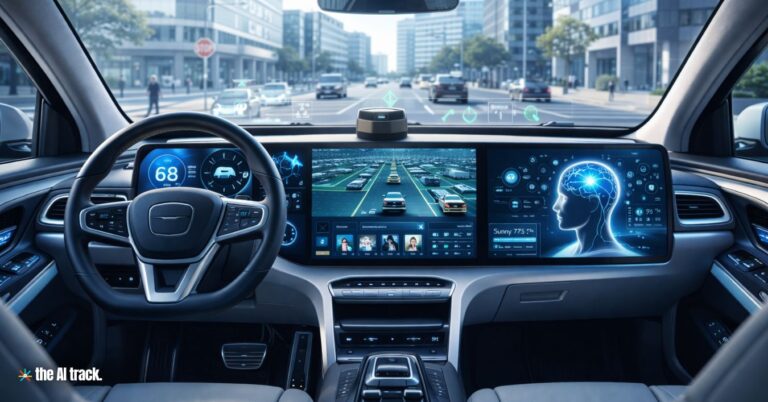
A central narrative of the CES 2026 keynote was NVIDIA’s push toward “physical AI” – systems that sense, reason, and act in the physical world. Huang argued that advances in perception models, simulation, and inference hardware are converging, enabling AI to move beyond screens and into machines.
Physical AI use cases highlighted by NVIDIA included:
- Autonomous and assisted-driving vehicles
- Industrial and warehouse robotics
- Intelligent machines operating at the edge
These applications impose constraints distinct from cloud-based AI, including deterministic latency, energy efficiency, and cost predictability. NVIDIA positioned the Rubin GPU as a foundational component for meeting these requirements.
“The ChatGPT Moment for Physical AI”
During the presentation, Huang stated that “the ChatGPT moment for physical AI is here,” framing robotics and autonomy as approaching a similar inflection point in adoption. The comparison was used to signal NVIDIA’s expectation of accelerated deployment, rather than to equate current physical AI capabilities with mature language models.
Alpamayo: Open Models for Autonomous Systems
Alongside the Vera Rubin platform, NVIDIA introduced Alpamayo, an open-source family of AI models and tools designed for autonomous vehicle perception and decision-making. Alpamayo is intended to reduce development friction for automotive and robotics developers while remaining optimized for NVIDIA hardware and software stacks.
The open-source positioning marks a strategic evolution for NVIDIA. Rather than relying solely on proprietary frameworks, the company is increasingly pairing open models with tightly integrated hardware acceleration, reinforcing its platform advantage while encouraging ecosystem adoption.
Automotive Partnerships and Demonstrations
NVIDIA highlighted expanded collaboration with Mercedes-Benz, noting that the upcoming CLA vehicle platform will integrate NVIDIA AI technologies for advanced driver assistance and in-vehicle intelligence. The announcement reinforces NVIDIA’s focus on automotive as a primary deployment environment for physical AI.
On stage, NVIDIA also featured robotic demonstrations inspired by BD-1 from the Star Wars franchise. These appearances generated significant attention and social media engagement, functioning primarily as symbolic representations of embodied AI rather than technical disclosures about the Rubin GPU itself.
Competitive Context and Market Implications
The introduction of the Rubin GPU within the Vera Rubin platform comes amid increasing competition from custom inference chips developed by hyperscalers, inference-focused ASICs, and rival GPU vendors. NVIDIA’s strategy centers on preserving differentiation through a vertically integrated stack encompassing hardware, software, models, and developer tools.
By emphasizing inference cost reduction and physical AI applications, NVIDIA is also expanding its total addressable market beyond data centers into vehicles, factories, logistics, and public infrastructure, areas where compute efficiency and reliability are critical.
Open Questions Ahead of Deployment
While the platform positioning is clear, several elements remain to be validated as Rubin approaches production:
- Independent benchmarks confirming cost and throughput claims
- Detailed power-efficiency and pricing data
- Migration complexity for existing Blackwell-based deployments
The second half of 2026 will be decisive in determining whether the Rubin GPU delivers a structural shift in AI economics or primarily defines NVIDIA’s next roadmap phase.
Why This Matters
The Vera Rubin platform reflects a broader transition in artificial intelligence, from building models to operating them at scale. By prioritizing inference cost and physical deployment, NVIDIA is aligning its roadmap with where AI adoption is expanding next: real-world systems that must function continuously, reliably, and economically. If the platform meets its stated goals, it could materially accelerate the spread of AI into transportation, industry, and robotics.
This article was drafted with the assistance of generative AI. All facts and details were reviewed and confirmed by an editor prior to publication.
Nvidia becomes first company to reach $5T market cap, driven by $500B chip orders, major deals with Intel, OpenAI, and Nokia, and record AI-fueled growth.
Nvidia agreed in December 2025 to a $20 billion Groq deal that moves most staff and core AI inference assets to Nvidia while keeping Groq independent.
Read a comprehensive monthly roundup of the latest AI news!