Key Takeaway
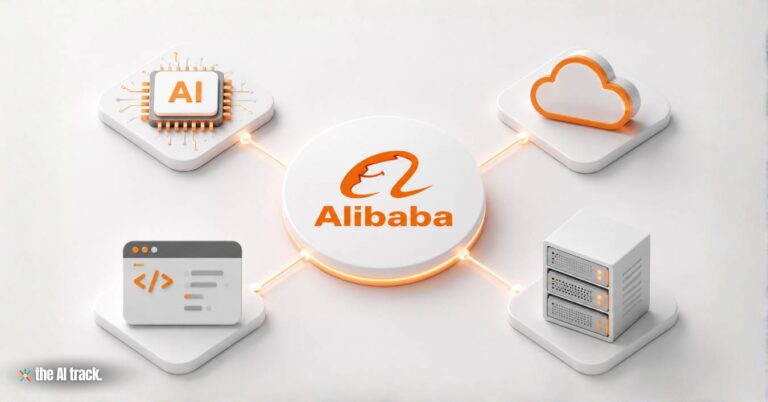
Alibaba launched Qwen3.5, positioning it as a lower-cost, higher-performance AI model built for the “agentic AI era,” combining multimodal reasoning, open-weight deployment, and autonomous task execution, while intensifying competition with ByteDance, DeepSeek, Zhipu AI, and leading U.S. AI firms.
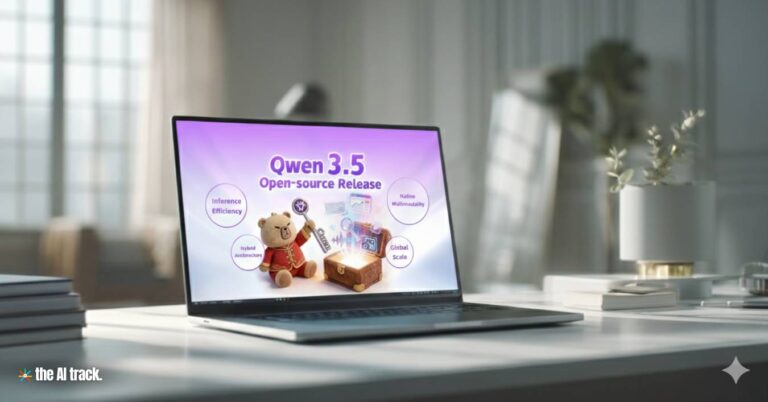
Alibaba Unveils Qwen3.5 – Key Points
Official Launch and Strategic Timing (February 16, 2026)
Alibaba unveiled Qwen3.5 in Beijing, making both open-weight and hosted versions available on the eve of the Chinese New Year. The release followed a week of multiple AI launches in China and came shortly after Alibaba introduced a separate AI model designed for robotics. The company framed Qwen3.5 as purpose-built for the “agentic AI era,” targeting developers and enterprises seeking higher capability per unit of inference cost. The first open-weight model in the series is explicitly named Qwen3.5-397B-A17B, positioned as a native vision-language model optimized for reasoning, coding, agent workflows, and multimodal understanding.
Open-Weight and Hosted Deployment Options
Qwen3.5 was released in two formats: an open-weight version, allowing developers to download, fine-tune, and deploy the model on their own infrastructure, and a hosted version (Qwen-3.5-Plus) available via Alibaba Cloud’s Model Studio. The hosted Qwen3.5-Plus is described as shipping with a 1M context window by default, plus official built-in tools and adaptive tool use, aligning with the product positioning around long-horizon workflows and tool-using agents.
Scale and Technical Specifications
The open-weight model includes 397 billion parameters, variables that shape how the AI system learns and reasons. Qwen states the model uses a hybrid architecture that combines linear attention (via Gated Delta Networks) with a sparse mixture-of-experts (MoE) design. A key efficiency claim is that despite 397B total parameters, only 17B parameters are activated per forward pass, aiming to optimize speed and cost while retaining frontier-level capability. While smaller than Alibaba’s previous flagship model, the company stated that internal benchmark tests show significant performance gains. Comparisons indicated parity or outperformance versus leading U.S. models including GPT-5.2, Claude Opus 4.5, and Gemini 3 Pro, though these benchmark results were self-reported.
Performance and Cost Efficiency
Alibaba stated Qwen3.5 is 60% cheaper to use than its predecessor and eight times better at processing large workloads. In addition to the cost narrative, Qwen reports concrete throughput gains under different context settings: at 32k/256k context length, decoding throughput is stated as 8.6× / 19.0× that of Qwen3-Max, with comparable performance, and 3.5× / 7.2× that of Qwen3-235B-A22B. The blog also claims a 250k vocabulary (up from 150k) that improves encoding/decoding efficiency by 10–60% across most languages, reinforcing the “more with the same compute” message.
Multimodal and Agentic Capabilities
Qwen3.5 introduces native multimodal capabilities, enabling simultaneous understanding of text, images, and video within a single system. It also supports enhanced coding and “visual agentic capabilities,” allowing the model to independently take actions across mobile and desktop applications. The model is positioned as compatible with open-source AI agents such as OpenClaw, and is described as capable of thinking, searching, and using tools as an agent in multimodal contexts. Qwen additionally describes tool-enabled multimodal reasoning workflows (e.g., using a code interpreter and image search during reasoning) to reduce errors and support verification steps.
Language Expansion and Global Ambitions
The new models support 201 languages and dialects. The Qwen technical post describes this as an expansion from 119 to 201; other reporting has cited a lower baseline for earlier generations, so the safest precise statement is that language support is now 201 and the company reports a substantial increase versus prior releases. Industry analysts, including Marc Einstein of Counterpoint Research, indicated that this multilingual expansion reflects Alibaba’s global ambitions beyond China’s domestic market.
Domestic Competition: ByteDance, DeepSeek, Zhipu AI
The launch coincided with a surge of competing releases. On February 14, 2026, ByteDance upgraded its chatbot with Doubao 2.0, serving nearly 200 million users. Zhipu AI also introduced enhanced models aimed at agentic functionality. Meanwhile, DeepSeek, which triggered global tech market volatility in 2025, is expected to release a next-generation model in the coming days, heightening investor anticipation.
Global Context: U.S. Agent Push
The agentic focus mirrors developments in the U.S. Following Anthropic’s rollout of new agent tools in February 2026, OpenAI CEO Sam Altman announced that the creator of OpenClaw would join OpenAI. In January 2026, Google DeepMind CEO Demis Hassabis stated that Chinese AI models were only “months” behind Western rivals, underscoring narrowing performance gaps.
User Growth Strategy and Ecosystem Integration
Earlier in February 2026, Alibaba ran a coupon campaign inside the Qwen chatbot enabling direct purchases of food and beverages. Despite technical glitches, the campaign reportedly resulted in a seven-fold increase in active users, demonstrating Alibaba’s strategy of embedding AI within e-commerce and consumer workflows. Product experience is presented as multi-mode (Auto/Thinking/Fast), with “Auto” positioned as adaptive thinking plus tool use.
Strategic Context and Iteration Cycle
In January 2025, Alibaba released **Qwen 2.5-Max**, claiming superiority over a DeepSeek flagship model. Qwen3.5 represents continued rapid iteration amid a market reshaped by DeepSeek’s breakthrough in 2025 and intensifying cost competition. The company signaled additional open-weight releases during the Chinese New Year period, suggesting an accelerated product cadence. Qwen’s roadmap language also shifts emphasis from pure model scaling to system integration: persistent memory for cross-session learning, embodied interfaces, self-improvement mechanisms, and “economic awareness” to operate under real-world constraints.
Why This Matters
Qwen3.5 reflects a structural shift in China’s AI industry from chatbot functionality toward autonomous, multimodal AI agents capable of executing real-world digital tasks. The combination of open-weight access, long-context deployment (with 1M context on the hosted Plus model), multilingual expansion to 201 languages, cost reduction (60%), and MoE efficiency (397B total with 17B activated per forward pass) indicates a strategic move to capture enterprise and global markets. With Alibaba, ByteDance, Zhipu AI, DeepSeek, OpenAI, Anthropic, and Google DeepMind all emphasizing agent capabilities in early 2026, the competitive frontier is rapidly moving toward automation, compute efficiency, and platform integration rather than incremental conversational upgrades. If the infrastructure claims hold, such as FP8 pipeline savings (around 50% activation memory reduction and >10% speedup) and asynchronous RL framework gains (3×–5× end-to-end speedup), the practical effect is faster iteration and cheaper agent deployment, which raises the pressure on SaaS-style workflows that can be automated by tool-using models.
This article was drafted with the assistance of generative AI. All facts and details were reviewed and confirmed by an editor prior to publication.

ByteDance released Doubao 2.0 on February 14, 2026, claiming GPT-5.2-level reasoning at 10x lower cost as competition with DeepSeek and Alibaba intensifies.
Explore the key differences between open source vs closed source AI, including their benefits, challenges, and implications for the future of AI

Seedance 2.0 launched in February 2026 with 15-second AI video and audio generation, prompting legal action from Disney and criticism from the MPA.

Autonomous AI Agents are moving from pilots to production. Updated 2026 analysis of Microsoft, NVIDIA, Google, Anthropic, use cases, risks, and governance.
Read a comprehensive monthly roundup of the latest AI news!