Key Takeaway
Huawei could take the largest share of China’s AI chip market in 2026 as Nvidia’s leading-edge China sales remain constrained and H200 shipments stay stalled by conflicting U.S. and Chinese regulatory requirements. The shift is being driven by Beijing’s push for domestic AI hardware, Huawei’s Ascend roadmap, DeepSeek V4 demand, and rising inference computing needs.
Huawei May Take 60% of AI Chip Market in China – Key Points
The Story
Huawei is on track to become China’s leading AI chip supplier in 2026 as Chinese companies seek domestic alternatives to Nvidia. The company’s AI chip revenue could rise at least 60%, from $7.5 billion in 2025 to roughly $12 billion in 2026, helped by orders from major Chinese technology firms including Alibaba, ByteDance and Tencent. Demand has accelerated after DeepSeek V4 was optimized for Huawei’s Ascend architecture and CANN software framework. Nvidia’s H200 chips have U.S. clearance for China sales, but shipments remain stalled by conflicting rules from Washington and Beijing.
The Facts
Huawei could take 60% of China’s domestic AI market by the end of 2026.
Market estimates suggest Huawei’s share could reach 60% by the end of 2026 as Nvidia’s leading-edge AI chip sales remain limited in China.
Huawei expects a major revenue jump in AI chips.
Huawei expects AI processor revenue to reach roughly $12 billion in 2026, up from $7.5 billion in 2025, based on orders already received from major Chinese tech firms.
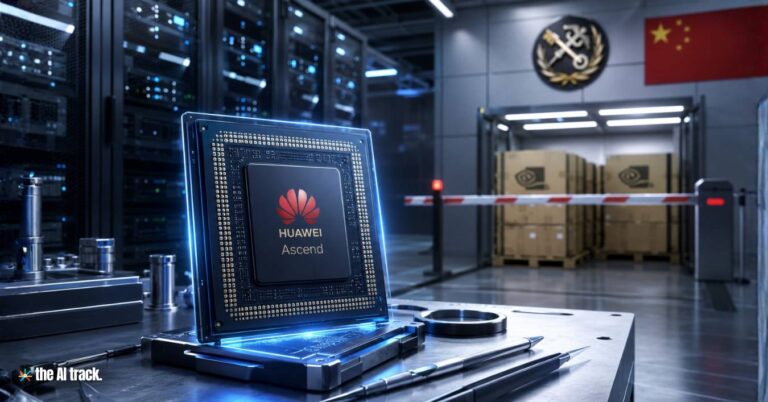
The Ascend 950PR is now the main procurement target.
Huawei’s Ascend 950PR has become the primary chip target for China’s largest technology companies, with Alibaba, ByteDance and Tencent among the firms linked to demand.
The Ascend 950PR entered mass production in March.
The chip is designed to work with advanced models such as DeepSeek V4 and is reported to deliver up to 2 PFLOPs of performance with 128 GB of locally produced memory.
Huawei’s roadmap extends beyond the 950PR.
Huawei is preparing the training-focused Ascend 950DT for later this year, followed by the Ascend 960 and Ascend 970 through 2028.
DeepSeek V4 has accelerated demand.
DeepSeek V4 was optimized for Huawei’s Ascend architecture and CANN software framework, with Huawei’s Ascend SuperNode product line adapted for V4 inference at launch. Alibaba Cloud and Tencent Cloud deployed V4 services within hours of release.
The 950PR is built for inference efficiency.
The chip supports FP8, a compressed numerical format that can improve operations per second and lower per-query costs. DeepSeek V4 uses a Mixture-of-Experts design with up to 1 trillion total parameters but activates about 37 billion per inference pass, favoring inference-efficient hardware.
Nvidia’s China position has collapsed.
Nvidia CEO Jensen Huang said in the Special Competitive Studies Project’s “Memos to the President” podcast that the company’s share in China had dropped to zero.
H200 shipments remain stuck.
Nvidia received U.S. licenses to sell H200 chips to China and secured orders, but no H200 units have shipped. U.S. regulators require Chinese orders to be used only inside China, while Beijing has instructed domestic firms to limit Nvidia hardware to overseas operations.
Huawei relies heavily on SMIC.
SMIC manufactures the 950PR on its N+3 process, a 7nm-class node built without EUV lithography. Huawei is targeting roughly 750,000 950PR units this year, but demand is expected to exceed supply.
Manufacturing remains a serious constraint.
SMIC’s 7nm-class yields remain weaker than TSMC’s equivalent nodes, and JP Morgan estimates the cycle time from wafer start to finished Ascend processor at about eight months, compared with about three months for similar TSMC nodes.
Huawei’s 950PR beats Nvidia’s H20 but still trails higher-end Nvidia chips.
The 950PR outperforms Nvidia’s restricted H20 by an estimated 2.8 times, though that figure cannot be directly verified because Hopper-era hardware does not support FP4 natively. The 950PR still trails the H200 in compute and memory bandwidth.
Numbers that Matter
- 60%: Huawei’s projected share of China’s domestic AI market by the end of 2026
- $12 billion: Huawei’s expected AI chip revenue in 2026
- $7.5 billion: Huawei’s AI chip revenue in 2025
- March 2026: Ascend 950PR mass production start
- Q4 2026: Planned launch window for the training-focused Ascend 950DT
- 2028: Roadmap window for Ascend 960 and Ascend 970
- 750,000: Huawei’s 950PR production target for 2026
- 37 billion: Approximate number of parameters activated per DeepSeek V4 inference pass
- $67 billion: Morgan Stanley’s projected size of China’s AI chip market by 2030
- 86%: Morgan Stanley’s expected domestic supplier share of China’s AI chip demand by 2030
Risks / Limitations
Huawei’s biggest constraints remain manufacturing scale, yields, power efficiency, access to advanced chipmaking machinery and software maturity. The Ascend 950PR is gaining traction for inference, but it still trails Nvidia’s H200 in compute and memory bandwidth, while Huawei’s CANN ecosystem remains much smaller than CUDA despite having more than four million developers. Supply is also constrained by SMIC’s advanced-node capacity, long production cycle times and uncertainty around domestic HBM ramp-up.
Market Timing
Huawei’s opportunity is emerging as Nvidia faces tighter access to China. Nvidia’s H20 previously helped it serve the Chinese market under U.S. export controls, but Beijing restricted its import last year. The H200 was meant to restore access after U.S. approval, yet conflicting U.S. and Chinese requirements have left shipments stalled while Chinese cloud providers move toward Ascend procurement.
What to Watch Next
The key test is whether Huawei can scale 950PR production, improve supply through SMIC-linked capacity expansion and bring the Ascend 950DT to market in the fourth quarter.
Why This Matters
China’s AI chip market is moving from Nvidia-dominated supply toward a domestic hardware stack led by Huawei. If Huawei can scale production and make inference workloads run efficiently on Ascend chips, it could become the central supplier for Chinese AI companies even without fully matching Nvidia’s highest-end performance.
This article was drafted with the assistance of generative AI. All facts and details were reviewed and confirmed by an editor prior to publication.

Explore the vital role of AI chips in driving the AI revolution, from semiconductors to processors: key players, market dynamics, and future implications.

Huawei outlines Atlas SuperPoDs and a 2026–2028 chip roadmap, aiming for million-chip clusters and a domestic alternative to Nvidia.

China bans foreign AI chips from all state-funded data centres (accorging to Reuters), reshaping AI supply chains and hurting Nvidia, AMD, Intel while boosting Huawei.

The U.S. restricts TSMC’s advanced AI chip exports to China, targeting Huawei and tightening control over semiconductor technology access.

Everything you need to know about the AI chip business and the geopolitical factors shaping the global race for AI (chip) dominance
Read a comprehensive monthly roundup of the latest AI news!