Key Takeaway
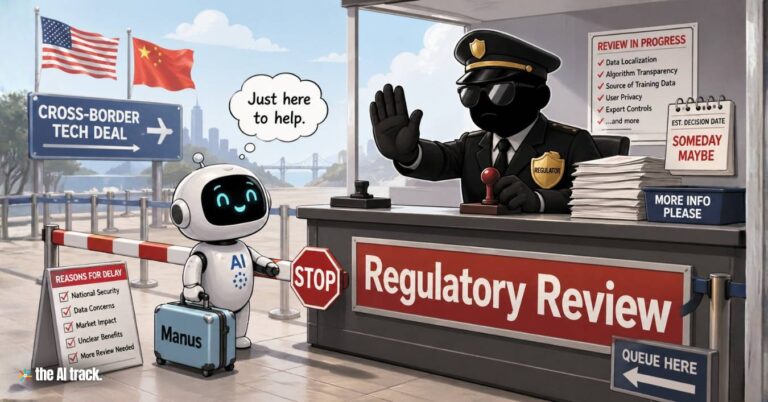
Chinese regulators have blocked Meta’s estimated $2 billion acquisition of AI startup Manus, raising the stakes for cross-border AI deals and putting pressure on Meta’s agentic AI strategy.
Deal for AI startup Manus Blocked – Key Points
The Story
Meta’s acquisition of AI startup Manus has been blocked by China’s National Development and Reform Commission after a months-long review. The deal, announced in December 2025 and estimated at around $2 billion, was intended to bring Manus’ autonomous AI agent technology into Meta AI and Meta’s wider product ecosystem. The NDRC said it would prohibit foreign investment in the Manus project and required the parties involved to withdraw the transaction.
The Facts
Chinese regulators blocked the deal.
China’s National Development and Reform Commission said it would prohibit foreign investment in the Manus project “in accordance with laws and regulations” and required both parties to withdraw the acquisition transaction.
The acquisition was valued at around $2 billion.
Meta announced the deal in December 2025. The acquisition was reported at roughly $2 billion, with some reporting placing the range at about $2 billion to $3 billion.
Meta wanted Manus’ AI agents for Meta AI and its platforms.
The acquisition was intended to bring a “leading agent to billions of people,” accelerate AI innovation for businesses, and integrate advanced automation into consumer and enterprise products, including Meta AI.
Meta says the transaction followed the law.
A Meta spokesperson said the transaction “complied fully with applicable law” and added that the company anticipated “an appropriate resolution to the inquiry.”
AI startup Manus develops general-purpose autonomous AI agents.
Its technology is designed to plan, execute and complete tasks independently based on instructions. Its first general AI agent, launched in March last year, was described as able to handle complex tasks such as market research, coding and data analysis.
Manus launched in Beijing and is now based in Singapore.
Manus was founded by Chinese engineers and relocated its headquarters from China to Singapore around mid-2025. Its founders previously established the parent company Butterfly Effect in Beijing in 2022.
The company was founded by Xiao Hong, Yichao Ji and Tao Zhang.
Manus CEO Xiao Hong reportedly took an executive role after the deal, while around 100 Manus employees had already moved into Meta’s Singapore offices as of March.
Manus does not build its own AI model.
The company develops an agent framework that operates on top of existing Western large language models.
China had already opened a formal review.
In January, China’s Ministry of Commerce said it would assess the acquisition under rules covering export controls, technology import and export, and overseas investment.
The deal drew scrutiny in both China and Washington.
Beijing has increased pressure on Chinese AI founders moving operations offshore, while US lawmakers have raised concerns about American capital flowing into Chinese-linked AI companies.
AI startup Manus had attracted major investor and revenue attention.
The company raised $75 million in a round led by US venture firm Benchmark in April last year and said it had passed $100 million in annual recurring revenue in December, eight months after launching a product.
The decision comes amid wider US-China AI tensions.
China and the US dominate frontier AI development, with all of the top 20 best-performing models produced by developers from one of the two countries.
Background / Context
Meta has been pouring billions of dollars into AI while restructuring parts of its workforce. The Manus deal was viewed as a natural fit because Meta CEO Mark Zuckerberg has been pushing the company’s AI development, especially as autonomous agents become a major focus for consumer and business platforms. AI startup Manus was also promoted in China as a potential next DeepSeek after releasing what it described as the world’s first general AI agent.
What to Watch Next
The next issue is whether Meta can reach a resolution with Chinese regulators or whether it must fully unwind the deal. The case may also become a reference point for future AI acquisitions and investment deals involving companies with Chinese roots, especially those using Singapore relocation structures to reduce exposure to Beijing and Washington scrutiny.
Why This Matters
The blocked acquisition of AI startup Manus shows how AI deals are becoming entangled with national technology controls, foreign investment rules and geopolitical competition. For users, the immediate impact may be limited, but the decision could influence how quickly major platforms like Meta integrate autonomous AI agents into everyday products.
This article was drafted with the assistance of generative AI. All facts and details were reviewed and confirmed by an editor prior to publication.

Meta launched Muse Spark AI with multimodal reasoning, image understanding, and Contemplating mode in Meta AI and meta.ai.

Meta and AMD announce a 60 billion dollar, five-year AI infrastructure partnership covering up to 6 gigawatts of customized GPUs starting in 2H 2026.

Meta acquires Moltbook, the viral AI agent social network built on OpenClaw that sparked debate about autonomous AI communication online.
Meta – Nvidia deal scales to millions of Nvidia GPUs and adds standalone Grace CPUs, plus confidential computing designed for WhatsApp AI processing.
Read a comprehensive monthly roundup of the latest AI news!