Key Takeaway
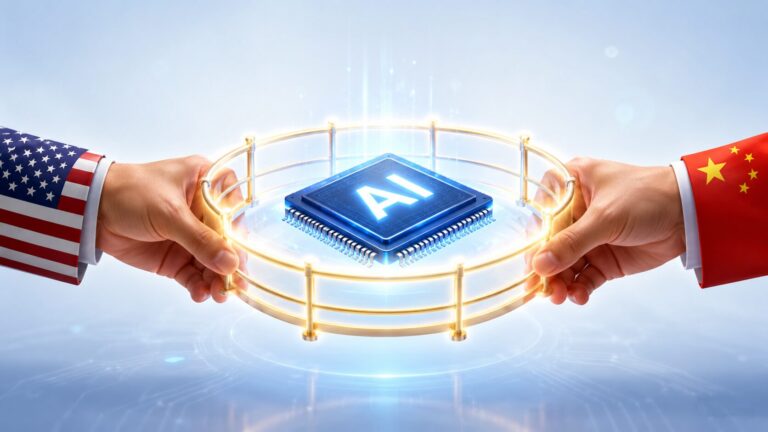
President Donald Trump said the U.S. and China discussed possible cooperation on AI guardrails during talks with Chinese President Xi Jinping in Beijing. The comments come as Washington weighs AI safety risks, including cyber, biological and nuclear concerns, while Nvidia’s H200 chip exports to China remain unresolved.
Trump and Xi Discuss AI Guardrails – Key Points
The Story
Trump told reporters on Air Force One that he and Xi discussed “possibly working together” on AI guardrails after meeting in Beijing. He described them as “guardrails that we talk about all the time,” but gave few details and acknowledged that AI risks could involve biological, nuclear or cyber threats. Trump also addressed Nvidia’s H200 chips, saying China had not approved purchases because it wants to develop domestic alternatives, while leaving open the possibility that the issue could move forward.
Key Points
Trump said AI guardrails were discussed with Xi.
The president said the two leaders talked about “possibly working together” on AI guardrails, without defining the specific rules, limits or mechanisms under consideration.
The discussion comes amid U.S.-China AI competition.
China is trying to remain competitive with the U.S. in AI development, while both governments have largely favored pro-innovation, light-touch regulation.
Trump highlighted both AI benefits and risks.
He described AI as “fantastic” and cited potential uses in health, medicine, operations and the military, while also saying the technology has “drawbacks.”
Possible risk areas include biological, nuclear and cyber threats.
When asked whether the concerns could involve those areas, Trump nodded and said, “Could be, yeah.”
Treasury Secretary Scott Bessent said the “two AI superpowers” would begin talking.
Bessent said the U.S. and China would set up a protocol for AI best practices, including measures to prevent nonstate actors from accessing powerful models.
A formal communications channel remains uncertain.
White House officials had suggested that the leaders’ meeting could open a conversation about creating a channel for discussing AI developments, but its structure and formality had not been determined.
AI guardrails remain loosely defined.
U.S. AI governance remains fragmented, with some state-level laws, a voluntary NIST risk management framework and limited federal action. China has published multiple AI frameworks and risk mitigation measures, but those are also described as optional rather than binding governance.
The Biden administration previously launched an AI dialogue with China.
That effort began in 2023 but had limited success because U.S. technical experts prioritized safety concerns while China focused on U.S. export controls on AI chips.
Anthropic’s Mythos model has intensified the AI safety debate in Washington.
Mythos was released about a month before the meeting to a limited group of technology firms, Wall Street banks and government groups.
The model can identify decades-old vulnerabilities, raising concerns that advanced AI systems could make it easier to target banks, government systems or other software.
Nvidia’s H200 chip exports remain unresolved.
Trump said China had not approved purchases because it “chose not to” and wants to develop its own alternatives. He first said the issue did not come up, then added that it did and that “something could happen.”
Nvidia CEO Jensen Huang joined Trump’s China trip.
Huang was among more than a dozen technology and business leaders who accompanied Trump, and he has argued that U.S. chip export controls helped China accelerate its own technology development.
Timeline / What Changed
- 2023: The Biden administration launched an official AI dialogue with China.
- Late last year: Trump cleared the way for Nvidia to sell more powerful H200 chips to China in exchange for a 25 percent revenue cut.
- About a month before the meeting: Anthropic released Mythos to a limited group of technology firms, banks and government groups.
- This week: Trump and Xi met in Beijing, with AI expected to be part of the agenda.
- Friday: Trump said the two sides discussed possible AI guardrails, while giving mixed comments on whether Nvidia’s H200 chips came up.
Market Timing
U.S. policymakers are debating whether advanced AI systems require stronger AI guardrails.
Nvidia’s H200 chips, Chinese approval of shipments and broader U.S. export controls remain central to the technology competition between Washington and Beijing.
What to Watch Next
The key open question is whether the U.S. and China will create a formal AI communications channel or keep discussions at the level of broad diplomatic language. Another major signal will be whether the Trump administration moves from general references to AI guardrails toward specific protocols for frontier AI models, nonstate actor access and chip exports.
Why This Matters
U.S.-China cooperation on AI guardrails would mark a significant shift in how the world’s two leading AI powers manage frontier technology risks. Even limited talks could affect AI model access, cybersecurity policy, Nvidia chip exports and the broader balance between innovation and regulation.
This article was drafted with the assistance of generative AI. All facts and details were reviewed and confirmed by an editor prior to publication.
Explore the U.S. government’s strategic push in semiconductor manufacturing, featuring TSMC’s and Samsung’s major investments and technological leaps.

All you need to know about the critical components of AI infrastructure, hardware, software, and networking, that are essential for supporting AI workloads.

China’s tech companies are racing to develop their own versions of AI chatbots like ChatGPT, facing significant obstacles.
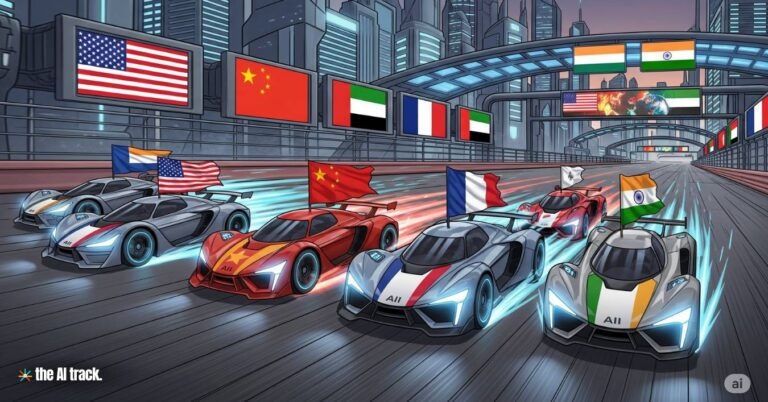
Explore the global race for AI supremacy as the US, China, EU, and India deploy competing strategies in compute, capital, and talent to lead the new era.
Explore the vital role of AI chips in driving the AI revolution, from semiconductors to processors: key players, market dynamics, and future implications.

Everything you need to know about the AI chip business and the geopolitical factors shaping the global race for AI (chip) dominance
Read a comprehensive monthly roundup of the latest AI news!