Key Takeaway:
Google’s Gemini 2.5 Deep Think model won gold-level performance at the 2025 ICPC World Finals in Baku, solving 10 out of 12 problems and even outperforming all human competitors on one task. DeepMind called it a “historic moment” comparable to Deep Blue’s chess victory in 1997 and AlphaGo’s Go triumph in 2016, underscoring a milestone toward artificial general intelligence (AGI).
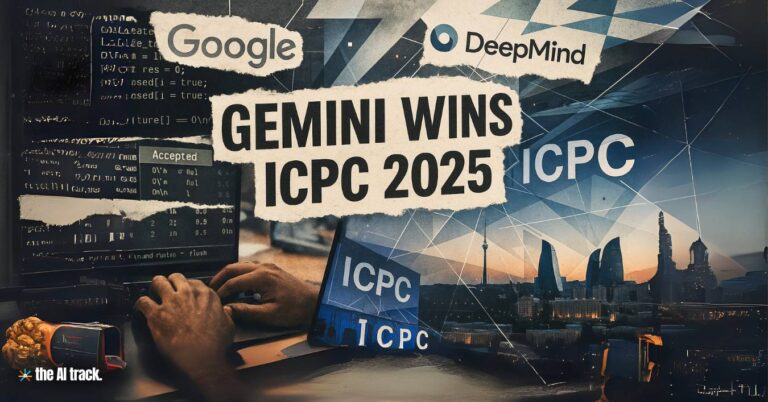
Gemini 2.5 Deep Think Achieves Gold at ICPC – Key Points
Historic ICPC Achievement
The International Collegiate Programming Contest (ICPC), held Sept. 4, 2025, in Baku, Azerbaijan, involved nearly 3,000 universities across 103 countries. Out of 139 elite teams, Gemini 2.5 Deep Think correctly solved 10 of 12 problems in five hours, earning gold-level status and finishing second overall—the first AI system to win gold at an international programming competition. Only the top four teams receive gold medals, and rankings depend on perfect solutions and elapsed time, per ICPC rules. Only four of the 139 human teams reached 10/12 solved, matching Gemini’s tally but not its time ranking.
Surpassing Human Competitors
Gemini uniquely solved “Problem C” (a duct-and-reservoir distribution challenge with infinite configurations) which no university team could crack, including top programs from Russia, China, and Japan. It used game theory (minimax theorem), dynamic programming, priority values across reservoirs, and nested ternary searches in a convex (“bowl-like”) solution space to produce a working solution in under 30 minutes. (Problem statement colloquially framed as a multi-dimensional “flubber” storage/drainage optimization.)
Comparison with Human Teams
While Gemini excelled on Problem C, it failed two tasks that human teams completed. Even so, its inventive reasoning echoed AlphaGo’s 2016 “Move 37.” Performance metrics: it solved 8 problems in the first 45 minutes, 2 more by three hours, and achieved an official combined time of 677 minutes for 10 accepted solutions – good for a hypothetical 2nd place if directly ranked against university teams.
Dual Gold Wins in Math and Coding
Beyond ICPC, Gemini 2.5 Deep Think and an OpenAI model both achieved gold-level results at the 2025 International Mathematical Olympiad (IMO). DeepMind reports that a similar Gemini version can also reach gold-medal level on the 2023 and 2024 ICPC World Finals, indicating consistent abstract-reasoning gains across years and domains.
System Architecture
Gemini operated as an integrated agentic system: multiple agents propose solutions, execute code and tests in terminals, verify, and iterate, mirroring human team workflows under time pressure. The ICPC run was conducted remotely under organizer guidance, with Gemini starting 10 minutes after human contestants yet competing under the same five-hour constraint. DeepMind has published solution write-ups and code for transparency.
Industry and Expert Reactions
Google DeepMind VP Quoc Le equated the ICPC win with Deep Blue (1997) and AlphaGo (2016), pointing to drug and chip design as early beneficiaries.
Independent voices urged caution: Stuart Russell (UC Berkeley) described “epochal” claims as overblown but acknowledged progress toward accurate, production-grade coding. Michael Wooldridge (Oxford) called the result impressive while questioning compute requirements. Dr Bill Poucher, ICPC executive director, labeled the gold result a “key moment” for defining AI tools and academic standards.
Model Versions and Access
The winning system drew on the same general Gemini 2.5 model family used in other applications but was enhanced for extended “thinking tokens” and long-horizon reasoning across the five-hour window, not a freshly trained bespoke model for ICPC (unlike the earlier IMO effort). It remains distinct from the lightweight edition available via the $250-per-month Google AI Ultra subscription; Google did not disclose exact compute and indicated it exceeded consumer-accessible limits.
Scientific Discovery Applications
Google framed the achievement as a step toward human–AI collaboration in biomedical research, semiconductor design, logistics, and scientific inquiry. OpenAI has launched a discovery accelerator, and Harvard Medical School recently developed an AI model targeting neurodegenerative diseases and cancer. DeepMind also notes that combining best human and AI solutions would have solved all 12 problems, reinforcing complementarity for complex R&D pipelines. Ars Technica emphasizes that sustained five-hour, high-throughput inference is computationally expensive, sharpening questions about near-term deployment economics.
Position in AI Breakthrough History
Gemini’s ICPC win sits alongside Rosenblatt’s Perceptron (1957), Deep Blue vs Kasparov (1997), AlphaGo vs Lee Sedol (2016), and AlphaFold (2020), the latter culminating in a 2024 Nobel Prize for DeepMind scientists. These milestones chart a progression from narrow game play to generalizable reasoning with direct scientific utility.
Why This Matters:
Gemini’s ICPC performance demonstrates abstract, multi-step reasoning under stringent, real-world constraints, beyond code autocompletion. Evidence that AI + humans together outperform either alone strengthens the case for near-term co-pilots in science and engineering. Key open questions (scalability, compute costs, and access) will shape how quickly such capabilities diffuse, but the result marks a concrete step toward AGI-grade problem-solving.
This article was drafted with the assistance of generative AI. All facts and details were reviewed and confirmed by an editor prior to publication.
Big Sleep, Google’s AI agent, blocked a critical SQLite vulnerability (CVE-2025-6965) before exploitation—marking a global first in proactive AI cyber defense.
Read a comprehensive monthly roundup of the latest AI news!