Key Takeaway:
Huawei introduced two huge AI systems (Atlas 950 and Atlas 960) plus a yearly chip upgrade plan through 2028. The aim: build giant, China-made computing clusters (hundreds of thousands to over a million chips) that can train and run top AI models and reduce reliance on Nvidia.

Huawei Unveils AI Chip Cluster “SuperPoDs” – Key Points
What Huawei actually launched
On September 19, 2025 in Shanghai, Huawei unveiled the Atlas 950 and Atlas 960 “SuperPoDs.” Think of each SuperPoD as a single giant computer made by wiring together many smaller machines so they work as one. Huawei says a full Atlas 950 setup uses thousands of chips and the Atlas 960 pushes that further, with room to scale into vast data-center halls.
How big this can get
Huawei plans SuperClusters that connect dozens of these giant computers together: one version in 2026 using over 500,000 chips, and a larger one in 2027 using over 1,000,000 chips. The promise is more capacity to train very large AI models (from today’s 100B-parameter scale to future trillion-parameter systems).
Why Huawei says it can beat Nvidia
Huawei’s rotating chairman Eric Xu claims the Atlas 950, when fully built, would include far more processing units and significantly more total memory than Nvidia’s next big system (NVL144 expected in late 2026). He also says the largest Huawei setup could edge past xAI’s Colossus supercomputer. Independent, like-for-like tests are still needed.
A new “wiring system” to make this work
Huawei introduced UnifiedBus 2.0, a networking method that links thousands of chips so they behave like one machine. Plainly: it’s designed to keep connections very fast and highly reliable over long distances inside a data center, reducing slowdowns and failures that can crash big AI jobs.
Huawei’s chip roadmap
From 2026 to 2028, Huawei plans a new chip every year that roughly doubles overall capability. The Ascend 950 arrives in 2026 (two versions: one tuned for fast “first-token” responses and recommendations; one tuned for training), Ascend 960 in 2027, and Ascend 970 in 2028. Huawei also says parts of its AI software stack (CANN, Mind toolchains, openPangu models) will be open-sourced by Dec 31, 2025 to attract developers.
Beyond AI training: general-purpose computing
Huawei announced the TaiShan 950 SuperPoD for banks and large enterprises that still rely on mainframes. The pitch: swap legacy systems with a larger, more flexible cluster that runs databases and analytics faster and more securely, without rewriting everything.
Why this is happening now
The US restricted sales of Nvidia’s most advanced chips to China in April 2025. In response, Chinese firms, including Huawei, are building homegrown setups by combining many domestic chips to reach top-tier performance. Nvidia acknowledges the competition is “gaining momentum,” and CEO Jensen Huang has called Huawei “formidable.”
Why This Matters:
If Huawei’s scaled systems and yearly chip upgrades deliver as advertised, China gains a domestic alternative to Nvidia for cutting-edge AI work. That could reshape global AI supply chains, affect pricing and availability of compute, and accelerate the shift toward multi-vendor AI stacks, so long as Huawei proves reliability, energy efficiency, and real-world performance on industry benchmarks.
This article was drafted with the assistance of generative AI. All facts and details were reviewed

Everything you need to know about the AI chip business and the geopolitical factors shaping the global race for AI (chip) dominance
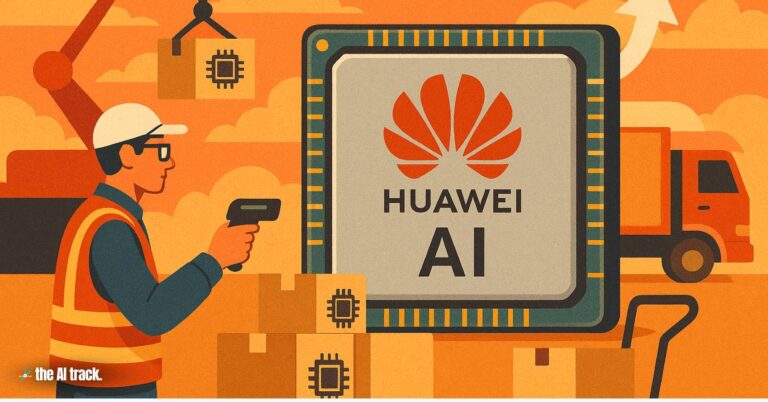
Huawei is accelerating shipments of its Ascend 910C AI chip, a domestic alternative to Nvidia’s restricted GPUs, reshaping China’s AI hardware landscape.

China has set a plan for mandatory AI studies in schools with Beijing piloting the program, expanding nationwide starting fall 2025.

All you need to know about the critical components of AI infrastructure, hardware, software, and networking, that are essential for supporting AI workloads.
Read a comprehensive monthly roundup of the latest AI news!