Key Takeaway
Google Cloud has launched the Gemini Enterprise Agent Platform, a governance and deployment hub for enterprise AI agents, alongside Agentic Data Cloud and eighth-generation TPUs built for AI training and inference. The move turns Vertex AI into a single agent-development stack covering model access, agent building, runtime, orchestration, security, evaluation and observability.
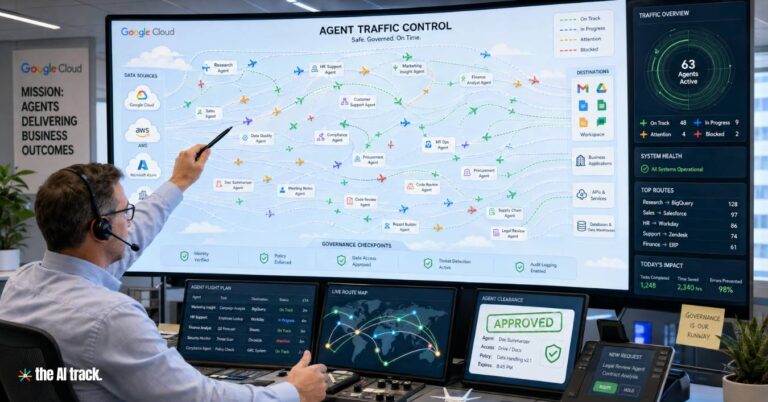
Gemini Enterprise Agent Platform – Key Points
The Story
At Google Cloud Next 2026 in Las Vegas, Google Cloud unveiled the Gemini Enterprise Agent Platform, Agentic Data Cloud, new eighth-generation TPUs and Agentic Defense security integrations with Wiz. The updates are aimed at enterprises trying to manage AI agents across workflows, data systems, cloud environments, Workspace apps and security operations. Future Vertex AI services and roadmap updates will move into the Gemini Enterprise Agent Platform instead of remaining a standalone product.
The Facts
The Gemini Enterprise Agent Platform is a central hub for enterprise AI agents.
It is designed to help technical teams build, test, deploy, govern and optimise agents that can execute multi-step business workflows.
The platform is the next stage of Vertex AI.
It combines model selection, model building and agent building with new capabilities for integration, DevOps, orchestration and security. Google Agentspace has also been folded into the unified Gemini Enterprise product.
It targets “agent sprawl” inside companies.
The product responds to ungoverned bots, fragmented data silos and agents interacting across multiple systems without sufficient security and governance guardrails.
Agent Studio, Agent Designer, ADK, Agent Runtime and Memory Bank support the build-and-scale layer.
Agent Studio and Agent Designer support visual and lower-code agent creation, the upgraded Agent Development Kit supports code-first logic, Agent Runtime supports long-running agents that maintain state for days, and Memory Bank adds persistent long-term context.
Gemini Enterprise is the employee-facing layer.
Developers can publish agents from the Gemini Enterprise Agent Platform into the Gemini Enterprise app, where employees can run agents or build their own through no-code and lower-code options.
Agent Registry, Agent Gateway and Agent Identity are core governance components.
Agent Registry indexes internal agents, tools and skills; Agent Gateway provides centralised connectivity, real-time policy enforcement and Model Armor protections against prompt injection and data leakage; Agent Identity gives each agent a unique cryptographic ID for auditable actions.
The platform supports orchestration, MCP and cross-agent communication.
Agents can delegate tasks to one another through complex, generative and deterministic workflows. MCP connects agents to tools, data sources and enterprise systems, while Agent2Agent is positioned for communication between agents built on different platforms.
Model Garden gives enterprises access to more than 200 models.
The catalogue includes Gemini 3.1 Pro, Gemini 3.1 Flash Image, Lyria 3, Gemma models and third-party models including Anthropic’s Claude family.
Testing and monitoring tools are built into the platform.
Agent Simulation tests agents against synthetic multi-step conversations, Agent Evaluation scores live traffic, Agent Observability traces reasoning, and Agent Optimizer clusters real-world failures to suggest improved system instructions.
Agentic Data Cloud gives agents business context across data systems.
The AI-native architecture powers a universal business context engine and a cross-cloud lakehouse to connect enterprise data estates, reduce silos and let agents query data without moving it out of AWS or Azure.
Workspace Intelligence extends Gemini across productivity apps.
The feature uses Gemini reasoning to understand Workspace content, active projects, collaborators and organisational knowledge across apps such as Docs, Slides and Gmail.
Google introduced eighth-generation TPUs for AI workloads.
TPU 8t is designed for training and can network up to 9,600 TPUs with two petabytes of shared high-bandwidth memory in one superpod. TPU 8i is designed for low-latency inference, with three times more on-chip SRAM for larger key-value caches and an 80% claimed performance-per-dollar improvement.
Agentic Defense combines Google security tools with Wiz.
The system merges Google SecOps and threat intelligence with Wiz’s cloud and AI security platform, including runtime protection for AI workloads, anomaly detection, threat detection and a Security Command Center-powered dashboard.
Numbers that Matter
- $32 billion: Value of Google’s acquisition of Wiz, referenced in the context of Google Cloud’s security integrations.
- 200+: Models available through Model Garden on the Gemini Enterprise Agent Platform.
- 6 trillion+: Monthly tokens processed on Gemini models through ADK.
- 150 organisations: Reported production use of Google’s Agent2Agent protocol.
- 10 concurrent tasks: Project Mariner’s stated cloud-based task-handling capacity.
- 9,600 TPUs: Maximum TPU 8t scale in a single superpod.
- 2 petabytes: Shared high-bandwidth memory supported in a TPU 8t superpod.
- 3x: Claimed TPU 8t processing-power improvement over the previous Ironwood generation.
- 1,152 TPUs: Maximum TPU 8i scale in a single pod.
- 80%: Claimed performance-per-dollar improvement for TPU 8i inference workloads.
- 84%: Share of cloud leaders intentionally selecting multiple clouds, according to Kyndryl’s 2025 Cloud Readiness Report.
- 89%: Share of business teams already using AI agents, according to Google’s AI Agent Trends report.
- 12: Average number of agents per organisation in Google’s AI Agent Trends report.
- 100,000+ hours: Time Macquarie Bank says it reclaimed using Gemini Enterprise.
- 90%+: Claimed reduction in Google’s internal threat mitigation time using security agents.
- 75%: Share of new Google code now AI-generated and engineer-approved, according to Sundar Pichai.
Use Cases
Google cited enterprise deployments across retail, finance, gaming, healthcare, beauty, payments and industrial operations. FairPrice Group has integrated Gemini-powered agents into smart carts, Macquarie Bank is using Gemini Enterprise to reclaim team time, and Square Enix and Capcom are building real-time in-game companions and playtesting agents with the Gemini Enterprise Agent Platform. Other cited examples include Burns & McDonnell using ADK for enterprise knowledge, Color Health using Agent Platform for a Virtual Cancer Clinic, Comcast rebuilding Xfinity Assistant, Gurunavi using Memory Bank for restaurant discovery, L’Oréal building a Beauty Tech Agentic Platform, Payhawk building financial assistants, PayPal using Agent Payment Protocol for agent-based commerce, Danfoss automating email-based order processing and Suzano translating natural language into SQL queries with Gemini Pro.
Background
Enterprise AI agents need access to business data across cloud platforms, but hybrid and multicloud architectures can create latency, fragmentation and governance gaps. Google and AWS launched a collaboration in December to simplify multicloud connections, with Microsoft Azure expected to join later in 2026. The broader market is also moving toward agent-ready data and cloud infrastructure, with cross-platform moves from CoreWeave, Databricks, Snowflake and other vendors.
Why This Matters
The Gemini Enterprise Agent Platform signals Google’s shift from standalone AI tools toward managed agent infrastructure spanning models, development tools, Workspace distribution, cloud data, security and custom silicon. For companies, the practical question is no longer only whether AI agents can be built, but whether they can be governed, secured, connected to business data across clouds, evaluated in production and run cost-effectively at scale.
This article was drafted with the assistance of generative AI. All facts and details were reviewed and confirmed by an editor prior to publication.
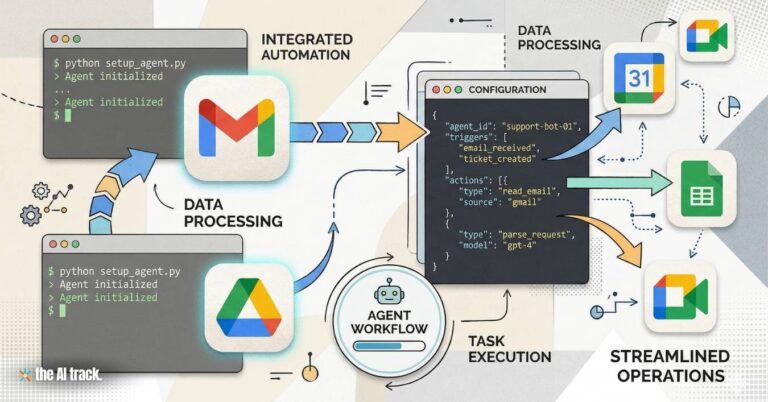
Google released the Google Workspace CLI, an open-source tool that lets AI agents automate tasks across Gmail, Docs, Sheets, and Drive.
Google launched Gemma 4 open-weight AI models and switched to Apache 2.0, adding audio support, 140-plus languages, and serverless options.
Read a comprehensive monthly roundup of the latest AI news!