
Key Takeaway
OpenAI has launched Workspace Agents in ChatGPT for Business, Enterprise, Edu and Teachers plans, positioning them as a successor to Custom GPTs for team workflow automation. The agents can run scheduled workflows, work in Slack, use persistent memory, request approvals for sensitive actions and execute multi-step tasks through Codex.
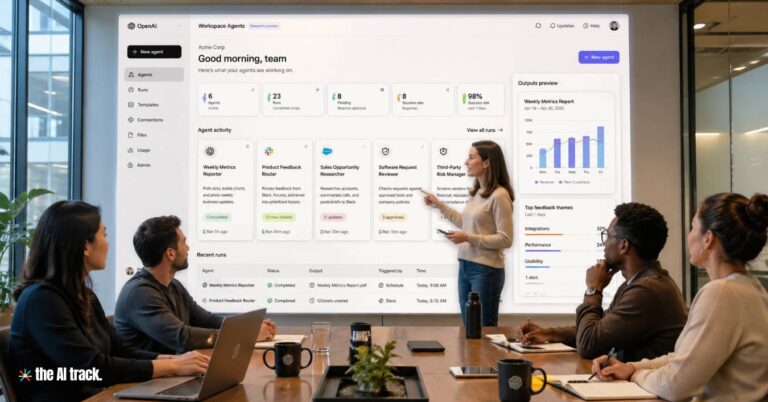
OpenAI Launches Workspace Agents – Key Points
The Story
OpenAI launched Workspace Agents in ChatGPT on April 22 as a research preview for workplace users. The feature lets teams create, share and manage AI agents that automate reporting, coding, communication and other recurring workflows across files, tools and connected systems. OpenAI describes the release as “an evolution of GPTs,” with existing Custom GPTs remaining available for now and a future conversion path planned. The launch extends OpenAI’s broader enterprise push against Microsoft, Google, Anthropic, Amazon, Salesforce and established workflow software providers.
The Facts
Workspace Agents are built for shared team workflows.
Teams can create cloud-based agents that turn scattered workplace knowledge into repeatable processes, rather than relying on one-off chatbot conversations or individual Custom GPTs.
They are powered by Codex.
OpenAI’s cloud-based coding agent underpins Workspace Agents, enabling them to write and run code, access files, use tools and retain memory as part of workflow execution.
Each agent has its own workspace.
Agents can operate with access to files, code, connected apps, tools and persistent memory, allowing them to pull context from multiple systems and continue work across sessions.
Users can build agents in natural language.
A user can describe a recurring workflow in the ChatGPT sidebar or drop in a file. ChatGPT then defines steps, connects tools, adds skills and tests performance.
Templates are available for business functions.
OpenAI includes templates for areas such as finance, sales and marketing, with built-in skills and suggested tools.
Agents can run without the user being online.
They can be scheduled to run automatically, such as generating weekly reports, or deployed in Slack to respond to incoming requests.
Current integrations include ChatGPT, Slack and enterprise apps.
Agents can work across third-party apps and data sources including Slack, Google Drive, Microsoft apps, Salesforce, Notion, Atlassian Rovo and other enterprise tools, with more channels planned.
Agents are managed through a shared Agents tab.
The product experience is centered on an Agents tab in the ChatGPT sidebar, where teams can discover, manage and reuse shared agents across a workspace.
Agents improve through use.
They have memory and can be corrected in conversation, allowing teams to refine workflows over time, then share or duplicate agents for new use cases.
Sensitive actions can require permission.
Teams decide which tools and data each agent can access and when approval is needed. Write actions such as sending email, editing a spreadsheet, posting a message or filing a ticket default to human approval.
Admins get role-based controls and Compliance API visibility.
Enterprise and Edu admins can control which user groups can browse, run, build and publish agents, which tools agents may use, and monitor configuration, changes and executions through the Compliance API.
GPTs will remain available temporarily.
OpenAI says existing Custom GPTs will stay available for now, while a tool to convert GPTs into Workspace Agents is in development.
How to Access / Pricing
Workspace Agents are available in research preview for ChatGPT Business, Enterprise, Edu and Teachers plans. ChatGPT Business is listed at $20 per user per month, while Enterprise, Edu and Teachers pricing varies by plan. On Enterprise and Edu plans, admins can enable the feature through role-based controls. Workspace Agents are free until May 6, 2026, after which OpenAI will apply credit-based pricing.
Use Cases
OpenAI shared examples including a Software Reviewer that checks employee software requests against approved tools and policies, a Product Feedback Router that turns feedback from Slack, support channels and public forums into prioritized tickets and weekly summaries, and a Weekly Metrics Reporter that pulls data every Friday, builds charts and shares a report with the team.
Other examples include a Third-Party Risk Manager that screens vendors for sanctions, financial and reputational risk; an accounting agent that helps with month-end close tasks such as journal entries, balance sheet reconciliations, variance analysis and audit-ready documentation; and a Lead Outreach Agent that researches incoming leads, scores them, drafts personalized follow-up emails and updates the CRM.
Background / Context
Workspace Agents follow a series of OpenAI enterprise moves across 2025 and early 2026, including connectors for Gmail, Google Drive, Outlook, SharePoint and GitHub; GPT-5-powered company knowledge features; AgentKit; and Frontier, an enterprise platform for managing AI coworkers. The move places OpenAI more directly against Microsoft Copilot Studio, Google Agentspace, Anthropic Claude Managed Agents, Salesforce Agentforce, ServiceNow and SAP in business workflow automation.
Why This Matters
Workspace Agents show OpenAI moving ChatGPT from a personal productivity tool toward a managed enterprise workflow platform. For end users, the shift means AI agents may increasingly handle recurring work across files, messages, code, approvals and business systems. For companies, the key question is whether these agents can deliver reliable automation while meeting governance, security and compliance expectations.
This article was drafted with the assistance of generative AI. All facts and details were reviewed and confirmed by an editor prior to publication.
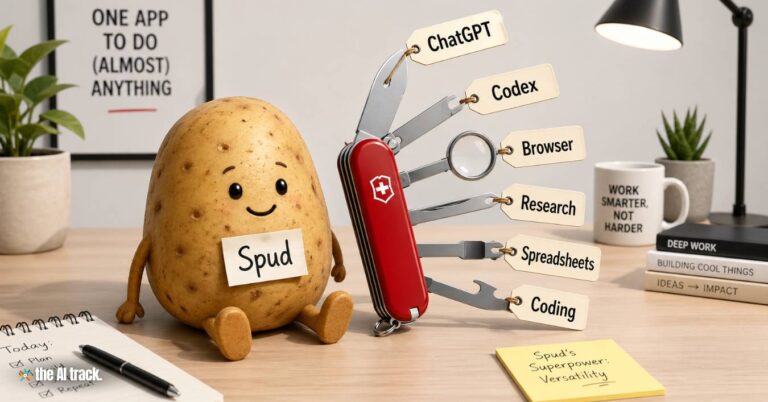
OpenAI released GPT-5.5, codenamed Spud, for ChatGPT and Codex, claiming gains in context handling, coding, research, and efficiency.

OpenAI releases ChatGPT Images 2.0 with reasoning, multilingual text, web search, broader aspect ratios, and multi-image output.

OpenAI is shutting down the Sora video generator and its API after fading app momentum and a shift toward robotics and world simulation.

OpenAI updated Codex with computer use, memory, SSH access, plugins, image generation, and long-running task automation for ChatGPT desktop users.
Read a comprehensive monthly roundup of the latest AI news!