
Key Takeaway
OpenAI has released GPT-5.5, codenamed “Spud,” calling it its smartest and most intuitive model yet. The launch strengthens ChatGPT and Codex across coding, knowledge work, computer use, research, cybersecurity, and enterprise workflows while moving OpenAI closer to its broader “super app” vision.

OpenAI releases GPT-5.5 – Key Points
The Story
OpenAI released GPT-5.5 on Thursday, presenting it as a faster and sharper model than GPT-5.4 that better understands context and intent while matching GPT-5.4 per-token latency in real-world serving. Greg Brockman called it “a new class of intelligence” and said it marks progress toward more agentic and intuitive computing, as well as OpenAI’s goal of combining ChatGPT, Codex, and an AI browser into a unified service. The model is designed for enterprise tasks such as agentic coding, computer use, data analysis, document creation, spreadsheets, and knowledge work, as well as more experimental uses in mathematics, scientific research, biology, and digital defense.
The Facts
GPT-5.5 is OpenAI’s newest model.
The company describes it as its “smartest and most intuitive to use model” so far, and the next step toward a new way of getting work done on a computer. The model was codenamed “Spud.”
The model follows GPT-5.4 by only about a month.
OpenAI has released models in November, December, March, and now April, signaling an accelerated release cycle. GPT-5.5 also arrived one week after Anthropic launched its latest model.
The main upgrade is better context understanding.
GPT-5.5 is designed to keep context more consistently across longer, multi-step tasks, reduce back-and-forth prompting, better infer user intent, navigate ambiguity, use tools, check its work, and keep going until a task is finished.
Greg Brockman framed GPT-5.5 as a step toward future computing.
He said the model advances “agentic and intuitive computing,” brings more frontier AI to businesses and consumers, and reflects a shift toward a “compute-powered economy.”
GPT-5.5 is designed to be more efficient than GPT-5.4.
It matches GPT-5.4 per-token latency in real-world serving while performing at a higher intelligence level, and uses significantly fewer tokens to complete the same Codex tasks.
The model is positioned for enterprise work.
Key use cases include agentic coding, knowledge work, computer use, document and spreadsheet generation, data analysis, online research, and turning messy business goals into practical plans.
Coding is a major focus area.
GPT-5.5 is described as OpenAI’s strongest agentic coding model to date, with 82.7% on Terminal-Bench 2.0, 58.6% on SWE-Bench Pro, and stronger performance than GPT-5.4 on its internal Expert-SWE evaluation.
OpenAI also sees broader workplace applications.
More than 85% of the company uses Codex weekly across functions including software engineering, finance, communications, marketing, data science, and product management. Early-access teams reportedly used GPT-5.5 to review thousands of additional documents and save up to 10 hours of work per week.
Scientific research is a major focus.
Mark Chen said GPT-5.5 shows gains in scientific and technical research workflows. The model improves on GPT-5.4 on GeneBench, BixBench, FrontierMath, and other research-oriented evaluations.
Drug discovery and biomedical research were named as possible use cases.
GPT-5.5 can support biomedical research workflows, with early testing involving biochemical datasets and drug discovery evaluations.
GPT-5.5 outperforms prior OpenAI models and competitors on several benchmarks.
The reported comparisons include Google Gemini 3.1 Pro and Anthropic Claude Opus 4.7, based on OpenAI’s own data. Results vary by benchmark, and some competitor models still lead on specific tests.
The rollout covers ChatGPT and Codex, with API access coming later.
GPT-5.5 is rolling out to Plus, Pro, Business, and Enterprise users in ChatGPT and Codex. GPT-5.5 Pro is available to Pro, Business, and Enterprise users in ChatGPT. In Codex, GPT-5.5 is also available for Edu and Go plans with a 400K context window.
Benchmarks
GPT-5.5 improves on GPT-5.4 across coding, knowledge work, computer use, browsing, scientific research, cybersecurity, long-context, and abstract reasoning evaluations, based on company-reported data. Reported scores include 82.7% on Terminal-Bench 2.0, 84.9% on GDPval, 78.7% on OSWorld-Verified, 98.0% on Tau2-bench Telecom without prompt tuning, 25.0% on GeneBench, 80.5% on BixBench, 81.8% on CyberGym, and 85.0% on ARC-AGI-2. These are mostly OpenAI-reported benchmark results; the company also notes that evaluations used high reasoning effort in a research environment, which may differ from production ChatGPT.
How to Access / Pricing
GPT-5.5 is available in ChatGPT and Codex for Plus, Pro, Business, and Enterprise users. GPT-5.5 Thinking is available in ChatGPT for Plus, Pro, Business, and Enterprise users, while GPT-5.5 Pro is available to Pro, Business, and Enterprise users. In Codex, GPT-5.5 is available for Plus, Pro, Business, Enterprise, Edu, and Go plans with a 400K context window, and Fast mode generates tokens 1.5x faster for 2.5x the cost. API access is coming “very soon,” with gpt-5.5 priced at $5 per 1M input tokens and $30 per 1M output tokens, and gpt-5.5-pro priced at $30 per 1M input tokens and $180 per 1M output tokens.
Background
The release comes during a fast model-launch cycle for OpenAI and amid intensifying enterprise competition with Anthropic. GPT-5.4 arrived in March, with previous model releases in December and November. OpenAI staff indicated that frequent improvements should continue, with chief scientist Jakub Pachocki saying the company expects significant short-term and medium-term gains.
What to Watch Next
The main signal to watch is how OpenAI turns GPT-5.5’s context handling, agentic behavior, and enterprise capabilities into a unified product experience. The company’s broader direction points toward a service that blends ChatGPT, Codex, and browser-based AI into a single work platform, while API availability will depend on the safeguards still needed. Another key factor is infrastructure cost: Nvidia says its new chips can reduce the cost of running advanced AI like GPT-5.5 by up to 35x per token.
Why This Matters
GPT-5.5 is not just another model update. It shows OpenAI moving ChatGPT from a chatbot toward a broader AI workspace for coding, research, knowledge work, software operation, cybersecurity, and enterprise automation. For end users and businesses, the practical question is whether better context understanding, fewer follow-up prompts, stronger tool use, and lower serving costs translate into faster, more reliable AI work at scale.
This article was drafted with the assistance of generative AI. All facts and details were reviewed and confirmed by an editor prior to publication.

OpenAI releases ChatGPT Images 2.0 with reasoning, multilingual text, web search, broader aspect ratios, and multi-image output.

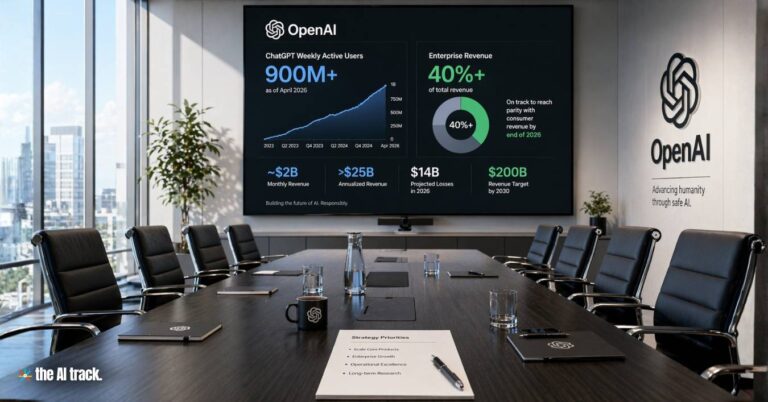
OpenAI raised $122 billion at an $852 billion valuation and said it now generates $2 billion in monthly revenue.

OpenAI is shutting down the Sora video generator and its API after fading app momentum and a shift toward robotics and world simulation.
OpenAI loses three senior executives as it shuts down Sora, folds OpenAI for Science into other teams, and pushes harder into enterprise AI.
Read a comprehensive monthly roundup of the latest AI news!