Key Takeaway
Pope Leo XIV will release his first encyclical, Magnifica Humanitas, on May 25, focusing on human dignity, work, justice, peace, and warfare in the age of artificial intelligence. The Vatican launch will include Anthropic co-founder Christopher Olah, making the document unusually visible for both religious and AI policy audiences.
ope Leo XIV Will Release First AI Encyclical – Key Points
The Story
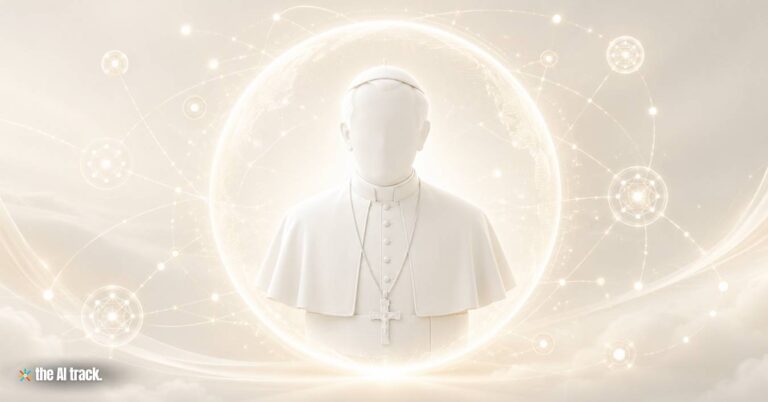
Pope Leo XIV has signed Magnifica Humanitas, a major papal teaching document on “the protection of the human person in the age of artificial intelligence.” The encyclical will be presented on May 25 in the main Vatican auditorium, with the pope attending, speaking, and giving a final blessing. The event will also feature Anthropic co-founder Christopher Olah, theologians Anna Rowlands and Léocadie Lushombo, and senior Vatican officials.
The Facts
The document is Pope Leo XIV’s first encyclical.
Encyclicals are among the most important forms of papal teaching and are official letters used to guide bishops and the wider Catholic community.
Its title is Magnifica Humanitas.
The Latin title means “Magnificent Humanity,” and the Vatican describes the document as focused on protecting the human person in the age of AI.
The release date is May 25, 2026.
The document was signed on May 15, the 135th anniversary of Pope Leo XIII’s 1891 social encyclical Rerum Novarum, which addressed workers’ rights, capitalism, and the obligations of states and employers during the Industrial Revolution.
The AI framing is deliberate.
Rerum Novarum became a foundation of modern Catholic social thought, and Pope Leo XIV has already connected that legacy to the AI revolution. The new encyclical is expected to place AI within the Church’s social teaching on labor, justice, peace, and human dignity.
AI in warfare is expected to be a major concern.
Pope Leo XIV has made AI a priority early in his pontificate, with particular concern about military uses of the technology and the need to monitor how AI systems are deployed.
The Vatican approved a new AI commission on May 16.
The commission will coordinate AI-related activity across Vatican institutions, align internal projects, share information, and help set policies for AI use within the Holy See.
The commission includes seven Vatican bodies.
These include the Dicastery for the Doctrine of the Faith, the Pontifical Academy for Life, and the Pontifical Academy of Sciences.
The launch will have an unusually high-profile Vatican format.
Doctrine chief Cardinal Víctor Manuel Fernández and development chief Cardinal Michael Czerny will be the main presenters. Vatican secretary of state Cardinal Pietro Parolin will offer the conclusion.
Christopher Olah’s presence gives the event unusual AI industry relevance.
Olah is a co-founder of Anthropic, the company behind Claude and a major player in AI safety research. His role as a lay speaker signals that the Vatican wants the encyclical to reach beyond church institutions.
Anthropic is also involved in a political and legal dispute in the US.
In February, the Trump administration ordered US agencies to stop using Anthropic’s AI technology and imposed penalties after the company refused to allow unrestricted military use of its systems. Anthropic is suing the administration, alleging illegal retaliation.
The Vatican has already been active on AI ethics.
Pope Francis addressed AI ethics at the G7 in June 2024, and Vatican officials have held discussions with executives from Google, Microsoft, Cisco, and other major technology companies.
The Catholic Church already has internal AI rules.
Guidelines that took effect on January 1, 2025 require disclosure of AI-generated content, prohibit AI uses that conflict with the Church’s mission, and created a five-member compliance body.
Why This Matters
This is one of the clearest signs that AI governance is moving beyond technology companies, regulators, and courts into wider social institutions. For end users, the encyclical matters because it frames AI not only as a productivity tool, but as a force affecting jobs, human dignity, warfare, regulation, institutional trust, and the kind of society AI systems are allowed to shape.
This article was drafted with the assistance of generative AI. All facts and details were reviewed and confirmed by an editor prior to publication.

EU AI Act simplification deal delays high-risk AI rules, adds sandboxes, reduces duplicate compliance, and bans nudification apps.
The European Commission is weighing a delay to the EU AI Act until 2027 under U.S. and industry pressure, balancing innovation, oversight, and global competitiveness.
Read a comprehensive monthly roundup of the latest AI news!