Key Takeaway
Google I/O 2026 repositioned Gemini as the operating layer across Search, Android, Chrome, Workspace, YouTube, shopping, creative tools, developer tools and new smart glasses.
The biggest shift at Google I/O 2026 was not one feature, but Google’s move toward agentic AI: assistants that can work across apps, create interfaces, manage tasks, build software, automate browsing and act in the background.
Google I/O 2026 – Key Points
The Story
Google I/O 2026 focused heavily on Gemini, with new AI models, agentic tools, Search upgrades, Chrome features, developer products, creative tools and Android XR smart glasses. Google introduced Gemini 3.5 Flash, Gemini Omni, Gemini Spark, Information agents in Search, Universal Cart, Ask YouTube, Daily Brief, Antigravity 2.0, Managed Agents in the Gemini API, WebMCP and intelligent eyewear developed with Samsung and eyewear partners. The announcements show Google moving beyond chatbot-style AI toward systems that can plan, retrieve, generate, edit, code, browse and act across its product ecosystem.
Key Points
Models and Agents
Gemini 3.5 Flash is Google’s new agent-focused model.
Gemini 3.5 Flash is the first release in the Gemini 3.5 family and is designed for complex workflows, coding, long-horizon tasks and agentic use cases. It is available in the Gemini app, AI Mode in Search, Google Antigravity, Gemini API in AI Studio, Android Studio and enterprise products.
Gemini 3.5 Flash is faster than other frontier models by Google’s measure.
Google says the model is four times faster than other frontier models when measured by output tokens per second, while also outperforming Gemini 3.1 Pro on several coding and agentic benchmarks.
Gemini 3.5 Pro is not available yet.
Google says Gemini 3.5 Pro is being used internally and is expected to roll out next month. The absence of a public Gemini 3.5 Pro release keeps attention on whether Google can match or beat rival frontier models in high-end reasoning and coding.
Gemini Spark is Google’s new 24/7 personal AI agent.
Spark runs on dedicated virtual machines in Google Cloud, works in the background, and is built to handle longer tasks without keeping a user’s laptop open. It will begin with trusted testers and then enter beta for Google AI Ultra subscribers in the U.S.
Search, Chrome, Apps and Daily Work
Google Search is moving toward agentic Search.
Information agents in Search will work in the background to find information and help users act on it. These will roll out this summer, starting with Google AI Pro and Ultra subscribers.
Search will generate custom interfaces and mini apps.
Google says Search will use Gemini 3.5 Flash and Antigravity to create dynamic layouts, interactive visuals, dashboards and trackers. Free generative UI features are planned for everyone in Search this summer, while persistent custom experiences will start with Google AI Pro and Ultra subscribers in the U.S.
The search box itself is becoming more active.
Google is adding a search bar that can dynamically expand for longer queries and offer AI-powered suggestions designed to go beyond traditional autocomplete.
Gemini in Chrome is becoming a browsing assistant.
Gemini in Chrome on Android is planned for late June, initially for English-U.S. devices with 4GB of RAM or more. It will summarize articles, answer page-specific questions, explain content and connect with Google apps such as Calendar, Keep and Gmail.
Auto browse brings agentic task completion into Chrome.
Auto browse can automate tasks such as booking appointments, planning events, finding in-stock items or locating parking. On desktop, Google plans to connect auto browse with Gemini Spark in the coming months so the personal agent can take actions in the browser.
Skills in Chrome turns repeated prompts into one-click workflows.
Users will be able to save multi-tab Gemini workflows, such as comparing product specs or scanning long documents, and run them again from Chrome with one click.
Daily Brief is coming to the Gemini app.
Daily Brief will synthesize information from Gmail, Calendar and tasks, then prioritize updates and suggest next steps in a short morning digest. Google is also expanding Gmail AI inbox features that can generate custom to-do lists and draft personalized replies based on emails.
Ask YouTube will answer questions by finding relevant video moments.
Ask YouTube is being tested now and is planned for broader rollout in the U.S. this summer. It will surface videos that match a question and jump to the most relevant part.
Universal Cart turns shopping into an agentic workflow.
Google’s shopping agent can organize products across retailers, monitor price changes, flag newer versions or color options, answer questions about items in the cart and help complete purchases through Google’s secure payment system.
Developer Tools
Google Antigravity 2.0 is becoming the central workspace for AI agents.
The new standalone desktop app lets developers orchestrate multiple agents in parallel, use dynamic subagents, schedule background tasks and connect workflows across Google AI Studio, Android and Firebase.
Antigravity is expanding beyond the desktop app.
Google introduced Antigravity CLI for terminal-based agent creation, Antigravity SDK for custom agent behavior, and Antigravity support inside the Gemini Enterprise Agent Platform for Google Cloud customers. Gemini CLI users are being directed to migrate to Antigravity CLI.
Managed Agents bring agent infrastructure into the Gemini API.
Developers can use one API call to spin up an agent that reasons, uses tools and executes code in an isolated Linux environment. Managed Agents are powered by the Antigravity agent harness, built on Gemini 3.5 Flash, and available through the Interactions API and Google AI Studio.
Chrome is adding tools for agent-friendly websites.
WebMCP is a proposed open web standard that lets websites expose structured tools, such as JavaScript functions and HTML forms, to browser-based agents. The experimental WebMCP origin trial starts in Chrome 149, and Gemini in Chrome is expected to support WebMCP APIs.
Chrome DevTools is being opened to coding agents.
Chrome DevTools for agents gives AI coding tools access to console logs, network traffic and accessibility trees so they can verify, debug and optimize code. It is available for Antigravity and more than 20 other coding agents.
Google AI Studio is expanding into mobile, Workspace and Android development.
A new Google AI Studio mobile app is available for pre-registration this week. Developers can export projects to Antigravity, call Google Workspace APIs from agents, build Android apps with a prompt, and publish directly to the Google Play Console test track.
Google is also pushing AI coding into cybersecurity.
Google is inviting select expert groups to test the API for CodeMender, an AI agent for code security designed to flag and fix software vulnerabilities.
Hardware, Creative Tools and Science
Google is bringing back smart glasses through Android XR.
Intelligent eyewear will come in two types: audio glasses that provide spoken help and display glasses that show information. The first audio glasses are planned for later this fall, with Samsung, Gentle Monster and Warby Parker involved.
The glasses will use Gemini for hands-free tasks.
Google highlighted directions, messages, photos, real-world questions, live translation and other actions without taking out a phone. The audio glasses include speakers in the temples and cameras so Gemini can respond to what the user is looking at; display versions are still in development.
Gemini is also moving into cars.
Google and Volvo announced that Gemini will be able to use external cameras in the upcoming Volvo EX60 SUV to interpret surroundings, starting with use cases such as explaining parking signs and restrictions.
Gemini Omni expands Google’s AI media ambitions.
Google describes Gemini Omni as a model that can create from different inputs, beginning with video, with a focus on world understanding, multimodality and conversational editing. OmniFlash is available for Google AI Pro and Ultra subscribers.
Google is pushing AI into creative workflows.
Google I/O 2026 announcements included Google Pics, Flow upgrades, Flow Music, Gemini Omni for video, Nano Banana in Chrome and creative tools that turn prompts, images, melodies or rough ideas into edited media, designs, interfaces or produced tracks.
YouTube Shorts is getting Gemini Omni remixing.
A new Shorts Remix option will let users “reimagine” videos with Gemini Omni, including restyling clips or inserting themselves into videos. Creators can disable remixing, and Omni-remixed Shorts will carry a digital watermark and link back to the original video.
Google is expanding AI content verification.
Google is bringing SynthID verification to Search features including Google Lens, AI Mode and Circle to Search, with Chrome support planned in the coming months. The expansion also covers C2PA content credentials, and OpenAI is adopting Google’s SynthID watermarks alongside C2PA for AI labeling.
Gemini for Science shows Google’s research ambitions.
Google also positioned Gemini as a tool for scientific work, with Gemini for Science aimed at accelerating research and prediction tasks. Demis Hassabis, CEO of Google DeepMind, framed the moment as the “foothills of singularity,” while arguing that AI could act as a multiplier for human ingenuity.
Numbers That Matter
- 3.2 quadrillion+ tokens per month: Google says its AI systems now process more than 3.2 quadrillion tokens monthly across its surfaces, up from roughly 480 trillion at I/O 2025.
- 900 million+ monthly active users: The Gemini app has surpassed 900 million monthly active users, more than doubling from 400 million a year earlier.
- 50 billion+ images: People have generated more than 50 billion images with Gemini.
- 2.5 billion+ monthly active users: AI Overviews now has more than 2.5 billion monthly active users.
- 1 billion+ monthly active users: AI Mode in Search has surpassed 1 billion monthly active users within a year.
- $100 per month: Google introduced a new AI Ultra plan starting at $100 per month, with 5x higher Antigravity usage limits than Google AI Pro and a limited-time $100 Antigravity credit offer ending May 25, 2026.
- $200 per month: A higher Google AI Ultra tier includes access to Project Genie, Google’s world-model system for generating interactive experiences.
- $2 million prize pool: Google launched the Build with Gemini XPRIZE Hackathon, with finalists set to pitch at the Moonshot Gathering in Los Angeles this September.
- Chrome 149: The experimental WebMCP origin trial starts in Chrome 149.
- Chrome 148: The Prompt API is stable in Chrome 148, using Gemini Nano with multimodal inputs, structured output and expanded language support.
- 4GB RAM: Gemini in Chrome on Android will initially require devices with at least 4GB of RAM and English-U.S. language settings.
- 4x faster: Google says Gemini 3.5 Flash is four times faster than other frontier models by output token speed.
Why This Matters
Google I/O 2026 shows Google turning Gemini into a practical AI layer across the services many people already use every day: Search, Gmail, Calendar, Docs, YouTube, Chrome, Android, shopping, cars and developer tools. For end users, the main change is that AI will increasingly move from answering prompts to managing tasks, creating interfaces, finding information, editing media, browsing the web and acting across apps. For developers, the new Antigravity ecosystem, Managed Agents, WebMCP, Chrome DevTools for agents and CodeMender point to a faster path from prompt to working software and security fixes. For publishers, retailers, creators and software companies, the shift is more disruptive: Search traffic, shopping flows, app discovery, content creation, web design, AI labeling and software development may all be reshaped by Google’s agentic AI stack. Google has the scale and infrastructure to compete aggressively, but the Google I/O 2026 announcements also show that the race remains open, especially in frontier models and AI coding.
This article was drafted with the assistance of generative AI. All facts and details were reviewed and confirmed by an editor prior to publication.

Google Cloud launched Gemini Enterprise Agent Platform with Agentic Data Cloud, new TPUs, Workspace Intelligence and Wiz security integrations.

Google disrupted an AI-assisted zero-day exploit that could bypass two-factor authentication before a planned mass attack.

Microsoft, Google DeepMind and xAI will join U.S. AI model testing for national security risks before advanced systems are released.
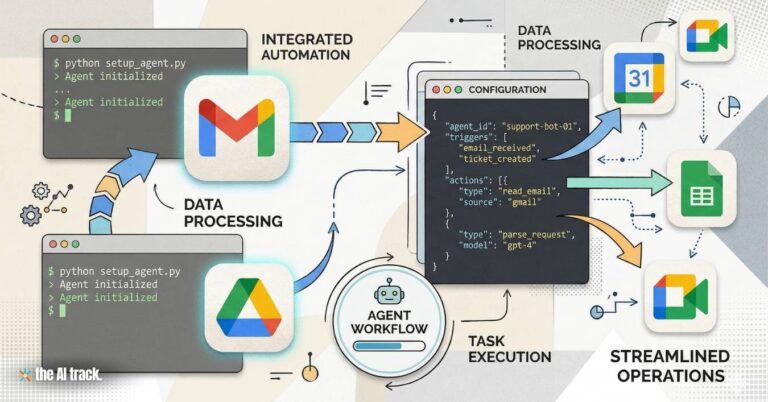
Google released the Google Workspace CLI, an open-source tool that lets AI agents automate tasks across Gmail, Docs, Sheets, and Drive.
Read a comprehensive monthly roundup of the latest AI news!