
Key Takeaway
OpenAI Codex is expanding from a coding agent into a broader enterprise work platform with Sites, Annotations, and role-specific plugins. The update targets knowledge workers who need AI agents to build dashboards, edit documents, connect business apps, and create internal tools without starting from code.
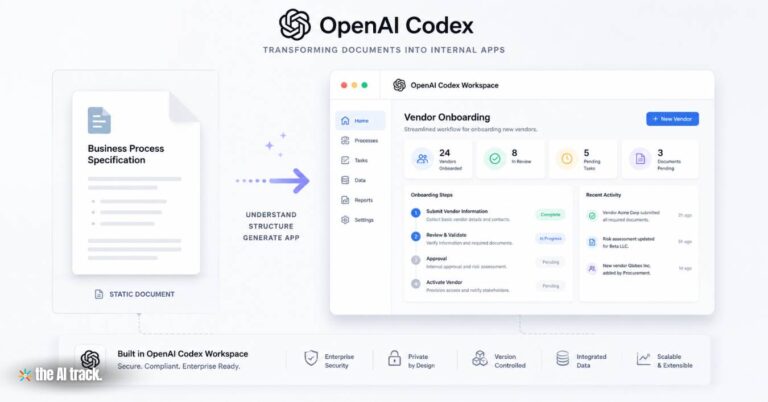
OpenAI Codex – Key Points
The Story
OpenAI has released a major OpenAI Codex update designed to move the product beyond software engineering and into everyday business workflows.
The new capabilities include Sites, a preview feature for creating hosted internal web apps; Annotations, a way to make precise edits to selected parts of documents, spreadsheets, slides, and websites; and role-specific plugins that bundle reusable skills, app integrations, and workflow instructions.
The shift matters because OpenAI Codex is no longer being positioned only as a developer assistant. It is becoming an agentic workspace where business users can connect tools, generate working interfaces, update documents, and automate multi-step tasks across departments.
OpenAI says more than 5 million people now use Codex every week. Non-developers, including analysts, marketers, operators, designers, researchers, investors, and bankers, now make up about 20% of overall Codex users and are growing more than 3x as fast as developers.
OpenAI says Sites are rolling out in preview for Business and Enterprise customers through the Codex app, while role-specific plugins are rolling out in supported regions through the Codex plugin directory.
What Is New
Sites turn work into internal web apps
Sites let OpenAI Codex create and share interactive, hosted websites and apps inside a company workspace.
Instead of sending a static spreadsheet, document, or slide deck, a team can ask Codex to turn the material into a dashboard, scenario planner, project hub, review workspace, gallery, or lightweight internal tool.
OpenAI gives examples such as:
- a customer review page with product updates and next steps
- a financial scenario planner based on a model
- a product launch hub with messaging, milestones, owners, and decisions
- an operations dashboard
- a creative brief repository
Sites can be shared through a workspace URL and can be updated as the underlying work changes. OpenAI says Sites are hosted by OpenAI and are available as a plugin within Codex for eligible Business and Enterprise workspaces.
OpenAI is also working with early partners including Vercel, Wix, Base44, Replit, Lovable, Figma, Webflow, and Emergent as it builds toward a Sites partner ecosystem.
Annotations make Codex edits more targeted
Annotations let users point Codex to the exact part of a file or interface they want to change.
That matters for business documents because AI editing often breaks formatting when it regenerates too much. With Annotations, a user can mark a chart, paragraph, spreadsheet range, slide element, or site component and ask Codex to update only that selected area.
OpenAI describes examples such as changing the font of a site navigation bar, checking the source of a claim in an investment thesis, or improving a chart label on a slide.
For business users, this is one of the most practical parts of the update. It makes Codex more useful after the first draft, when the task is not “create everything,” but “fix this specific section without damaging the rest.”
Key Points
- OpenAI Codex now has more than 5 million weekly users, according to OpenAI.
- Non-developers make up about 20% of Codex users and are growing more than 3x as fast as developers.
- The fastest-growing knowledge-work tasks include data analysis, research, and knowledge artifacts, including reports, memos, documents, contracts, multimedia assets, PDFs, and spreadsheets.
- More than 60% of Codex users now run more than one task at the same time at some point during the day, up from less than half in mid-April.
- Sites are in preview for Business and Enterprise teams through the Codex app.
- Business workspaces have Sites enabled by default, while Enterprise workspaces can enable the feature through admin controls.
- Sites can create hosted internal apps, including dashboards, planners, project boards, review workspaces, and lightweight tools.
- Plugins package skills, app integrations, and MCP servers into reusable Codex workflows.
- Plugins can connect Codex to tools such as Gmail, Google Drive, Slack, GitHub, and other services, depending on what is installed and approved.
- Admins can control plugin and app permissions for Business, Enterprise, and Edu workspaces.
- Codex is included across Free, Go, Plus, Pro, Business, Edu, and Enterprise plans, although usage limits vary by plan.
Role-Specific Plugins Bring Codex Into Departments
The plugin system is the second major part of the update.
OpenAI Codex plugins are not simple browser-style add-ons. They are packaged workflows that can include three parts:
- Skills: reusable instructions for specific tasks or team processes.
- Apps: connections to workplace tools and data sources.
- MCP servers: external services that give Codex access to additional tools or shared information.
OpenAI is launching six role-specific plugins that together include 62 popular apps and 110 skills. The initial set covers data analytics, creative production, sales, product design, public equity investing, and investment banking.
The plugins are designed to be useful out of the box, then improve as teams customize them with company-specific instructions, context, and connected tools.
This structure allows Codex to become more department-specific. A sales team might use it to summarize account data and draft follow-ups. A finance team might use it to analyze spreadsheets and build scenario tools. A marketing team might use it to generate campaign boards or creative variations.
OpenAI says more role-specific plugins are coming soon, including Corporate Finance, Private Equity Investing, Marketing Strategy, Strategy Consulting, and Legal. The company is also working toward a plugin ecosystem where partners can create and deploy plugins directly in Codex and ChatGPT.
Who This Is For
The update is most relevant to teams that already rely on many disconnected apps and documents.
The strongest use cases include:
- Finance teams building live scenario planners from spreadsheets.
- Sales teams preparing account reviews, follow-up plans, and pipeline analysis.
- Marketing teams creating campaign hubs, creative briefs, and asset review spaces.
- Product teams turning plans, research, and wireframes into interactive workspaces.
- Operations teams building internal trackers and dashboards.
- Executives who need live summaries instead of static decks.
- Researchers and analysts collecting context, running analysis, and turning results into reports, tables, and dashboards.
The common thread is not coding. It is turning workplace information into interactive, editable, shareable systems.
Access, Admin Controls, and Data Considerations
OpenAI Codex is available through several surfaces, including the Codex app, CLI, IDE extension, and Codex web. Sites, however, are specifically tied to Codex as a plugin and are available in preview for eligible Business and Enterprise workspaces.
The Bigger Shift
This update shows where agentic AI tools are heading.
The first phase of AI assistants focused on text generation. The second phase focused on coding. The next phase is about work orchestration: connecting apps, reading files, editing outputs, building interfaces, and keeping business artifacts updated.
OpenAI says internal non-technical teams already use Codex to build internal apps, prepare executive materials, create dashboards, and turn creative briefs into work that reflects brand and design constraints. Zapier teams use Codex to pull knowledge from tools such as Slack, Google Docs, and Coda, then turn that context into postmortems, incident response plans, and feature tickets. NVIDIA researchers use Codex to speed up experiment workflows, from finding research ideas to writing scripts for machine learning infrastructure.
The enterprise push also follows the launch of the OpenAI Deployment Company, a joint venture for enterprise clients with more than $4 billion in funding from global investment firms. Denise Dresser, OpenAI’s chief revenue officer, said at launch that the challenge is helping companies integrate AI systems into the infrastructure and workflows that power their businesses.
What to Watch Next
The most important test will be adoption outside engineering teams.
Codex will need to prove that non-technical workers can use Sites, Annotations, and plugins without complex setup. It will also need strong permission controls, reliable app integrations, and clear audit trails for enterprise use.
The competitive pressure will also increase. Anthropic, Microsoft, Google, and enterprise SaaS companies are all pushing AI agents deeper into workplace software.
Codex’s advantage will depend on whether it can make agentic work feel useful, controlled, and safe inside real business environments.
Why This Matters
For end users, this update points to a future where AI tools do more than answer questions or write drafts. They can turn documents into working apps, edit selected parts of business files, and connect workflows across company systems. For businesses, the opportunity is faster internal tool creation. The risk is adding another layer of automation that still requires human supervision, permission controls, and careful review.
This article was drafted with the assistance of generative AI. All facts and details were reviewed and confirmed by an editor prior to publication.

OpenAI launches Rosalind Biodefense, expanding controlled GPT-Rosalind access for pandemic preparedness and public-health defense.

OpenAI’s reasoning model found a counterexample in the unit distance problem, overturning an 80-year assumption in discrete geometry.

OpenAI is reportedly accelerating a ChatGPT phone, with MediaTek likely to supply the chip and mass production possible in 2027.

OpenAI is rolling out GPT-5.5-Cyber to vetted defenders for vulnerability triage, patching, penetration testing, and malware analysis.
Read a comprehensive monthly roundup of the latest AI news!