Key Takeaway
AI search traffic is becoming a critical issue for publishers and creators because users increasingly get answers directly — and may soon complete more tasks inside search itself — while websites receive fewer visits. AI referrals are growing and often valuable, but they are still far too small to replace the scale of traditional search.
The Core Shift
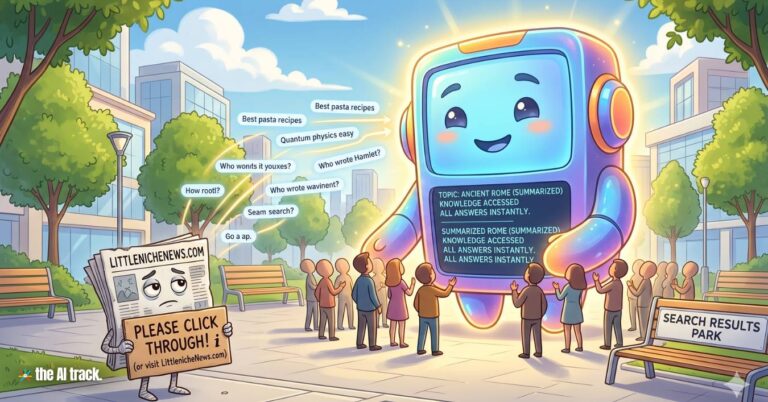
For two decades, search engines acted as a distribution engine for publishers: they indexed content, surfaced links, and sent readers to websites. AI search changes that bargain by summarizing information directly inside search results or chat interfaces.
The clearest signal comes from Pew Research Center’s March 2025 study of Google users. When an AI summary appeared, users clicked a traditional search result in 8% of visits. Without an AI summary, they clicked a result in 15% of visits. Pew also found that only 1% of visits with an AI summary led to a click on a link inside the summary itself.
This is no longer a narrow experiment. By May 2025, Google AI Overviews were available in more than 200 countries and territories and in more than 40 languages.
The latest shift goes beyond summaries. Google’s 2026 Search upgrade pushes AI Mode deeper into the search experience, with longer natural-language prompts, follow-up questions from AI Overviews, file and tab inputs, background information agents, personal Google context, shopping support, booking tools, generated interfaces, and custom mini apps. That moves Search further away from a link index and closer to an AI assistant that can research, monitor, compare, and act.
The Numbers That Matter
- Click-through falls sharply with AI summaries. Pew’s 8% versus 15% finding points to a 47% relative reduction in traditional search clicks when an AI summary appears.
- AI summaries are now common enough to matter. Pew found that 18% of Google searches in its March 2025 sample produced an AI summary. Searches phrased as questions were especially likely to trigger one.
- AI search traffic is growing fast, but Google still dominates. Similarweb estimated that AI platforms generated more than 1.13 billion referral visits to the top 1,000 websites in June 2025, up 357% year over year. Google Search generated 191 billion referrals in the same period.
- Publisher-specific AI traffic remains tiny. Chartbeat data cited in 2026 found that chatbots still accounted for less than 1% of publisher page-view referrals, even after ChatGPT referrals rose more than 200%.
- AI-referred visitors can be more engaged. Adobe found that in May 2025, AI traffic had a 27% lower bounce rate, 38% longer time spent, and 10% more page views per visit than non-AI traffic.
- Publisher exposure is uneven. Outlets dependent on search-optimized evergreen content are more exposed than publishers with strong direct audiences, paid subscriptions, newsletters, events, exclusive reporting, or proprietary data.
Who Is Most Affected
The most vulnerable publishers and creators are those whose content answers generic, high-volume informational queries: basic explainers, summaries, definitions, reviews, recipes, travel guides, comparison pages, and simple how-to articles.
That content is easy for AI systems to summarize. The user often gets a useful answer without needing to visit the original source.
The least vulnerable publishers are those with clear audience loyalty or content that cannot be easily commoditized: original reporting, expert analysis, distinctive voice, community trust, niche authority, first-party data, tools, events, courses, and subscriber-only value.
For creators, the same logic applies. Generic posts, commodity explainers, and simple tutorials are more exposed. Distinctive perspective, lived expertise, trusted curation, community, and repeat audience relationships are harder for AI search to replace.
The Business Impact
The effect is not only a traffic problem. It changes the economics of publishing.
A page view historically supported ads, subscriptions, affiliate revenue, lead generation, and audience development. When AI search uses publisher content to answer the user directly, the publisher may lose the monetizable visit even if its content helped produce the answer.
The risk is no longer limited to informational pages. If Search can compare products, monitor prices, call businesses, surface availability, build carts, or generate task-specific interfaces, more commercial and service-oriented queries may also be handled inside Google’s AI layer before a user reaches an external website.
Several major publishers have reported or been associated with steep traffic declines. Business Insider’s organic search traffic reportedly fell 55% between April 2022 and April 2025, while other large publishers including HuffPost, Forbes, CNN, and The Washington Post have also been cited in reports about sharp search or overall traffic declines.
The causality is complex. AI Overviews are not the only factor. Google algorithm changes, social media decline, changing user behavior, news fatigue, and platform fragmentation all contribute. But AI search accelerates the central problem: fewer users need to click.
Why AI Search Traffic Is Not Enough Yet
AI tools do send traffic. The problem is scale.
Similarweb’s June 2025 comparison shows the imbalance clearly: more than 1.13 billion AI referrals to the top 1,000 websites sounds large until it is compared with 191 billion referrals from Google Search in the same month.
Adobe’s data suggests that visitors arriving from AI tools can be more engaged than average visitors, which makes AI search traffic valuable. But for most publishers, AI referrals are still a small channel compared with the volume historically delivered by Google Search.
That creates a structural mismatch: publishers may lose large amounts of search traffic while gaining a smaller, higher-intent stream of AI-referred users.
The practical conclusion is blunt: AI referral optimization matters, but it cannot be the whole strategy.
The Crawl Problem
There is a second problem beyond lost clicks: AI systems may crawl large amounts of content without sending proportionate traffic back.
Cloudflare has started tracking crawl-to-referral behavior through Cloudflare Radar, showing how often AI models send traffic to a site compared with how often they crawl that site. For publishers, this turns crawler access into a strategic decision rather than a purely technical setting.
This matters because traditional search crawling came with an implied exchange: search engines indexed pages and returned traffic. AI search weakens that exchange. Content can be crawled, summarized, and used to answer queries while the original publisher receives little or no audience value.
Licensing Deals Are Real, but Not a Universal Solution
Large publishers and platforms have signed AI licensing deals, but those deals are concentrated among companies with valuable archives, strong brands, and legal leverage.
News Corp signed a multi-year agreement with OpenAI in 2024 covering current and archived content from publications including The Wall Street Journal, Barron’s, MarketWatch, and the New York Post. Financial terms were not officially disclosed, but the deal has been reported as potentially worth more than $250 million over five years.
Reddit also became a major licensing example. In 2024, Reddit reached a content licensing deal with Google reported at about $60 million per year, making Reddit content available for AI training.
These deals show that content has market value. They also show the limits of that market. Licensing rewards scale, archives, brand authority, community data, and negotiation power. It does not automatically replace the open-web traffic model for independent publishers, small creators, or niche sites.
The Legal Pressure
Copyright litigation remains the biggest uncertainty.
Anthropic agreed in 2025 to a $1.5 billion settlement with authors over claims involving pirated books used in AI training. The case became important because the court separated two issues: training on legally acquired books and the unauthorized acquisition or storage of pirated works.
The wider legal question remains unsettled: whether AI companies can train broadly on copyrighted web content without permission, payment, or a licensing framework. Continuing cases involving AI companies, publishers, authors, and creators could reshape how content is crawled, licensed, cited, and compensated.
What Publishers and Creators Should Do
Publishers should treat AI search as a permanent distribution shift, not a temporary traffic dip.
The priority is to reduce dependence on anonymous search visits and build channels that AI platforms cannot fully replace:
- Measure AI separately. Track AI search traffic from ChatGPT, Perplexity, Claude, Gemini, Copilot, Google AI Mode, and other AI interfaces instead of grouping it under generic referral traffic.
- Identify exposed content. Separate generic evergreen pages from defensible content such as original reporting, expert analysis, proprietary research, tools, templates, and opinionated frameworks.
- Build direct audience channels. Prioritize newsletters, apps, memberships, subscriptions, communities, repeat visitors, and registered users.
- Strengthen first-party data. Build owned customer relationships through accounts, preference data, email lists, surveys, events, and premium products.
- Create original value. Invest in reporting, interviews, datasets, expert commentary, calculators, workflows, downloadable resources, and distinctive editorial voice.
- Improve AI visibility without depending on it. Use clear structure, strong entity signals, author pages, citations, schema, original images, and concise summaries that AI tools can reference accurately.
- Review crawler policy. Decide which AI crawlers to allow, block, or negotiate with, based on business model, legal strategy, and referral value.
- Diversify revenue. Develop events, courses, consulting, licensing, premium research, B2B services, and direct sponsorships.
For individual creators, the lesson is similar. Generic content is becoming easier to summarize away. Durable creator value will come from trust, taste, lived expertise, community, and formats that make the audience want the original source.
What to Watch Next
The next phase will depend on three forces.
First, Google’s AI search expansion will determine how much traditional search traffic remains available to publishers. Second, AI search traffic patterns will show whether users begin clicking source links more often from ChatGPT, Gemini, Claude, Perplexity, Copilot, and other assistants. Third, courts and regulators will decide whether AI companies need broader licensing agreements for copyrighted material.
The strongest publishers will not wait for one of those forces to save them. They will rebuild around direct relationships, distinctive content, and business models that do not depend on Google sending free traffic at historical levels.
Why This Matters
First, Google’s expansion from AI Overviews into AI Mode and agentic Search will determine how much traditional search traffic remains available to publishers, creators, ecommerce sites, local businesses, and service providers. The long-term risk is not only lower website visits; it is a weaker incentive system for producing original, reliable, and useful content.
This article was drafted with the assistance of generative AI. All facts and details were reviewed and confirmed by an editor prior to publication.
Google search is being redesigned with AI Mode, agents, generative widgets, personal context, shopping tools, booking, and mini apps.
Google I/O 2026 introduced Gemini 3.5 Flash, Spark, AI Search, Chrome agents, smart glasses, Antigravity and creative AI tools.

AI model migration is more than moving chats. Learn how to switch AI models, preserve prompts, and rebuild your workflow without losing quality.
Read a comprehensive monthly roundup of the latest AI news!