Key Takeaway
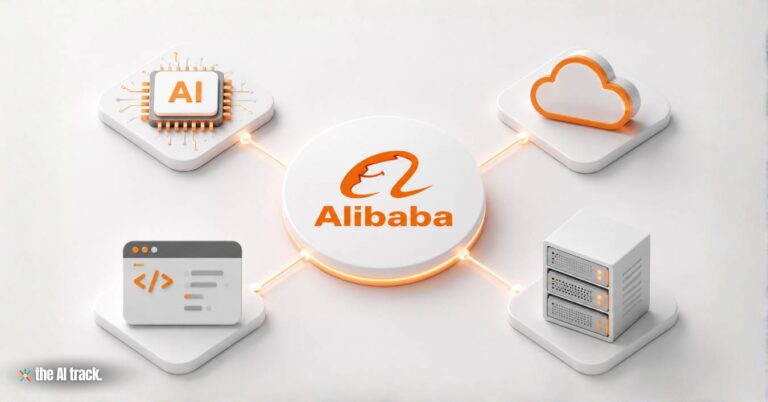
Alibaba has introduced the Zhenwu M890, a new AI chip built for training, inference, and agentic AI workloads, alongside Qwen3.7-Max, a model for long-running coding, reasoning, and workflow automation tasks. The launch strengthens Alibaba’s push to build a full domestic AI stack as China reduces reliance on Nvidia hardware.
Zhenwu M890 AI Chip and Qwen3.7-Max – Key Points
The Story
Alibaba announced the Zhenwu M890 at its Alibaba Cloud Summit on May 20, 2026, positioning the chip as part of a broader full-stack AI upgrade covering chips, cloud infrastructure, model services, foundation models, networking, and software. The company also introduced Qwen3.7-Max, a foundation model designed for coding, office automation, complex reasoning, and long-horizon agent tasks. The combined launch points to a platform strategy: Alibaba is aligning its own chips, cloud services, model platform, and Qwen models around the same agentic AI workload.
The Facts
The Zhenwu M890 is Alibaba’s new AI training and inference processor.
The chip was developed by T-Head, Alibaba’s semiconductor design subsidiary, and delivers three times the performance of the earlier Zhenwu 810E.
The chip is built for agentic AI workloads.
The M890 is designed for workloads that require long context retention, high-speed communication between multiple AI models, and efficient low-precision computing. These are core requirements for AI agents that perform multi-step tasks with limited human supervision.
The headline specifications are 144GB of GPU memory and 800GB/s inter-chip bandwidth.
The M890 supports precision formats from FP32 down to FP4, allowing it to handle both high-precision model training and lower-cost inference. It is built on T-Head’s proprietary parallel computing architecture and uses its custom ICN interconnect protocol.
Alibaba also launched the Panjiu AL128 Supernode Server.
The system integrates 128 M890 accelerators in a single rack and is designed for scalable AI agent inference and large-scale model training. It is powered by the M890 processor and ICN Switch 1.0 networking chip, delivering single-rack bandwidth at petabyte-per-second scale.
The Panjiu AL128 is available in China through Bailian.
Bailian, Alibaba’s domestic Model Studio platform, gives Chinese enterprises access to the system for training and inference workloads. The platform also includes Agentic RL, a reinforcement learning mechanism that uses agent execution feedback to improve model performance, plus built-in safety governance for autonomous agents.
Qwen3.7-Max targets long-running agent tasks.
Qwen3.7-Max can handle code generation, debugging, office workflow automation, complex reasoning, multi-file code editing, refactoring, prototyping, and multi-step tasks requiring hundreds or thousands of actions. Alibaba says it can sustain up to 35 hours of continuous operation and more than 1,000 tool calls without performance degradation.
Qwen3.7-Max is built for very large working contexts.
Qwen3.7-Max has been reported with a 1-million-token context window and a 64K maximum output limit, making it suitable for long codebases, technical documents, and agent workflows that need extensive information available during execution.
Qwen3.7-Max is designed for agent frameworks.
The model is optimized for frameworks including OpenClaw, Hermes Agent, Claude Code, Qwen Paw, and Qoder. Alibaba says it will be available through Model Studio for global developers and enterprises.
T-Head also introduced ICN Switch 1.0 and T-Head SAIL.
ICN Switch 1.0 is a dedicated networking chip for high-bandwidth, low-latency scale-up networks. It delivers up to 25.6Tbps of aggregate bandwidth and enables full-bandwidth interconnection across 64 accelerators. T-Head SAIL is the company’s proprietary software stack for its chips.
Alibaba says Zhenwu chips are already deployed commercially.
T-Head has shipped more than 560,000 Zhenwu units to date, with deployments across more than 400 external customers in 20 industries, including automotive and financial services.
Alibaba has laid out a multi-year chip roadmap.
Alibaba plans to follow the M890 with the V900 in the third quarter of 2027 and the J900 in the third quarter of 2028. The V900 is expected to deliver roughly three times the performance of the M890.
The launch is part of a larger AI infrastructure investment.
Alibaba previously committed more than 380 billion yuan, about $53 billion, to cloud and AI infrastructure over three years.
Alibaba still faces supply-chain and efficiency challenges.
Chinese vendors are trying to become more self-sufficient, but China’s chip supply chain remains weaker than the global one. Lower chipset efficiency could also limit the long-term cost savings of relying on domestic chips.
Why It Matters
Alibaba is trying to control more of the AI stack: chips, cloud infrastructure, foundation models, agent platforms, networking, and enterprise deployment. For users and businesses, the most important shift is not just a faster chip or a larger model; it is the move toward AI systems that can run longer, coordinate more tools, and complete complex workflows with less manual intervention. For the AI industry, the announcement shows how quickly Chinese technology companies are turning domestic AI infrastructure from a workaround into a long-term strategy.
Numbers that Matter
- 3x: Claimed performance gain of Zhenwu M890 over Zhenwu 810E.
- 144GB: GPU memory on the M890.
- 800GB/s: Inter-chip bandwidth.
- 128 accelerators: Number of M890 chips in the Panjiu AL128 rack.
- PB/s scale: Claimed single-rack bandwidth for Panjiu AL128.
- 25.6Tbps: Aggregate bandwidth for ICN Switch 1.0.
- 64 accelerators: Full-bandwidth interconnection supported by ICN Switch 1.0.
- 1 million tokens: Reported context window for Qwen3.7-Max.
- 64K tokens: Reported maximum output limit for Qwen3.7-Max.
- 35 hours: Claimed continuous operating window for Qwen3.7-Max.
- 1,000+ tool calls: Claimed long-horizon task capacity for Qwen3.7-Max.
- 560,000+ units: Zhenwu chips shipped to date.
- 400+ customers: External customers using Zhenwu chips.
- 20 industries: Reported deployment footprint.
- 380 billion yuan / $53 billion: Alibaba’s three-year cloud and AI infrastructure commitment.
What to Watch Next
The main test is whether Alibaba can turn the M890, Panjiu AL128, Bailian, T-Head SAIL, and Qwen3.7-Max into a credible enterprise AI platform, not only a set of hardware and model announcements. Key signals will include independent benchmarks, real-world availability for developers outside China, enterprise adoption of Panjiu AL128, and whether Qwen3.7-Max performs reliably in long-running agent workflows. The chip roadmap also matters: if the V900 arrives in 2027 with another major performance jump, Alibaba’s domestic AI infrastructure strategy becomes more credible.
This article was drafted with the assistance of generative AI. All facts and details were reviewed and confirmed by an editor prior to publication.

Alibaba is preparing to connect Qwen with Taobao Shopping, giving users AI tools for browsing, comparison and after-sales support.

Alibaba and Nvidia integrate Physical AI into Cloud PAI, expand data centers worldwide, and grow AI spending despite China’s chip restrictions.
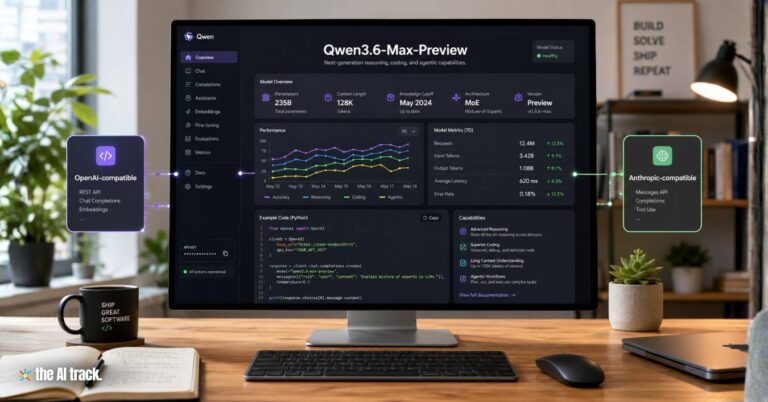
Alibaba released Qwen 3.6 Max Preview on April 20, 2026, with a 256k context window and reported coding and agent benchmark gains.
Read a comprehensive monthly roundup of the latest AI news!