In December 2025, President Donald Trump approved limited exports of Nvidia H200 AI Chips to vetted Chinese customers, attaching a 25% US government fee and strict security review. The move reopens trade while keeping Nvidia’s most advanced chips off-limits, and leaves open the question of how much China will actually buy.
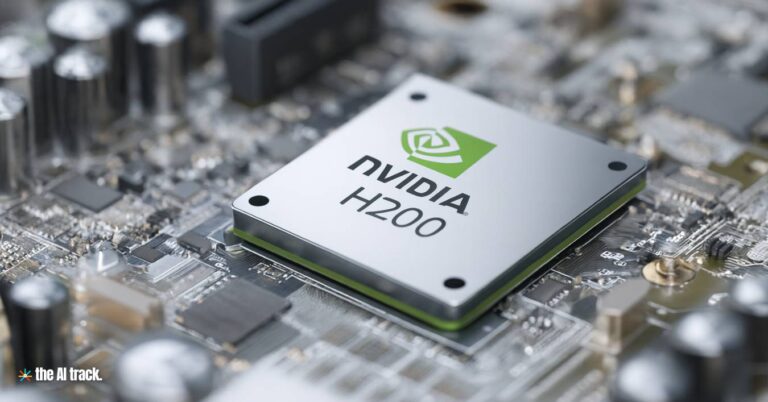
Nvidia H200 AI accelerator module - Trump Clears Nvidia to Sell H200 AI Chips to China (Credit - Midjourney, The AI Track)
Nvidia H200 AI Chips Exports to China – Key Points
What Changed
Exports approved, with limits
Nvidia can now sell H200 AI Chips to “approved customers” in China. The policy also extends to AMD and may later include Intel. All buyers must be vetted by the US Department of Commerce, marking a partial rollback of export controls imposed earlier in 2025.
A 25% government fee
Trump confirmed that 25% of revenue from H200 AI Chips sold to China will go to the US government—up from a previously discussed 15%. The fee is collected during US security review after chips arrive from Taiwan and before export to China.
Top-tier chips still blocked
Nvidia’s Blackwell chips and next-generation Rubin processors are explicitly excluded. The US is allowing access to powerful—but not frontier—AI hardware, drawing a firm line around the most advanced compute.
Why Nvidia Pushed for This
Nvidia CEO Jensen Huang lobbied US officials throughout 2025, arguing that blocking all exports would push China fully toward domestic alternatives. Nvidia welcomed the decision as a “thoughtful balance,” though it has not built major China revenue from H200 AI Chips into its forecasts. Shares rose modestly after the announcement.
How China Is Likely to Respond
China has previously discouraged local firms from buying Nvidia chips tailored for China, including the H20.
Beijing may still limit access to H200 AI Chips, despite US approval.
Trump said President Xi Jinping “responded positively,” and China’s foreign ministry signaled openness to cooperation—but long-term self-sufficiency remains Beijing’s priority.
The Strategic Context
H200 AI Chips are Nvidia’s second most powerful offering, one generation behind Blackwell.
A non-partisan Institute for Progress report estimates H200 is nearly six times more powerful than the H20.
Blackwell is 1.5× faster than H200 for training and up to 5× faster for inference, explaining why it remains restricted.
China continues investing heavily in domestic chips from Huawei and others, while US officials argue that allowing some sales prevents China from accelerating that shift even faster.
Why This Matters
The decision shows how US export controls are evolving—from outright bans to conditional access tied to revenue, security review, and political leverage. Limited sales of H200 AI Chips may ease short-term supply pressures and preserve US influence, but they do not alter the long-term trajectory: China is racing toward self-sufficiency, and the US is guarding the AI frontier.
The outcome will shape global AI competition, semiconductor markets, and future US–China tech policy.
This article was drafted with the assistance of generative AI. All facts and details were reviewed and confirmed by an editor prior to publication.
All you need to know about the critical components of AI infrastructure, hardware, software, and networking, that are essential for supporting AI workloads.
Explore the vital role of AI chips in driving the AI revolution, from semiconductors to processors: key players, market dynamics, and future implications.
Nvidia will supply Blackwell AI chips to South Korea (260k+ units) for government & industry; Announced plan spans sovereign clouds, AI factories, 6G, research.
Read a comprehensive monthly roundup of the latest AI news!
Nvidia will invest in Intel with a $5B stock purchase (~4% stake), building NVLink-connected CPUs and RTX SoCs for data centers and PCs, reshaping chip supply.
DeepSeek’s Oct 2025 open-source OCR model compresses text up to 10x via images, with reported efficiency gains of 7–20×, enabling million-token contexts.