Key Takeaway
Anthropic has introduced “Claude for Healthcare” and expanded “Claude for Life Sciences,” a suite of HIPAA-ready AI tools powered by its latest Claude Opus 4.5 model. The release follows OpenAI’s January 7, 2026 launch of “ChatGPT Health,” a consumer-centric workspace. While OpenAI focuses on personal health management through app integrations like MyFitnessPal and Peloton, Anthropic distinguishes its offering through deep backend integration —automating complex workflows like prior authorizations, clinical trial management, and regulatory submissions — supported by strict safety protocols.

Anthropic Launches Claude for Healthcare – Key Points
Launch Details & Strategic Positioning
Anthropic announced its expansion on January 11, 2026, just days after OpenAI unveiled ChatGPT Health. While OpenAI’s product is designed as a distinct “Health tab” for centralizing personal wellness queries and patient preparedness, Anthropic positions its suite as a comprehensive B2B solution for providers, payers, and researchers. The platform leverages Claude Opus 4.5, utilizing “extended thinking” (processing up to 64k tokens) to handle intricate medical logic, contrasting with OpenAI’s focus on simplifying terminology and organizing personal records.
Privacy & Consumer Integrations
Both companies emphasize privacy-first architectures where health data is not used to train models.
- Anthropic: U.S. subscribers of Claude Pro and Max can securely sync data via Apple Health, Android Health Connect, and HealthEx.
- OpenAI: ChatGPT Health employs a “sandboxed” environment separate from general chat. It connects to U.S. electronic health records via b.well Connected Health and integrates with wellness apps including MyFitnessPal, Peloton, Function Health, and Weight Watchers.
Safety Protocols & Acceptable Use Policy
Amid growing scrutiny over AI reliability, Anthropic has codified strict safety measures. The company explicitly mandates that a qualified professional must review generated outputs “prior to dissemination or finalization” for high-risk use cases, such as diagnosis or therapy. Similarly, OpenAI positions its tool strictly for “preparation and understanding” (such as generating question lists for doctor visits) rather than diagnostic decisions. This caution reflects industry-wide risk mitigation, particularly after competitors like Google faced backlash for inaccurate health summaries.
“Connectors” for Healthcare Operations
Anthropic’s platform features “connectors” that interface directly with industry standards, a feature absent in ChatGPT Health’s consumer-focused model. Key integrations include the Centers for Medicare and Medicaid Services (CMS) Coverage Database, the International Classification of Diseases, 10th Revision (ICD-10), the National Provider Identifier Registry, and PubMed. Additionally, new Agent Skills include FHIR (Fast Healthcare Interoperability Resources) development to improve system interoperability.
Expansion into Life Sciences & Clinical Trials
Moving beyond healthcare delivery, Anthropic has expanded “Claude for Life Sciences” to support clinical trial operations. New connectors link Claude to Medidata (for trial data and site performance), ClinicalTrials.gov, Open Targets, ChEMBL, and preprint servers like bioRxiv & medRxiv. These tools assist researchers in drafting protocols that account for FDA guidelines and tracking enrollment indicators, capabilities distinct from OpenAI’s current health roadmap.
Focus on Administrative Automation
A primary use case for Anthropic is the automation of “prior authorization review.” Mike Krieger, Anthropic’s CPO, noted that clinicians often spend more time on documentation than patient care. Claude’s new skills allow it to pull coverage requirements, check clinical criteria against patient records, and propose determinations to reduce administrative friction.
Model Performance & Partnerships
The new Claude Opus 4.5 model has demonstrated high proficiency in medical benchmarks, specifically in MedCalc (calculation accuracy) and MedAgentBench. To facilitate adoption, Anthropic has secured partnerships with Amazon Bedrock, Google Cloud Vertex AI, Microsoft Foundry, and consultancies like Accenture, Deloitte, and KPMG.
Market Context & Availability
The releases target a surging market; OpenAI reported that 230 million people already discuss health with ChatGPT weekly. However, availability varies significantly:
- Anthropic: Consumer features are available to U.S. subscribers; enterprise tools are generally available.
- OpenAI: ChatGPT Health is available via waitlist to Free, Plus, and Pro users in the U.S. but is not available in the EEA, UK, or Switzerland due to regulatory constraints.
Why This Matters
This signals a divergence in the “AI Wars”: OpenAI is capturing the patient experience by integrating lifestyle data (sleep, nutrition, activity) to improve health literacy, while Anthropic targets the systemic “back office” inefficiencies of healthcare. By automating high-friction areas like insurance authorization and clinical trials, Anthropic aims to reduce provider burnout. However, the explicit requirement for human review in safety policies highlights the industry’s continued acknowledgement that while AI can streamline operations and preparation, it cannot yet autonomously replace clinical judgment.
This article was drafted with the assistance of generative AI. All facts and details were reviewed and confirmed by an editor prior to publication.

10 brilliant free health AI apps that offer a variety of services from emotional support to medical symptom analysis, all designed to enhance your well-being

A curated collection of the most important recent AI breakthroughs in health, enhancing diagnostics, treatments, and healthcare operations.
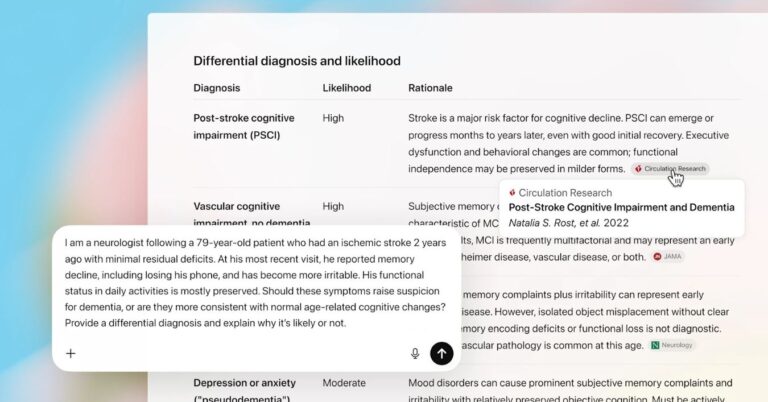
ChatGPT Health is OpenAI’s new health-focused feature, linking medical records and wellness data to support more contextual, personalized health assistance.
The Revolution of AI in Healthcare: From Workflow Optimization to Personalized Medicine

The AI Track’s extensive analysis of the impact of AI in medical technology – how it is transforming healthcare by streamlining workflows, facilitating personalized medicine, and beyond. Explore the profound impact of AI in the medical field.
Read a comprehensive monthly roundup of the latest AI news!