
Key Takeaway
The US government has allowed Anthropic to restore Claude Mythos 5 access for selected US cyber defenders, infrastructure providers, federal agencies, and private companies after an earlier export-control block. The decision creates a controlled release path for one of Anthropic’s most capable cybersecurity models while Fable 5 remains blocked.
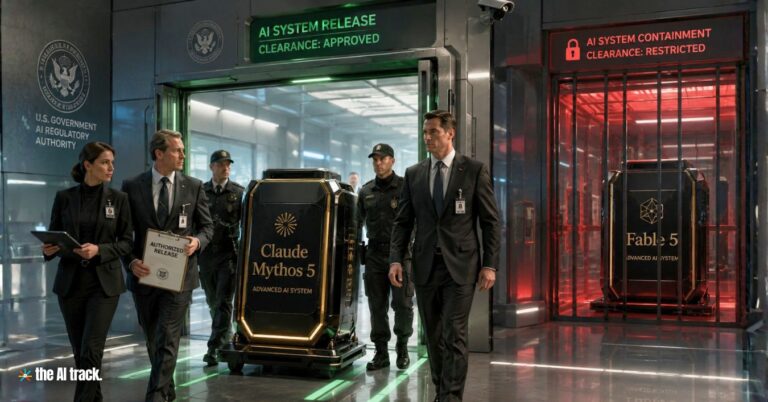
Limited Claude Mythos 5 Release – Key Points
The Story
The US government has partially rescinded its earlier export ban on Anthropic’s most advanced AI models, allowing Claude Mythos 5 to return for a limited group of approved US organizations. The move de-escalates a two-week confrontation that created uncertainty across the US AI industry.
The decision follows a June 12 export-control directive that forced Anthropic to disable access to both Claude Mythos 5 and Claude Fable 5. The order applied to foreign nationals inside and outside the United States, including Anthropic employees who are not US citizens.
The new permission applies to Claude Mythos 5 for approved companies, agencies, partners, and their employees, including non-US citizens at approved organizations and non-US Anthropic employees. Licensing restrictions remain for companies outside the approved list.
Claude Mythos 5 can now be redeployed to US organizations that operate and defend critical infrastructure. More than 100 companies and agencies are expected to receive access, including federal agencies, private companies, many Fortune 500 companies, and organizations connected to Anthropic’s Project Glasswing.
The Facts
- The original restriction was issued on June 12, 2026.
- Anthropic disabled customer access to both Claude Mythos 5 and Claude Fable 5 to comply with the order.
- The restriction applied to foreign nationals, including non-US Anthropic employees.
- The revised permission covers Claude Mythos 5 only.
- More than 100 companies and agencies are expected to receive access.
- Some approved organizations are linked to Anthropic’s Project Glasswing, including infrastructure providers such as Cisco and banks such as JPMorgan Chase.
- Fable 5 remains blocked and has not received the same clearance.
- Claude Mythos 5 is designed for selected cybersecurity use, with some safeguards lifted.
- An early version of Claude Mythos 5 was able to find thousands of new cyber vulnerabilities and bugs.
- Fable 5 and Claude Mythos 5 use the same underlying AI model, but differ in safeguard settings and intended access.
- Fable 5 had been available to the general public, with stronger guardrails blocking some cyber and biology-related requests.
- The government’s concern centered on cybersecurity risk, including possible misuse by military intelligence users in China, Russia, or other countries of concern.
- Administration officials were also concerned that users could circumvent Fable 5’s guardrails.
- Anthropic has argued that the reported concern involved a narrow jailbreak rather than a universal bypass.
What Is New
The main change is not a full release. It is a limited carveout.
Claude Mythos 5 can return for approved US organizations that operate and defend critical infrastructure. That makes the model available for high-value cybersecurity use cases, but only under government-vetted access conditions.
The decision also separates Claude Mythos 5 from Fable 5. Claude Mythos 5 is being treated as a restricted tool for trusted cyber defense users. Fable 5, which was intended for broader public and developer access, remains blocked while talks continue. No timeline has been confirmed for restoring Fable 5 access.
Why Claude Mythos 5 Raised Cybersecurity Concerns
Claude Mythos 5 is positioned as Anthropic’s strongest cybersecurity model. That is the source of both its value and its risk.
For defenders, a model with advanced code analysis and vulnerability-discovery capabilities could help secure critical systems, inspect large software environments, and respond faster to threats. For attackers, similar capabilities could accelerate vulnerability discovery, exploit development, and intrusion planning.
Experts have warned that such systems could be especially dangerous in sectors such as banking, where complex and older technology systems remain deeply interconnected.
In response to the export-control directive, Anthropic sent senior scientists and engineers to Washington, D.C., to work with the Commerce Department and the Office of the National Cyber Director on restoring access while limiting cyber risk.
The Access Debate
The decision introduces a practical but controversial model for frontier AI release: trusted access before broader availability.
This gives selected companies, agencies, and institutions early access to powerful systems while others remain excluded. Critics argue that the process gives the government too much influence over which customers can use frontier models, especially when selection criteria are not public.
The issue now extends beyond Anthropic. OpenAI has also delayed the full public launch of GPT-5.6 at the US government’s request, limiting access to a small group of vetted partners for its GPT-5.6 Sol, Terra, and Luna models. OpenAI’s launch plan included a trusted-partner list shared with the government before release, along with work on a clearer framework for future model reviews.
What to Watch Next
The next major question is whether the US government allows Anthropic to restore Fable 5 for broader use.
Three issues matter most:
- whether Fable 5 receives a separate clearance;
- whether Anthropic expands Claude Mythos 5 access beyond the first approved US group;
- whether the US creates clearer criteria for model restrictions, trusted organizations, and frontier AI release reviews.
At the beginning of June, US President Donald Trump issued an executive order directing the federal government to strengthen cyber defenses and create a mechanism for testing the most advanced AI models for safety issues. That mechanism remains in development.
A clearer framework would matter for developers, enterprise buyers, cybersecurity teams, and AI companies planning future model launches.
Why This Matters
This case shows how frontier AI access may become more controlled when models cross sensitive capability thresholds. For end users and businesses, the impact is practical: the most capable AI systems may not arrive as simple public product launches, but through staged access, government review, and sector-specific restrictions.
This article was drafted with the assistance of generative AI. All facts and details were reviewed and confirmed by an editor prior to publication.

Anthropic has accused Alibaba-linked operators of using fraudulent accounts in a Claude Distillation campaign involving 28.8 million exchanges.

Anthropic disabled Fable 5 and Mythos 5 after a U.S. export-control order, raising new questions about AI access and safety.
Anthropic launched Claude Fable 5 and Mythos 5 with stronger coding, long-context work, guarded access, new pricing, and safety fallbacks.

The GPT 5.6 launch starts with Sol, Terra and Luna in limited preview as U.S. officials review cyber risks before wider access.

Claude Opus 4.8 adds better agentic coding, effort control, dynamic workflows, cheaper fast mode, and top benchmark results.
Read a comprehensive monthly roundup of the latest AI news!