Key Takeaway
Google AI talent loss is becoming a visible pressure point as Noam Shazeer moves to OpenAI, John Jumper moves to Anthropic, and Arthur Conmy lists Anthropic as his next role. The moves do not change Google’s products immediately, but they add pressure around Gemini, AI coding tools, AI training expertise, and AI for science.
Google AI Talent Loss – Key Points
The Core Shift
Google is facing a high-profile AI talent test at a time when frontier labs are competing not only on models, chips, and products, but also on the researchers who shape them.
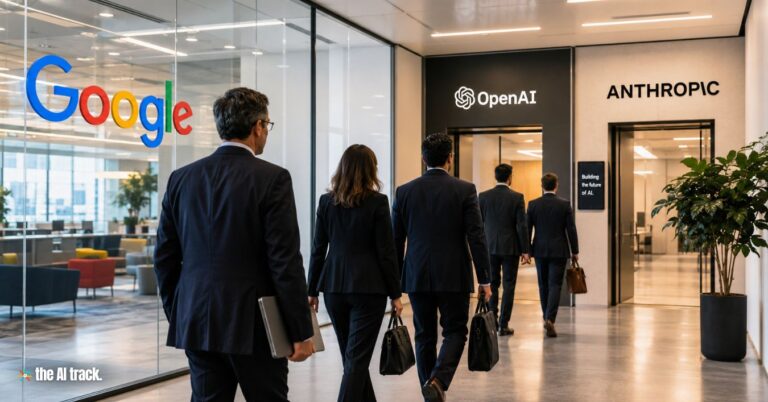
Noam Shazeer, Google’s vice president of engineering and a co-lead of its Gemini models, is leaving for OpenAI. John Jumper, one of the central figures behind AlphaFold at Google DeepMind, is leaving for Anthropic after nearly nine years. Arthur Conmy, a former Google DeepMind senior research engineer who worked on post-training for Gemini and AI safety, lists Anthropic as his next role.
Jonas Adler and Alexander Pritzel, both described as important Gemini contributors, are also reportedly preparing to join Anthropic. Neither Google nor Anthropic has publicly confirmed those two reported moves.
Google AI talent loss now involves researchers linked to several layers of modern AI development. Shazeer co-authored the 2017 “Attention Is All You Need” paper, which introduced the Transformer architecture used across much of modern generative AI. Jumper helped lead AlphaFold, the protein-structure prediction system that became one of the clearest examples of AI’s scientific impact. Conmy worked on Gemini post-training and alignment. Adler worked on Google’s AI coding efforts, while Pritzel was involved in AI training processes.
The Facts
Confirmed and Public Talent Moves
- Noam Shazeer is leaving Google for OpenAI.
- Shazeer was Google’s vice president of engineering and a co-lead of Gemini, Google’s flagship AI model family.
- He co-authored the 2017 Transformer paper, a foundation for today’s large language models.
- Shazeer and Daniel De Freitas left Google in 2021 after Google declined to aggressively pursue a chatbot project they had championed.
- They later founded Character.AI, one of the most prominent consumer chatbot startups.
- Google brought Shazeer and De Freitas back in August 2024 after a Character.AI licensing and hiring deal reported at about $2.7 billion.
- John Jumper is leaving Google DeepMind for Anthropic.
- Jumper worked on AlphaFold, Google DeepMind’s AI system for predicting protein structures.
- Jumper shared the 2024 Nobel Prize in Chemistry with Demis Hassabis and David Baker. Hassabis and Jumper were recognized for AI-based protein-structure prediction.
- Arthur Conmy lists Anthropic as his next role as a member of technical staff working on aligning upcoming models as they are trained.
- Conmy worked at Google DeepMind from 2023 to 2026 on post-training for Gemini, interpretability tools, and AI safety.
Anthropic’s Research Push
- OpenAI co-founder and former Tesla AI director Andrej Karpathy joined Anthropic’s pre-training team in May 2026.
- Anthropic has an AI for Science event scheduled for June 30, 2026.
- Anthropic announced in April 2026 an expanded agreement with Google and Broadcom for multiple gigawatts of next-generation TPU capacity.
- The additional TPU capacity is expected to come online starting in 2027.
Market Reaction
- Alphabet shares fell sharply on June 22, 2026.
- Market coverage tied the decline to concerns about AI spending, competition, and Google’s ability to retain senior AI talent.
- The stock reaction turned Google AI talent loss from internal personnel news into a broader investor concern.
Product Pressure
- OpenAI and Anthropic have gained visibility with developer-facing products and coding-focused model use.
- Google CEO Sundar Pichai previously said Google was “a bit behind” in agentic coding, citing the lack of developer-facing products as one reason.
- The departures came weeks after Google I/O 2026, where Google introduced Gemini 3.5 Flash and Gemini Spark, a personal AI agent using 3.5 Flash.
Why These Departures Stand Out
This is not a routine movement of employees between technology companies.
Shazeer is linked to the Transformer architecture, which underpins large language models, AI search, chatbots, coding assistants, and many multimodal systems. His move to OpenAI matters because OpenAI is one of Google’s strongest competitors in consumer AI, enterprise AI, and developer tools.
Jumper’s move matters for a different reason. AlphaFold showed that AI could solve scientific problems with direct relevance to biology, medicine, and drug discovery. Anthropic has been expanding Claude beyond chat and coding into enterprise and scientific use cases, so Jumper’s arrival strengthens that direction.
Conmy’s move adds an AI safety and alignment layer to the broader pattern. His work at Google DeepMind involved post-training for Gemini and interpretability tools, both central to how advanced models are shaped after initial training.
The reported moves by Adler and Pritzel would add another layer of significance. Training a large AI model depends on decisions about architecture, data preparation, distributed computing, and post-training methods. Researchers with experience at Gemini scale are difficult to replace quickly.
Together, the moves show why Google AI talent loss has become a competitive signal for investors, developers, and rival AI labs.
What It Means for Google
Google still has one of the deepest AI research organizations in the world. It owns major infrastructure, search distribution, cloud capacity, DeepMind, Gemini, Android, YouTube, and enterprise channels.
The concern is not whether Google has AI talent. It clearly does.
The concern is whether Google can keep its most visible researchers aligned with its product and business strategy while faster-moving rivals compete for the same people with focused labs, large compensation packages, and potential pre-IPO upside.
The larger issue is product translation. Google has produced major research breakthroughs, but the market is judging whether those breakthroughs become developer tools, business products, and user-facing AI features quickly enough.
The Anthropic relationship also makes the situation more complex. Anthropic competes directly with Gemini through Claude, but it also relies on Google as an infrastructure partner for large-scale TPU capacity.
What to Watch Next
Google’s response will matter more than the departures themselves.
The main questions are whether Google changes compensation, gives senior researchers more product authority, accelerates developer-facing AI tools, or reorganizes teams around clearer commercial priorities.
The reported Adler and Pritzel moves are another point to track. Confirmation of those departures would deepen the narrative that Anthropic is recruiting not only high-profile names, but also researchers with direct experience building and training frontier model systems.
OpenAI’s next moves will also matter. Shazeer’s role could influence model research, architecture work, coding systems, or product-facing AI capabilities.
Why This Matters
AI progress is shaped by research talent, but end users feel the impact through products: search, coding assistants, scientific tools, workplace automation, and creative systems. Google AI talent loss shows that the AI race is not only about model benchmarks; it is also about which companies can turn elite research into useful, reliable, and widely adopted tools.
This article was drafted with the assistance of generative AI. All facts and details were reviewed and confirmed by an editor prior to publication.
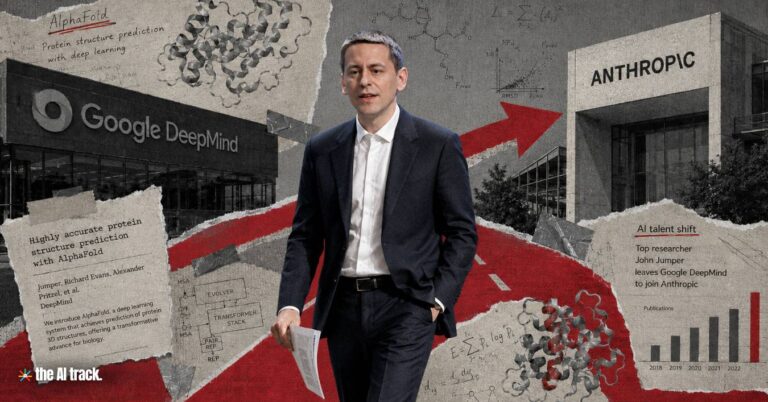
John Jumper is leaving Google DeepMind for Anthropic, giving the Claude maker a major AI-for-science hire amid a wider frontier AI talent war.
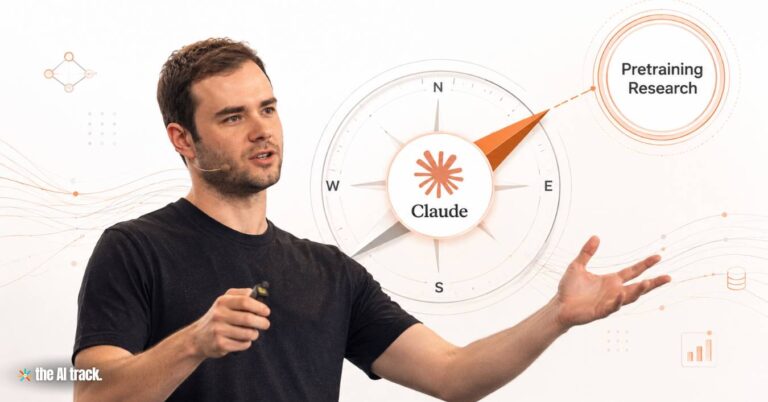
Andrej Karpathy joins Anthropic to work on Claude pretraining, strengthening the company’s AI research team amid rising competition.
The Google SpaceX compute deal gives Google access to 110,000 Nvidia GPUs from October 2026 to June 2029 as AI demand rises.
Google DeepMind’s AI Control Roadmap treats advanced AI agents as insider threats, using monitoring and access controls to reduce deployment risks.
Google’s DiffusionGemma is an experimental open model that uses text diffusion to generate blocks of text in parallel for faster local AI workflows.
Read a comprehensive monthly roundup of the latest AI news!