Key Takeaway
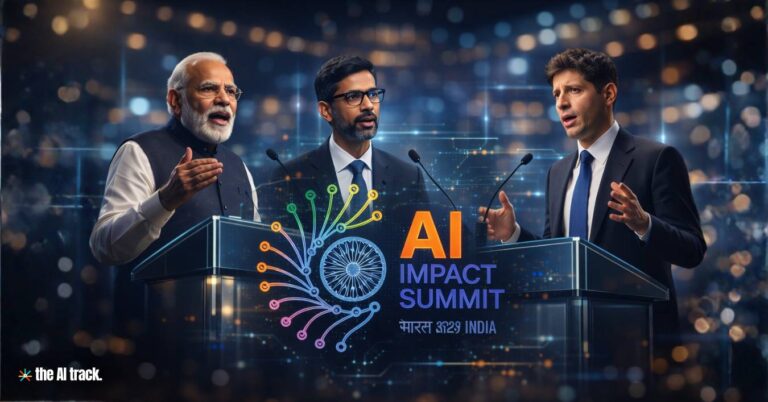
The India AI Impact Summit 2026 concluded with 88 nations and international organizations adopting the New Delhi Declaration, a framework for “AI for All” centered on equitable access and shared principles. India utilized the event to position itself as a global AI hub, targeting $200 billion in data center and infrastructure investments over the next two years. Major industry commitments include a ₹10 lakh crore ($120 billion) pledge from Reliance Industries and expanded infrastructure projects from Google and Microsoft.
India AI Impact Summit 2026 – Key Points
The Overview
Across five high-stakes days in New Delhi, the global tech elite converged to navigate a shifting power dynamic in the artificial intelligence landscape. The India AI Impact Summit 2026 established a multilateral consensus on responsible governance while securing massive capital commitments from global technology leaders. As the first major international AI forum of this scale to be hosted in the Global South, the event served as a platform for India to pitch itself as a cost-effective, trusted counterweight to the U.S.–China tech axis.
The Facts
Governance & National Policy Roadmap
- New Delhi Declaration: Adopted by 88 signatories including the US, UK, Canada, China, and Germany, the declaration is built on seven pillars (“Chakras”) focusing on collaborative, trusted, and resilient AI.
- Healthcare Blueprint: The Union Health Ministry launched a national AI policy roadmap and a testing platform to validate AI tools for safe real-world deployment in public healthcare.
- Democratic AI: OpenAI CEO Sam Altman suggested an international body similar to the IAEA for governance, while Google DeepMind CEO Demis Hassabis called for urgent research into autonomous system threats.
The $200B Infrastructure Push
- Reliance Commitment: Reliance Industries announced a ₹10 lakh crore ($120 billion) investment over seven years to develop autonomous AI systems and infrastructure.
- Data Center Goals: The Indian government introduced long-term tax holidays for data centers to attract a targeted $200 billion in private investment.
- Connectivity & Compute: Google unveiled the “America-India Connect” subsea cable initiative, while the government operationalized a facility with 38,000 GPUs to provide startups with low-cost compute.
Technological Milestones & Market Expansion
- Sovereign Models: BharatGen released Param 2, a 17-billion-parameter model supporting 22 Indian languages; Sarvam AI introduced the Sarvam 30B and 105B open-source models.
- Voice AI: Bengaluru-based Gnani.ai launched Vachana, a voice-cloning text-to-speech model supporting 12 Indian languages.
- OpenAI Expansion: OpenAI confirmed it will open new offices in Bengaluru and Mumbai and partnered with Tata Group to deploy up to 1 gigawatt of compute.
Summit Happenings & Logistical Challenges
- Robotic Dog Dispute: Galgotias University was evicted from the summit after a professor claimed a Chinese-made Unitree Go2 robot dog was an original university invention.
- Cancellations: Bill Gates and Nvidia CEO Jensen Huang withdrew from scheduled appearances; Gates’ cancellation followed recent DOJ scrutiny regarding foundation files.
- Logistical Failures: The opening days of the India AI Impact Summit 2026 were marked by “logistical chaos,” including hours-long queues, overcrowding, and reports of stolen equipment.
Numbers that Matter
- $200 Billion: The total investment in AI infrastructure and data centers India aims to attract over the next two years.
- 100 Million: Weekly active ChatGPT users in India, the second-largest user base globally after the US.
- $30 Million: The value of Google’s new “AI for Science” fund launched during the summit.
Winners / Losers / Risks / Limitations
- Winners: India’s startup ecosystem gained access to 38,000 government-backed GPUs and new multilingual open-source models.
- Risks: Amnesty International criticized the summit for failing to establish binding human rights protections, alleging that AI deployment in India is being used for mass surveillance.
- Limitations: Despite the “AI for All” rhetoric, the US expressed opposition to “centralized control,” signaling a rift between Western corporate interests and Global South calls for a $3 billion capacity fund.
Quotes
“Design and develop in India. Deliver to the world. Deliver to humanity.” — Prime Minister Narendra Modi
“AI must not become exclusive. It must remain widely accessible.” — Ashwini Vaishnaw, Minister for Electronics and IT
What to Watch Next
- Sovereign AI Deployment: Implementation of the National AI blueprint for healthcare across Indian public hospitals.
- Superintelligence Timeline: Industry monitoring of Sam Altman’s prediction that early versions of “true superintelligence” may arrive by the end of 2028.
- Investment Flow: Monitoring whether the $200 billion in pipeline investments materializes following the India AI Impact Summit 2026.
This article was drafted with the assistance of generative AI. All facts and details were reviewed and confirmed by an editor prior to publication.
Sarvam opens Indus in limited beta powered by its 105B sovereign model, alongside Akshar, Saaras V3, Edge, Studio, and Arya for India-focused AI.
India and AI: A $500B vision by 2030, driven by mega infrastructure, sovereign AI, and global partnerships in agriculture, healthcare, and smart cities.

MeitY unveils the India AI governance guidelines on 5 Nov 2025, outlining light-touch, risk-based regulation, new institutions, and deepfake labelling rules ahead of the 2026 summit.

OpenAI launches OpenAI for India and partners with Tata Group to deploy 100MW of AI-ready data center capacity, with plans to scale to 1GW and expand enterprise and youth AI programs.

India, Australia and Canada launched the ACITI Partnership at the G20 to advance critical tech, AI, clean energy & supply-chain resilience, with talks set for early 2026.
Read a comprehensive monthly roundup of the latest AI news!