Key Takeaway
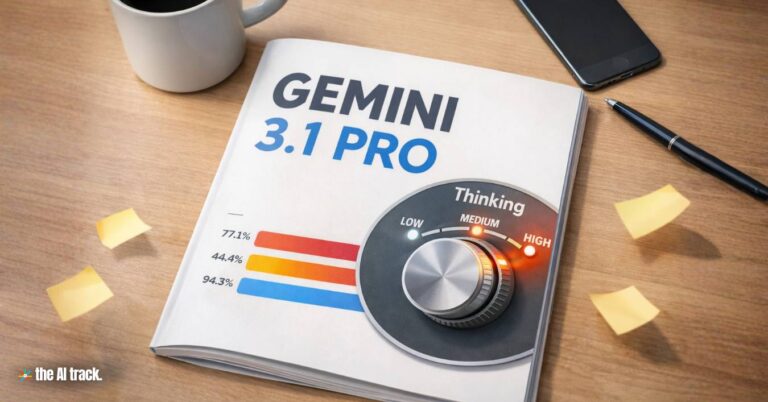
Google has released Gemini 3.1 Pro in preview, introducing a three-tier adjustable reasoning system and reporting major gains on logic and agentic benchmarks. The model scored 77.1% on ARC-AGI-2 and 44.4% on Humanity’s Last Exam, while adding low, medium, and high “thinking” modes that scale reasoning effort on demand. It is rolling out in February 2026 across Google AI Studio, Vertex AI, Gemini Enterprise, and consumer apps, with API pricing unchanged at $2 input and $12 output per 1 million tokens.
Google Releases Gemini 3.1 Pro – Key Points
The Overview
Gemini 3.1 Pro succeeds Gemini 3, launched in November 2025, and represents the first “point one” update in the Gemini series. Google says the model brings the upgraded core intelligence behind its February 2026 Gemini 3 Deep Think update into wider preview access, positioning 3.1 Pro as a stronger baseline for complex problem-solving.
The Facts
Adjustable Reasoning & Architecture
- Introduces three thinking levels — low, medium, and high — allowing developers to dynamically scale computational effort per request.
- “High” mode functions as a lightweight version of Gemini Deep Think, which Google updated in February 2026, bringing that upgraded core intelligence into Gemini 3.1 Pro.
- Enables a single model endpoint to handle both routine tasks (fast, low thinking) and multi-minute complex reasoning sessions (high thinking), reducing the need to route across multiple models.
Benchmarks & Competitive Position
- Scored 77.1% on ARC-AGI-2, more than double Gemini 3 Pro’s 31.1%, outperforming Claude and GPT-5.2 on this logic-focused test.
- Reached 44.4% on Humanity’s Last Exam and 94.3% on GPQA Diamond, leading across academic and scientific evaluations.
- Posted strong gains on real-world task benchmarks, including 68.5% on coding tasks and 85.9% on web-based tasks, and now leads the APEX-Agents leaderboard.
- However, it does not currently top the Arena public leaderboard for text or coding, where Claude Opus 4.6 and GPT-5.2 rank slightly higher. (Arena results are user-voted rather than strictly accuracy-based.)
Capabilities & Demos
- Google highlights practical uses tied to “advanced reasoning,” including producing clear visual explanations, synthesizing data into a single view, and supporting creative projects.
- Demonstrations include website-ready animated SVG generation from text prompts, emphasizing crisp scaling and small file sizes versus traditional video.
- Demonstrations also include complex system synthesis: building a live aerospace dashboard by configuring a public telemetry stream to visualize the International Space Station’s orbit.
- Examples also include creative coding (generating an entire website concept from a prompt) and an interactive simulation (a controllable 3D starling murmuration with hand-tracking controls and a generative score that changes with flock movement).
Access, Pricing & Technical Limits
- Rolling out now in the Gemini app (with higher limits for Pro and Ultra users) and NotebookLM (Pro and Ultra only).
- Available for developers via the Gemini API, AI Studio, Vertex AI, and related tools.
- Pricing remains $2 per 1M input tokens and $12 per 1M output tokens.
- Context size remains unchanged.
- Currently in preview, with full general availability expected soon.
Why This Matters
Gemini 3.1 Pro combines benchmark gains with a deployment lever enterprises can actually use: adjustable reasoning depth in a single endpoint, plus higher usage limits for paid consumer tiers. The release targets a practical trade-off: speed and cost for routine requests versus deeper reasoning for complex work, while pushing harder into agentic and code-driven workflows that increasingly define production AI use.
This article was drafted with the assistance of generative AI. All facts and details were reviewed and confirmed by an editor prior to publication.

Google’s Veo 3 can autonomously generate hyperreal AI video with audio and dialogue. Its capabilities are impressive—and controversial.

Google Translate adds AI practice and Gemini-powered live translation in 70+ languages, launching first in the US, India, and Mexico.

Google publishes its 2026 Responsible AI Progress Report, detailing Gemini 3 safety testing, agentic AI controls, SAIF 2.0, and compliance ahead of EU AI Act enforcement.

Google made Gemini 3 the default model for AI Overviews globally in January 2026, enabling seamless follow-up conversations inside Search

Google rolls out Gemini-powered Google Translate updates, including live headphone translation and native audio upgrades, starting December 2025.

Google launches Gemini Personal Intelligence in the U.S., enabling opt-in context across Gmail, Photos, YouTube history, and Search for paid users.
Read a comprehensive monthly roundup of the latest AI news!