Key Takeaway
The Google SpaceX compute deal gives Google access to large-scale AI infrastructure, with SpaceX reportedly charging $920 million per month from October 2026 through June 2029.
Google SpaceX compute deal – Key Points
The Core Shift
AI competition is moving deeper into infrastructure.
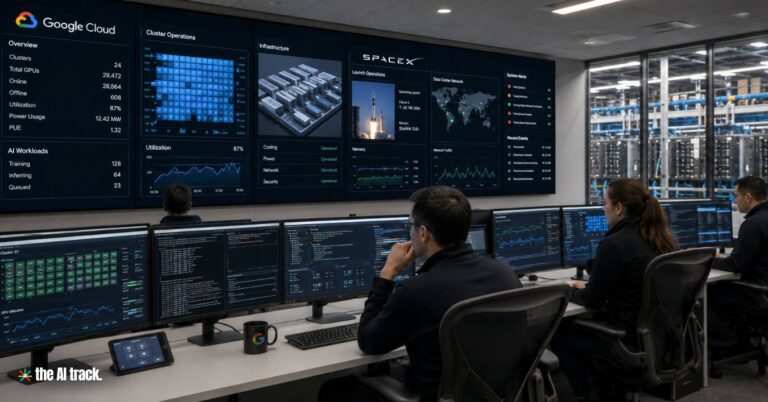
The Google SpaceX compute deal gives Google access to roughly 110,000 Nvidia GPUs, along with CPUs, memory, and related components used for AI processing. Instead of relying only on its own data centers and cloud infrastructure, Google is adding external high-performance compute capacity from SpaceX.
What Changed
SpaceX is no longer being positioned only as a rocket, satellite, and Starlink company. Its AI infrastructure business is becoming a major part of its growth story.
The Google SpaceX compute deal follows another major compute partnership involving Anthropic and SpaceX/xAI’s Colossus 1 infrastructure in Memphis, Tennessee. Anthropic said in May that it would use the full computing power of Colossus 1, which houses more than 220,000 Nvidia processors and is expected to add 300 megawatts of new capacity.
For Google, the agreement adds bridge capacity at a time when demand for AI platforms, agents, enterprise tools, and model inference continues to rise. A Google spokesperson said the agreement is intended to meet surging customer demand for Gemini Enterprise, Google’s agentic AI platform, which has been higher than expected.
The Numbers That Matter
- Google will reportedly pay SpaceX $920 million per month for compute capacity.
- The agreement is expected to run from October 2026 through June 2029.
- The deal could generate more than $30 billion for SpaceX if it runs its full course.
- The deal gives Google access to about 110,000 Nvidia GPUs.
- The infrastructure package also includes CPUs, memory, and related components.
- Capacity will ramp up through the delivery period at a reduced fee.
- Google can terminate the agreement, or accept fewer GPUs at a reduced fee, if SpaceX fails to deliver the agreed GPU capacity after a one-month grace period.
- After December 31, either party can terminate the agreement with 90 days’ notice.
- Google will retain ownership and intellectual property rights over its content, AI models, and associated data.
- SpaceX’s disclosed compute agreements with Google and Anthropic are worth about $26 billion annually and more than $70 billion in aggregate if neither contract is terminated early.
- SpaceX is preparing for a major public listing while promoting AI infrastructure and orbital data centers as part of its future growth strategy.
Why Google Needs More AI Compute
Google already operates one of the world’s largest cloud and AI infrastructures. It also develops its own Tensor Processing Units, or TPUs, for AI workloads.
But the AI market is expanding faster than most companies can comfortably serve with internal capacity alone. Enterprise customers are building AI agents, automating workflows, testing multimodal systems, and integrating AI into software, search, productivity tools, and cloud services.
That creates pressure in two areas.
First, training advanced models still requires massive clusters of specialized chips.
Second, inference demand is growing as more users interact with AI systems every day. Inference is the process of running a model after training, and it can become extremely expensive at consumer and enterprise scale.
Leasing external compute can help Google expand capacity faster without waiting for every internal data center project to be completed.
Why SpaceX Is Entering AI Infrastructure
SpaceX has several assets that can support a compute business: engineering scale, large capital access, energy-intensive infrastructure experience, and a long-term plan around orbital data centers.
The company is also using AI compute agreements to strengthen its financial story ahead of its public market debut. Large, recurring compute contracts can make SpaceX look less dependent on launch services and Starlink subscriptions alone.
The strategy has accelerated since SpaceX and xAI merged earlier in 2026. SpaceX/xAI has been investing heavily in AI infrastructure, including Colossus 1 in Memphis, while also promoting longer-term plans for compute capacity beyond conventional data centers.
This does not mean SpaceX is becoming a traditional cloud provider overnight. But it does show a strategic expansion: compute capacity is becoming a product.
The Business Impact
The Google SpaceX compute deal could reshape how major AI companies think about infrastructure sourcing.
Cloud giants such as Google, Microsoft, Amazon, and Oracle already compete to provide AI infrastructure to customers. But this agreement shows that even the largest cloud and AI companies may rent capacity from outside providers when demand is high enough.
This creates a wider market for non-traditional infrastructure players. Companies with access to chips, power, land, cooling, data center operations, and capital can become strategically important in the AI supply chain.
It also increases pressure on Nvidia GPU supply. Access to advanced GPUs remains one of the central constraints in AI development and deployment.
What to Watch Next
The next test is execution.
SpaceX must deliver enough usable GPU capacity on time. Google must integrate that capacity into its AI infrastructure strategy. Investors will watch whether these compute contracts become stable long-term revenue or short-term demand driven by the current AI boom.
The bigger question is whether SpaceX can turn AI data centers, and eventually orbital compute, into a durable business line alongside launch services and Starlink.
Why This Matters
The Google SpaceX compute deal shows that AI progress is becoming inseparable from infrastructure control. The companies that secure chips, data centers, power, and scalable compute capacity will have a major advantage in building and running advanced AI systems.
This article was drafted with the assistance of generative AI. All facts and details were reviewed and confirmed by an editor prior to publication.

SpaceX will give Anthropic access to Colossus 1, a Memphis AI supercomputer with 220,000+ NVIDIA GPUs, boosting Claude capacity.

Humain invests $3 billion in xAI Series E, part of a $20 billion round closed in January 2026, ahead of SpaceX acquisition and share conversion.

SpaceX acquires xAI in February 2026, with valuations reported around $1.125tn to $1.25tn, creating the world’s most valuable private company.

OpenAI surpasses SpaceX as the world’s most valuable private company after a $6.6B secondary share sale at a $500B valuation.
Read a comprehensive monthly roundup of the latest AI news!