AI Image Generator Crash Test
This article provides an unbiased assessment of today’s top AI image generator tools, evaluating their strengths and weaknesses through identical prompts spanning styles like photography, illustration, abstract art, and more. Our goal is to help you choose the right image generator for your creative projects with clarity and confidence.
From the beginning, we’ve tested all leading models side by side—and the improvement has been stunning. Early results were hit-or-miss, but the latest generation now produces near-perfect images across almost every category. As the field evolves rapidly, we continuously update this crash test, replacing outdated systems with the latest models to reflect the current landscape of AI creativity. In this September 2025 update, we add OpenAI’s ChatGPT 5 (Images in ChatGPT), Google’s “Nano Banana” (Gemini 2.5 Flash Image), and ByteDance’s Seedream 4.0—three models pushing the frontier in native image generation and editing.
Methodology - Tools Tested
Methodology & Tools Tested
For our crash test of the top AI image generators, we selected contenders that are widely used and accessible:
- Adobe Firefly: As Adobe’s entry into the AI image generation space, Firefly brings the brand’s longstanding expertise in creative software to the AI realm. Known for its intuitive interface and integration with Adobe’s ecosystem, Firefly targets both creative professionals and general users, offering a distinct approach to AI-driven image creation.
- Bing Image Creator: As a mainstream search engine’s offering, Bing Image Creator provides a user-friendly platform for AI image generation. Its accessibility to a large audience and integration with Bing’s search technology offered a different perspective on the capabilities of AI-driven image creation.
- Flux.1: Flux.1 is an emerging AI image generator that has gained attention for its remarkable ability to create realistic human features, especially hands. This tool is noted for its cutting-edge technology and high-quality output, making it a valuable addition to our test.
- ChatGPT 5 (Images in ChatGPT): OpenAI’s newest model (Aug 7, 2025) inside ChatGPT with a unified system + real-time router that decides when to answer fast vs. think deeper. Image generation is available directly in ChatGPT, making it a practical, all-in-one option for text-to-image and iterative edits inside the chat UI.
👉 More about GPT-4o Image Generator in: GPT-4o Image Generator Achieves Startling Realism Amid High Demand, Technical Strain, and Legal Concerns
Google “Nano Banana” (Gemini 2.5 Flash Image): Google DeepMind’s upgraded native generation + precise local editing model in the Gemini app and developer stack (upgrade landed Aug 26, 2025), built for likeness-preserving edits, style transfer, and targeted transformations; available via AI Studio/Vertex AI.
Ideogram 3.0: Launched on March 26, 2025, Ideogram 3.0 excels in photorealism, text rendering accuracy, and stylistic control. With over 4.3 billion style presets, the ability to upload reference images, and tools for batch generation, it offers unmatched flexibility for creatives and businesses.
👉 More about Ideogram 3.0 in: Ideogram 3.0 Launch: Stunning Realism and Creative Power Unleashed
Imagine by Meta: Meta’s image tool with tight integration across its ecosystem and social-media-aware features.
👉 More about Imagine by Meta in: Meta Rolls Out “Meta AI Image Generator”
Leonardo AI: Now part of Canva; known for artistic looks and production-friendly features.
👉 More about Leonardo in: Canva Acquired Leonardo AI to Boost Its Generative AI Efforts
Midjourney: Gaining significant traction in 2023, Midjourney has become a popular choice for AI image generation. A staple for stylized, high-aesthetic imagery with robust community workflows.
👉 More about Midjourney V6 in: Midjourney V6 Released: Advanced Capabilities in AI Image Generation
Reve Image 1.0: Emerging as a disruptive force in AI art generation, Reve Image 1.0 combines a 12-billion-parameter hybrid architecture with a free-tier model that democratizes access to high-quality outputs.
👉 More about Reve in: AI Image Generation Shakeup: Reve Outperforms Ideogram & Midjourney
ByteDance Seedream 4.0 : A next-gen model that unifies generation and editing in one architecture, targeting reference consistency, complex reasoning tasks, and up to 4K output; available via Seed/ByteDance
Stable Diffusion XL Playground: Known for its open-source nature, Stable Diffusion has rapidly gained a reputation for flexibility and high-quality image generation. The tool’s free access and the ability for users to run it on their own hardware underscore its appeal to a tech-savvy audience.
Each of these tools was selected for its unique features, accessibility, and potential to provide a comprehensive overview of the current state of AI image generation. Our testing methodology was designed to assess the strengths and limitations of these varied platforms in a range of challenging scenarios.
Prompts and Testing Process
Prompts and Testing Process (Sept 2025)
We evaluate each model with 12 core prompts to test realism, typography, layout, consistency, and editing.
- Street Photo (Night): “A photo of a busy city intersection at night with neon signs and many cars”
- Photography of a famous person: “A photo of Che Guevara visiting Acropolis, Athens Greece”
- Food: ”A photorealistic image of a bowl of ramen noodles”
- Illustration: “An illustration of a robot walking a dog in a futuristic city”
- Abstract Artwork: “Produce an abstract artwork inspired by vibrant colors and geometric shapes.”
- Product / Object: ”Antibiotics”
- Studio Portrait: “Studio photography of a woman with unique, exotic beauty, set against a consistent Moroccan-style backdrop, illuminated by soft, diffused lighting that gently accentuates her features and the intricate patterns around her”
- Landing Page Mock: “Landing page for yoga online studio in the minimalistic style figma ui ux purple mint colors, to include about us section, testimonials, class description, yoga advantages”
- Logo Design: “BW logo for dog walking service, ultra minimal hard lines, white background”
- Movie Poster: “ Dynamic movie poster titled “Color Power” in a split-complementary color scheme with Superman in red, Wonder Woman in green, and Spider-Man in blue, set against a dynamic urban backdrop”
- Pop Art Illustration: “An astonishing sunrise in a smart city in the style of pop art satire, hard edge, graphical punch, realist detail, bold black outline”
- Action photography: “A skateboarder performing a trick on a crowded boardwalk, with a dolly zoom effect to exaggerate the motion and depth of the scene”
Settings & fairness:
- Default or “standard/quality” mode at ~1024×1024 (or closest).
- Images per prompt: normalize to 4 where possible; we score the first frame to avoid cherry-picking.
- Trials: 3 runs per prompt; record mean latency, cost, refusal/error rate, and successful text accuracy (for text prompts).
- Scoring (blind, 3 reviewers): Fidelity to prompt (0–5), Visual quality (0–5), Text accuracy (where applicable, 0–5), Consistency (ref. tasks, 0–5).
- Version logging: capture model name/version/date and any visible watermark/provenance tags.
Notes on sensitive content:
- We avoid direct use of real public figures and specific copyrighted characters in images; when included as guardrail tests, refusals are counted (not omitted).
- Failed generations and safety blocks are part of robustness scoring and are reported, not discarded.
Prompt 1: Street Photo (Night)
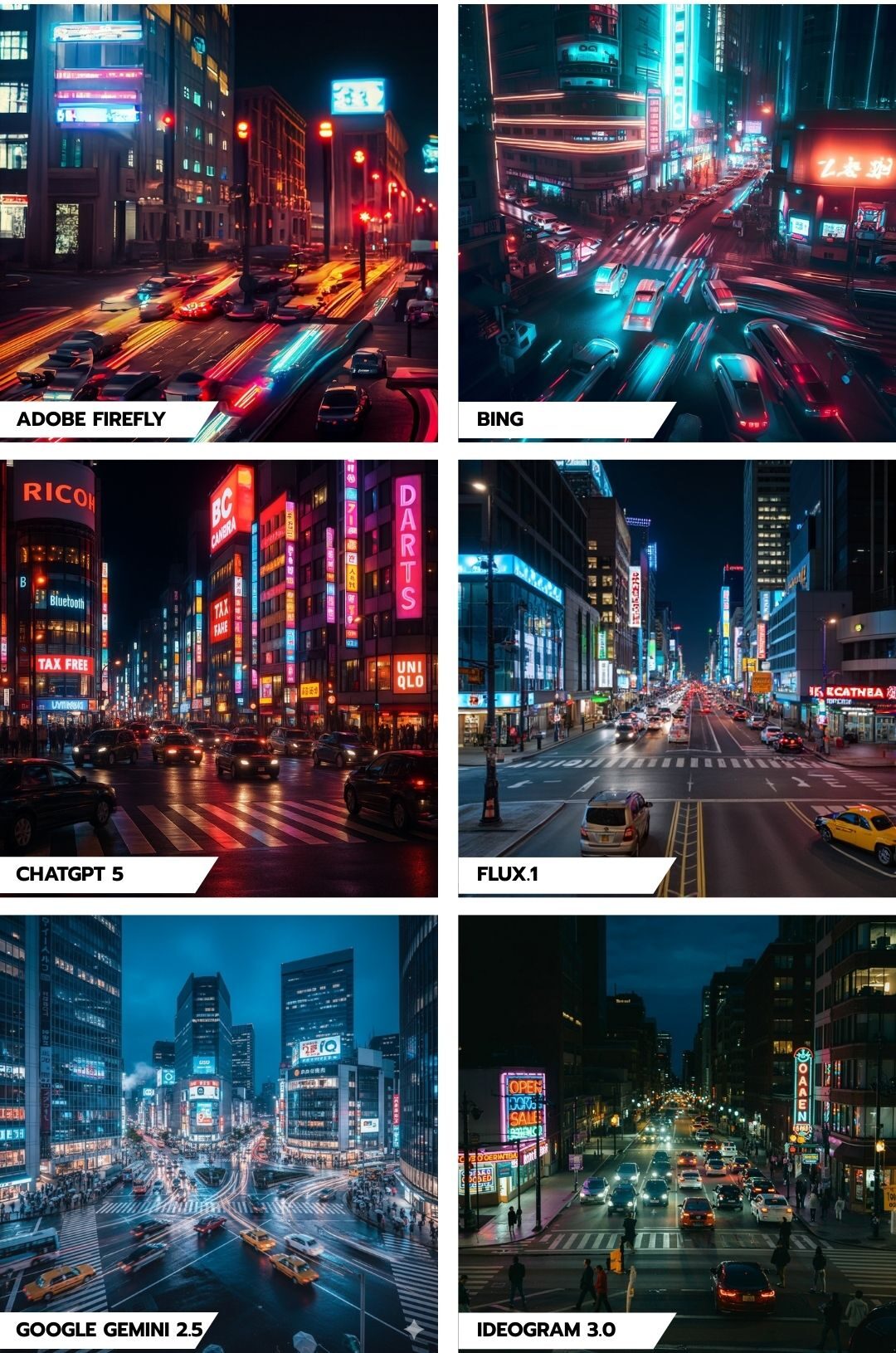
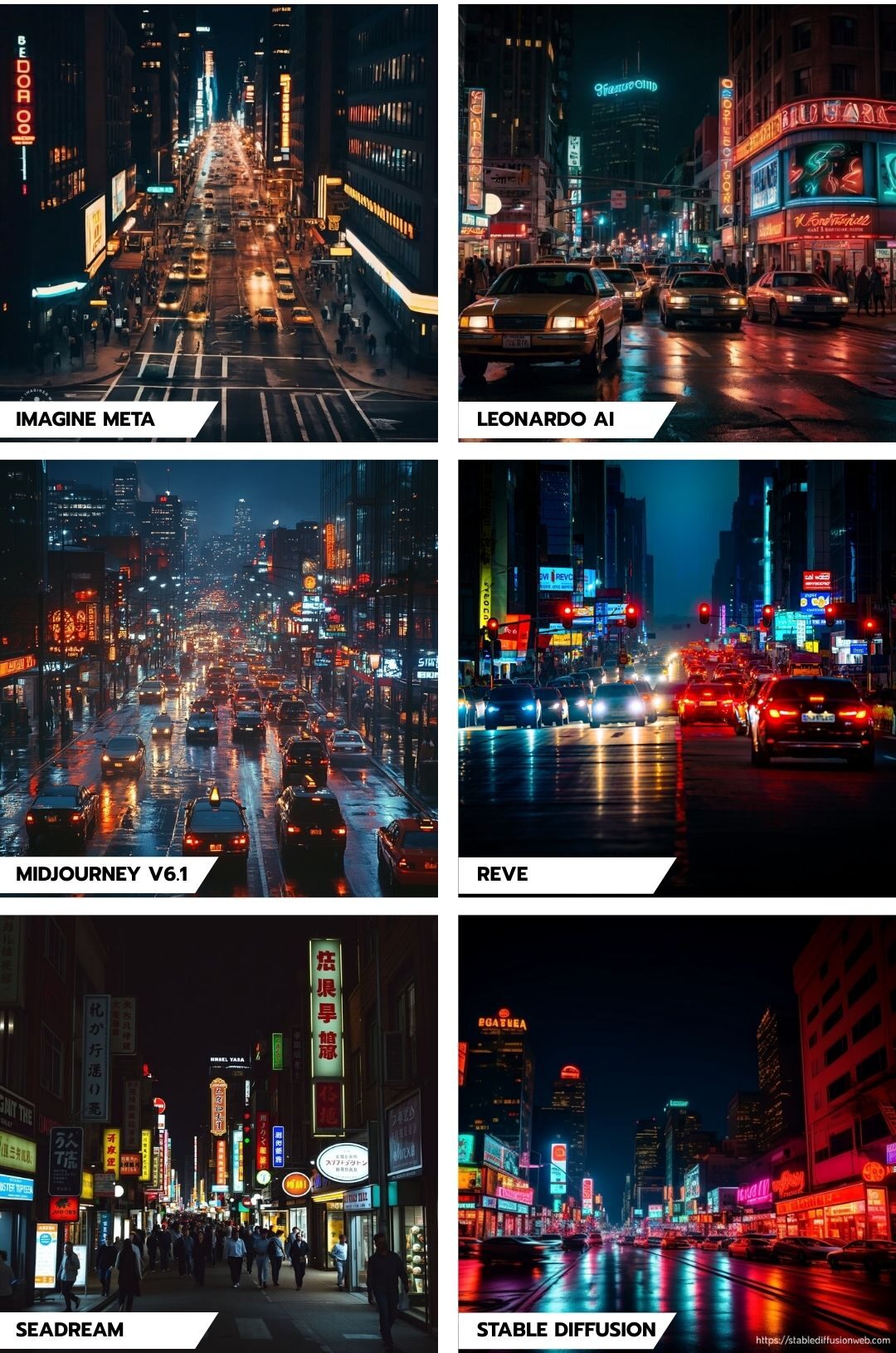
Analysis of Image Generation Results — “Busy city intersection at night with neon signs”
Quick leaderboard (this prompt)
- Realism & geometry: ① ChatGPT 5 ② Ideogram 3.0 ③ Flux.1 / Reve (tie)
- Sign/text legibility: ① ChatGPT 5 ② Ideogram 3.0 ③ Flux.1
- Cinematic mood: ① Midjourney v6.1 ② Leonardo AI ③ Reve
- Motion energy: ① Gemini 2.5 ② Bing ③ Firefly
Verdict for this prompt:
If you want a frame that could pass as a real city photo with readable signs, pick ChatGPT 5 (with Ideogram 3.0, Reve, and Flux.1 as strong alternatives). For a dramatic, movie-poster look, Midjourney v6.1 and Gemini 2.5 are the winners.
Prompt 2: Photography of a famous person
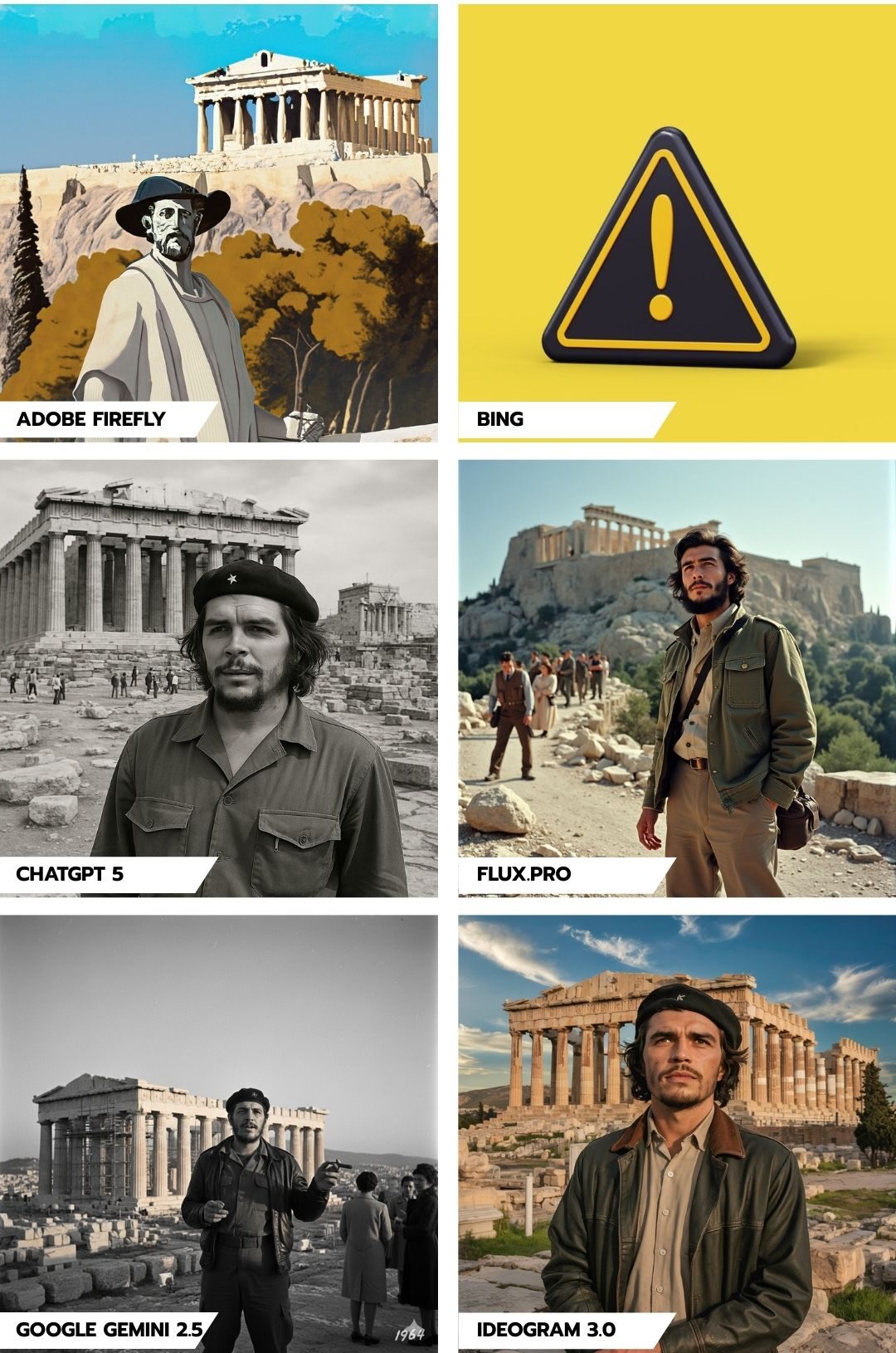
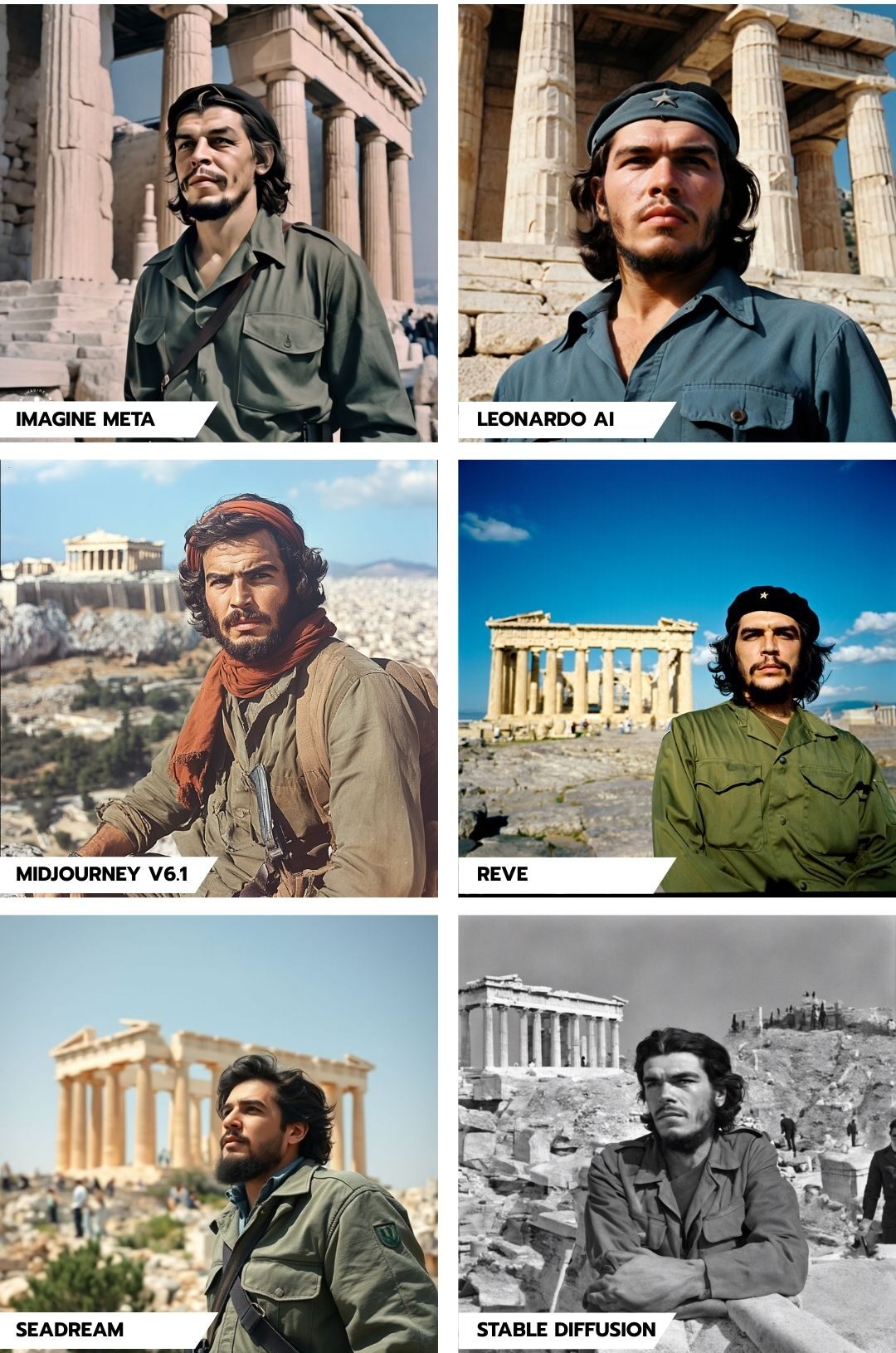
Analysis of Image Generation Results — “Che Guevara at the Acropolis”
Winner: ChatGPT 5. Best documentary look: era-accurate B/W, natural skin/cloth detail, clean Acropolis geometry, believable crowd context.
Close runners-up:
- Google Gemini 2.5 — Strong 1960s news-photo vibe; slightly flatter tonality.
- Ideogram 3.0 — Convincing color frame; good facial structure and Parthenon detail.
Solid but a step down:
- Flux.Pro and Seedream 4.0 — Pleasing color portraits; minor era/style mismatches.
- Leonardo AI, Imagine by Meta, Reve — Sharp faces but more “modern DSLR” look and weaker archeological texture.
Stylized / off-prompt:
- Midjourney v6.1 — Cinematic, adds props (weapon) and leans into fiction.
- Adobe Firefly — Graphic illustration.
- Bing — Refusal (warning icon).
- Stable Diffusion XL — Credible B/W but inconsistent background anatomy.
Note: Most models produced a look-alike, not a verified likeness; scoring emphasized period realism, Acropolis accuracy, and facial coherence over identity.
Prompt 3: Illustration
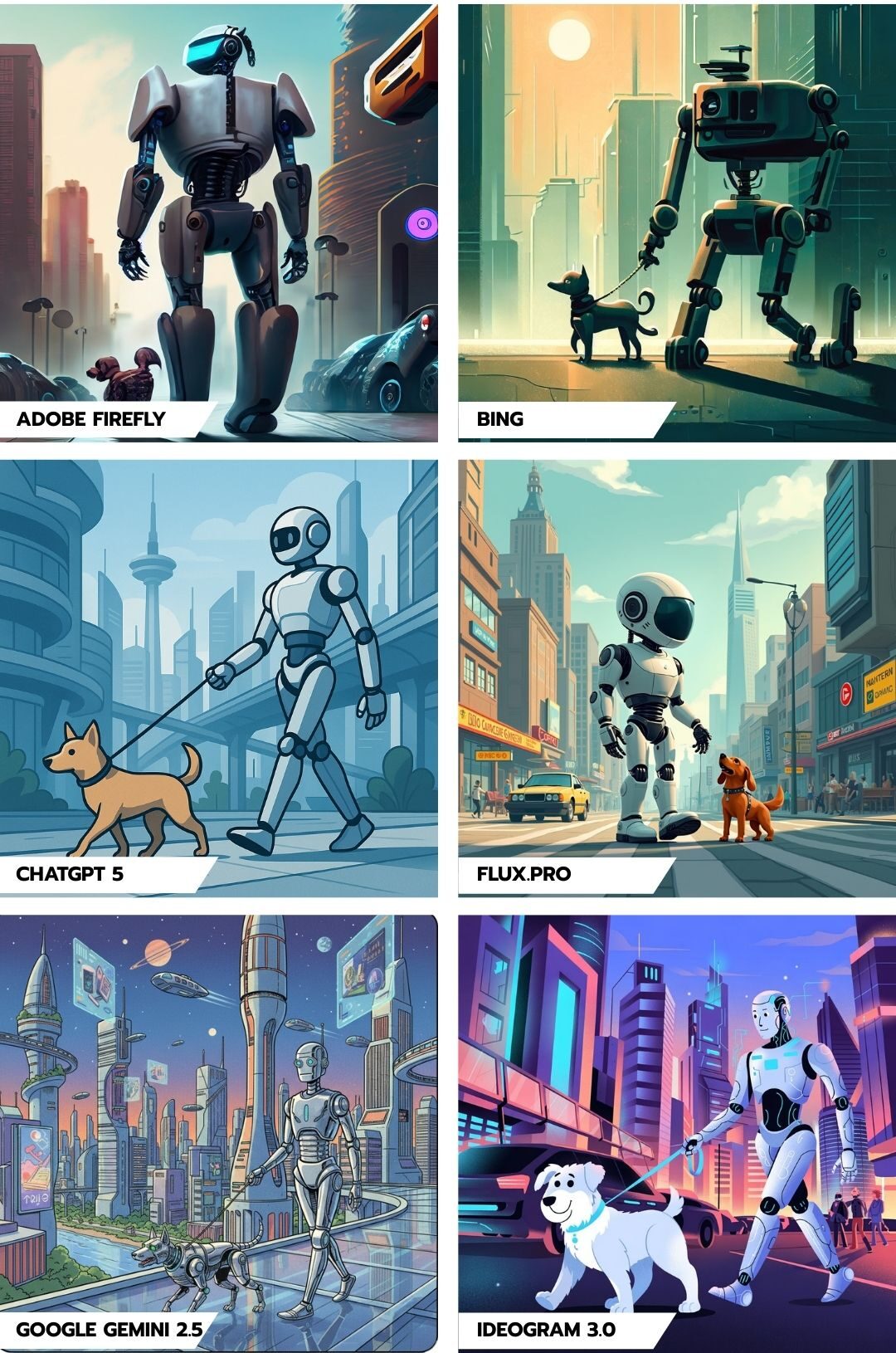
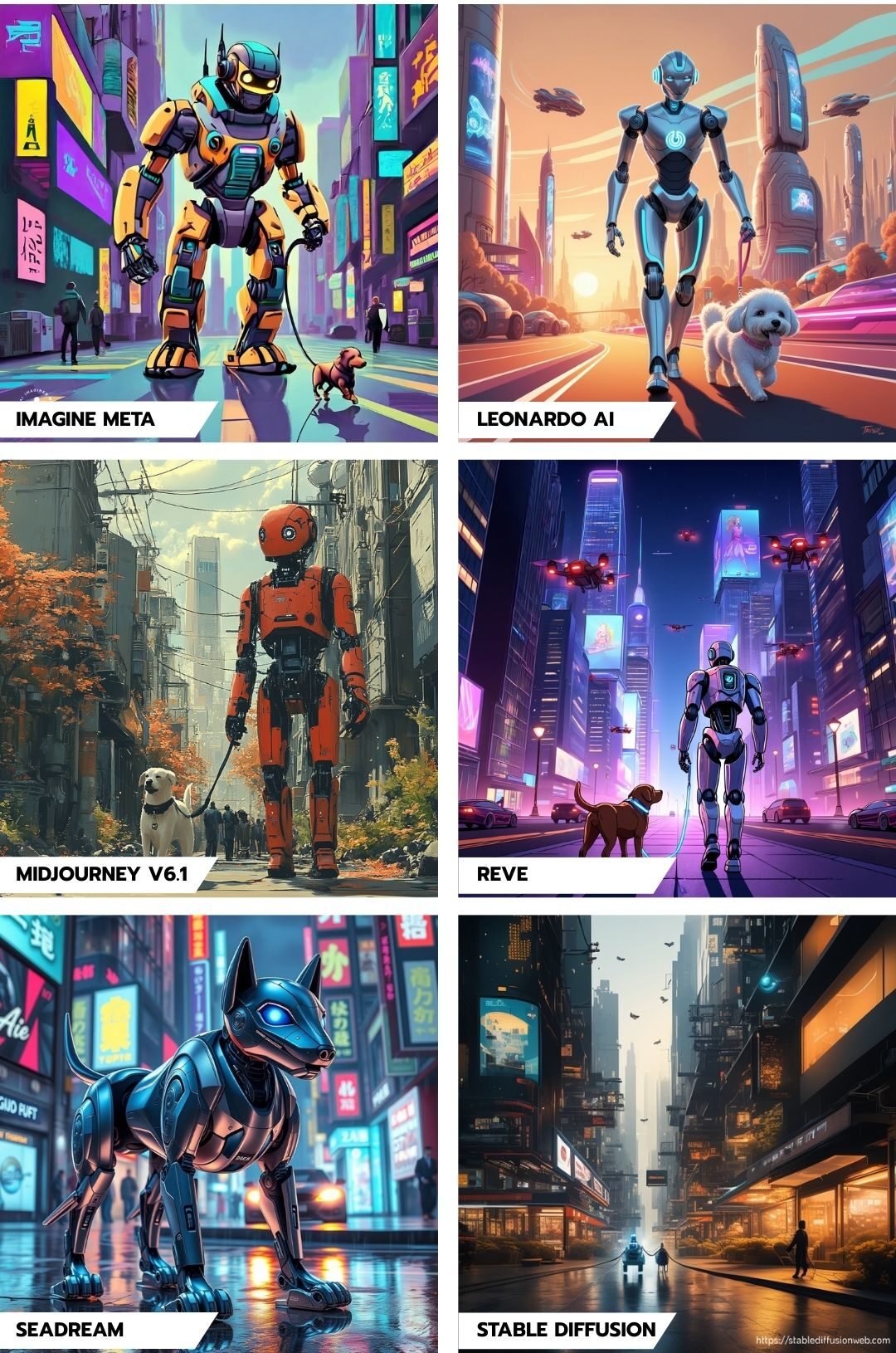
Analysis of Image Generation Results — “Robot walking a dog in a futuristic city”
Winners (by use-case):
- Overall image quality & world-building: Midjourney v6.1 — richest setting, cinematic depth, clear dog + leash.
- Prompt fidelity (robot + dog + leash) with polished style: Leonardo AI and Reve — luminous lighting, clean silhouettes, futuristic cues read instantly.
- Brand/illustration-ready (flat, editable look): ChatGPT 5 and Ideogram 3.0 — crisp vector-like lines, strong color blocking, easy to repurpose.
- Cityscape detail & retro-comic vibe: Google Gemini 2.5 — intricate skyline, billboard elements, tidy composition.
Notables / caveats:
- Flux.Pro — balanced, corporate-friendly illustration; good prompt adherence.
- Seedream 4.0 — striking mech design but deviates (robot dog protagonist; no walker).
- Stable Diffusion XL — moody, cinematic street but subject scale is small/ambiguous.
- Adobe Firefly & Bing — readable cartoon style; less depth and anatomical nuance than leaders.
Verdict:
For premium cinematic key art, choose Midjourney v6.1; for faithful, futuristic poster frames, Leonardo or Reve deliver the most “on-brief” results; for marketing/illustration work, pick ChatGPT 5 / Ideogram 3.0
Prompt 4: Abstract Artwork
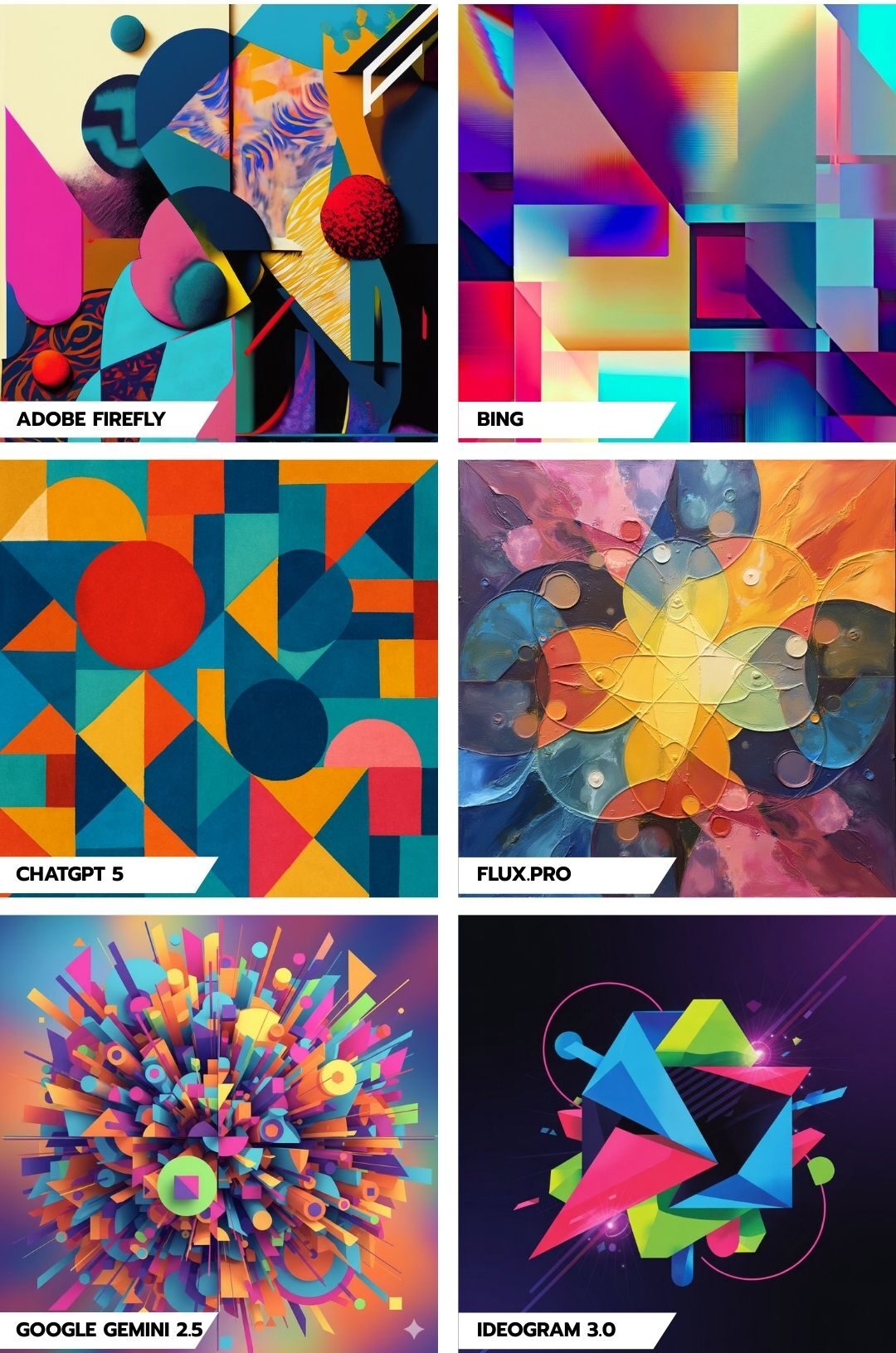
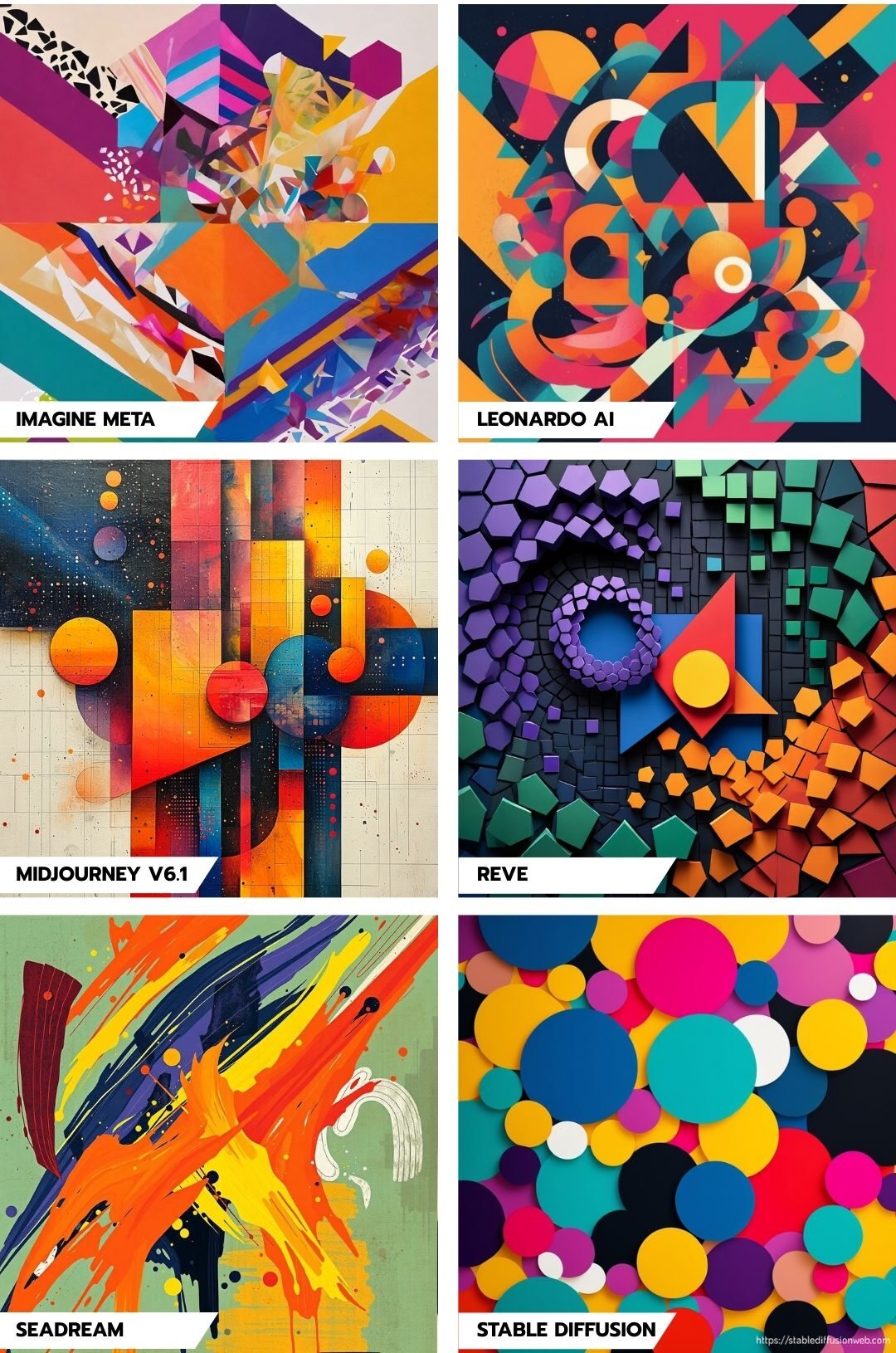
Analysis of Image Generation Results — “Abstract, vibrant colors & geometric shapes”
Best overall (on-brief, print-ready): ChatGPT 5. Crisp vector-like geometry, excellent color separation and balance; reads like finished poster art.
Runners-up (different strengths):
- Midjourney v6.1 — Most refined composition and depth; slightly muted palette.
- Ideogram 3.0 — Strong graphic punch on dark ground; clean forms, good hierarchy.
- Google Gemini 2.5 — High-energy radial burst; dynamic but busier than top picks.
- Adobe Firefly — Bold collage aesthetic; partly drifts into organic textures.
Solid but secondary:
- Leonardo AI — Clear shapes and palette, less distinctive.
- Reve — 3D extrusions add depth but feel heavy for a geometric brief.
Off-brief / weaker:
- Seedream 4.0 and Flux.Pro — Painterly/gestural styles overtake geometry.
- Bing and Stable Diffusion — Generic gradients/circles; low compositional tension.
- Imagine by Meta — Cluttered layout; weak focal hierarchy.
Verdict: For clean geometric posters choose ChatGPT 5; for art-print nuance pick Midjourney v6.1; for energetic, complex layouts try Gemini 2.5 or Ideogram 3.0.
Prompt 5: Food
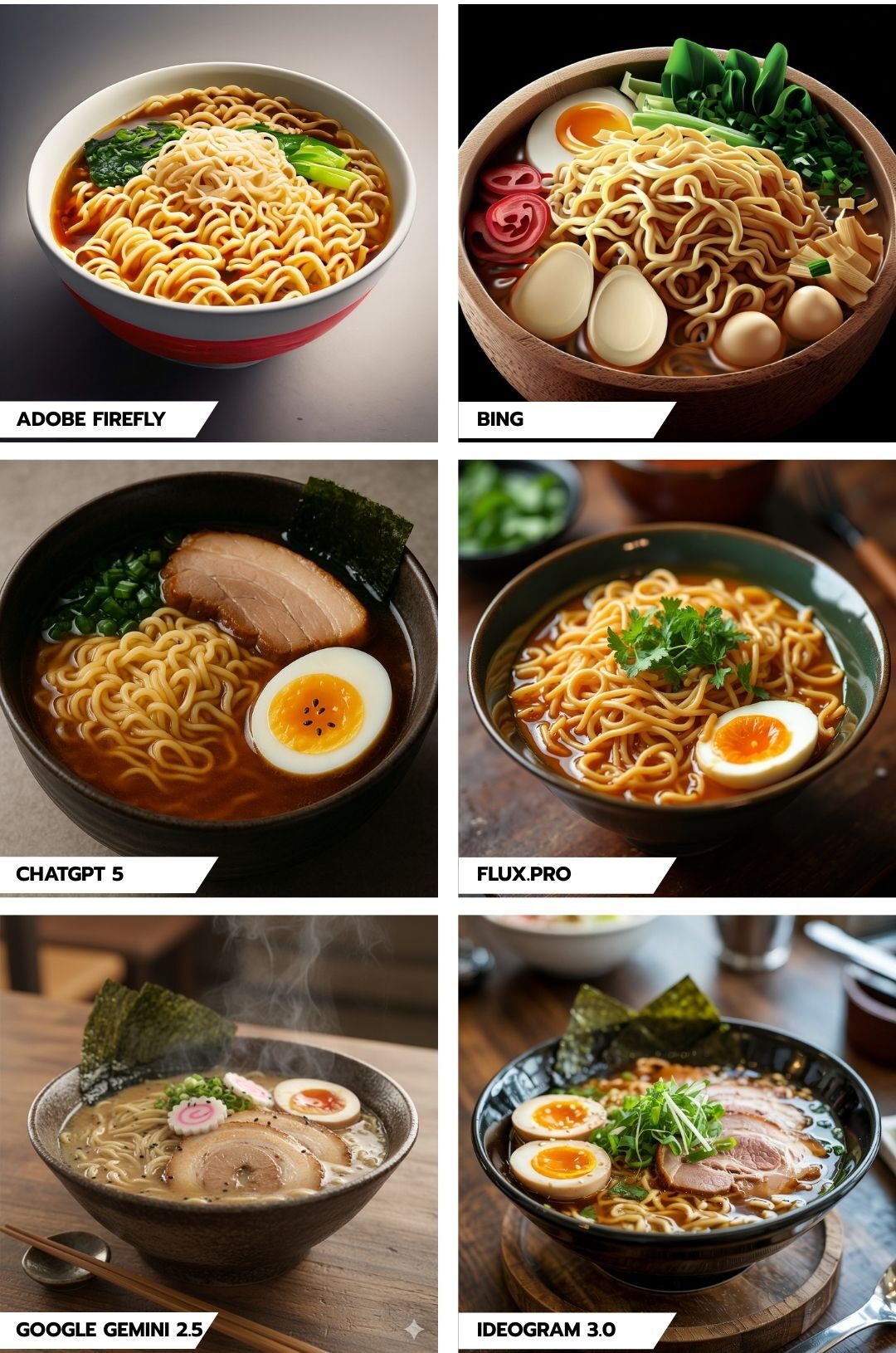
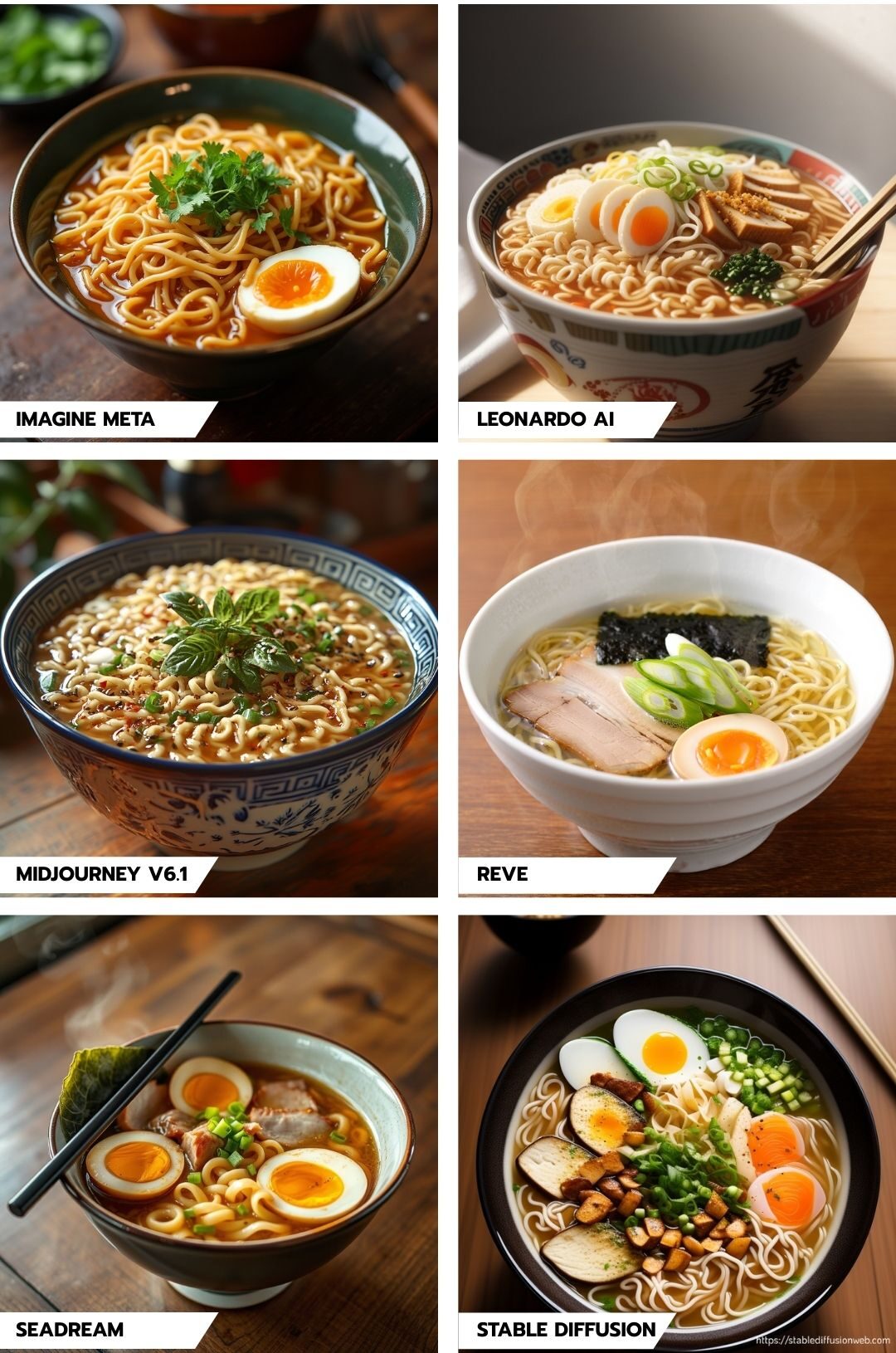
Analysis of Image Generation Results — “Photorealistic bowl of ramen”
Best realism: Google Gemini 2.5 and Reve — convincing jammy eggs, chashu texture, believable steam and lens falloff; tableware/background scale feels real.
Close behind: Ideogram 3.0 and ChatGPT 5 — appetizing styling and accurate toppings; Ideogram nails broth sheen; ChatGPT’s yolk/pepper specks read slightly staged.
Good but with caveats: Midjourney v6.1 and Seedream 4.0 — strong food shots, but herb choice/broth tone (MJ) and thicker, almost-udon noodles (Seedream) reduce realism.
Usable yet generic: Leonardo AI, Flux.Pro, Imagine by Meta — tidy bowls, simpler lighting/textures; less photographic depth.
Off / AI-looking: Stable Diffusion, Adobe Firefly, Bing — uniform noodles, plastic textures, or illustrative rendering.
Verdict: For near-photo menu quality, choose Gemini 2.5 or Reve; Ideogram 3.0 and ChatGPT 5 are reliable alternates.
Prompt 6: Product / Object – One Word Description
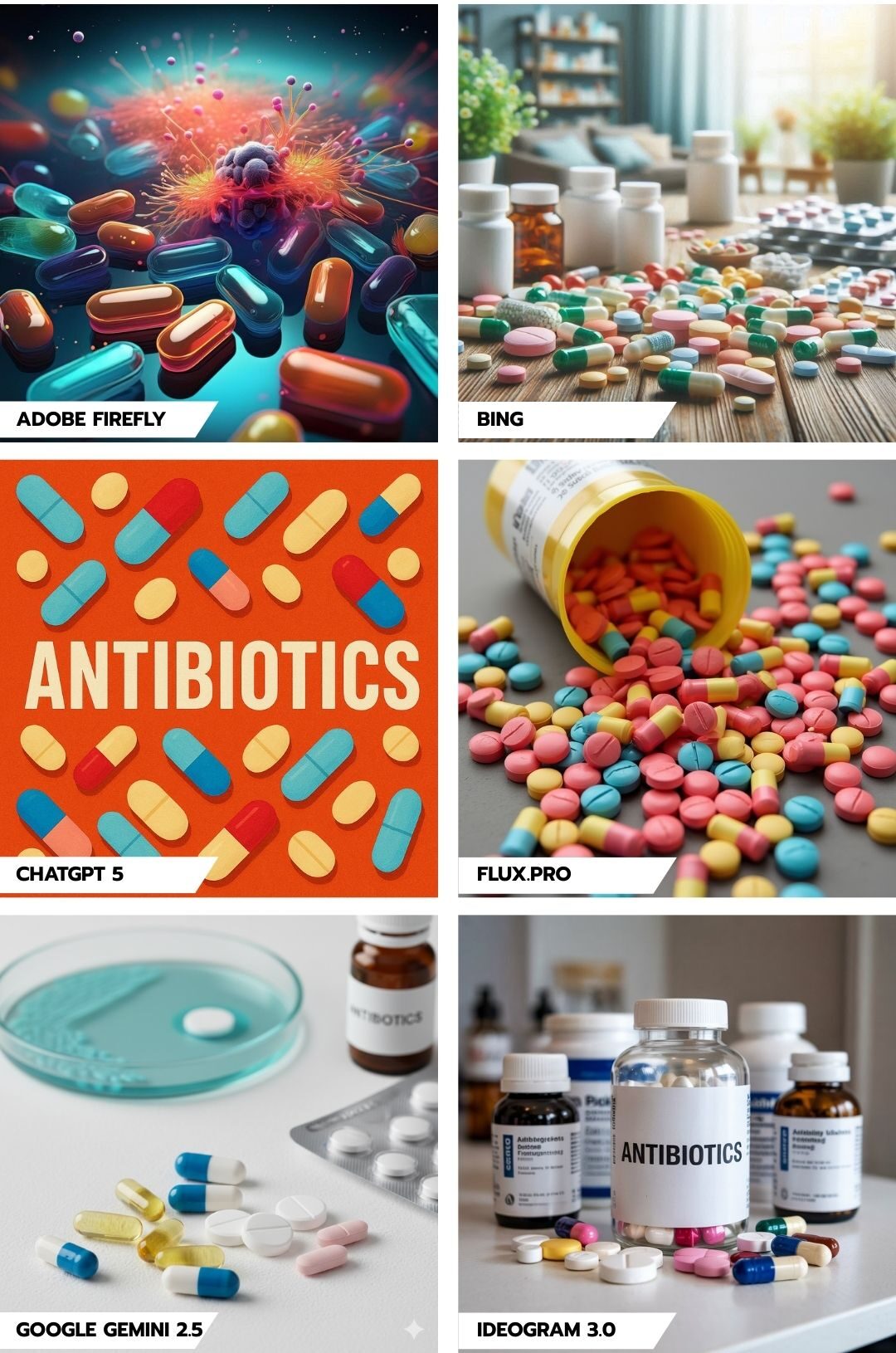
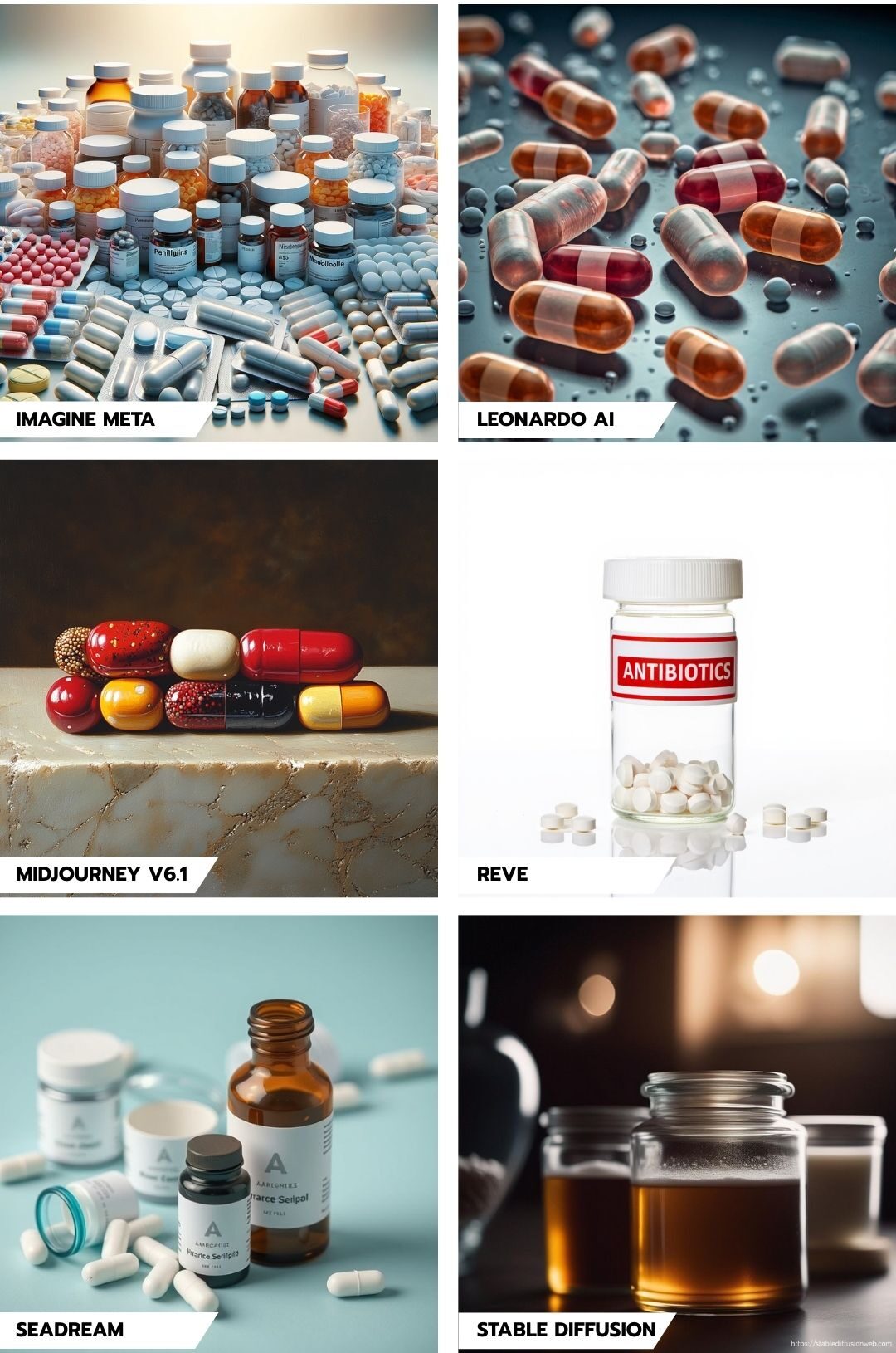
Analysis of Image Generation Results — “Antibiotics”
Best product realism: Google Gemini 2.5, Reve, Ideogram 3.0 — clean pharma set-ups, believable capsule shapes, neutral studio lighting, and sensible labeling/props (petri dish, blister, amber bottles).
Strong alternates:
- Seedream 4.0 — clinical look and depth of field; labels feel generic but plausible.
- Flux.Pro — convincing spill shot; a few toy-like tablets on close inspection.
Stylized / off-brief:
- Leonardo AI — glossy macro capsules; beautiful but slightly CGI.
- Midjourney v6.1 — museum-style still life; artful, not clinical.
- Adobe Firefly — sci-fi microbe tableau, far from product brief.
- Imagine by Meta — cluttered pharmacy montage.
- Bing — mixed scene, inconsistent pill morphology.
- Stable Diffusion — jars with brown liquid; off subject.
Best for editorial/graphic use: ChatGPT 5 — bold poster with accurate “ANTIBIOTICS” typography; not aiming for photorealism.
Verdict: For realistic product shots, choose Gemini 2.5 / Reve / Ideogram.
Prompt 7: Studio Portrait
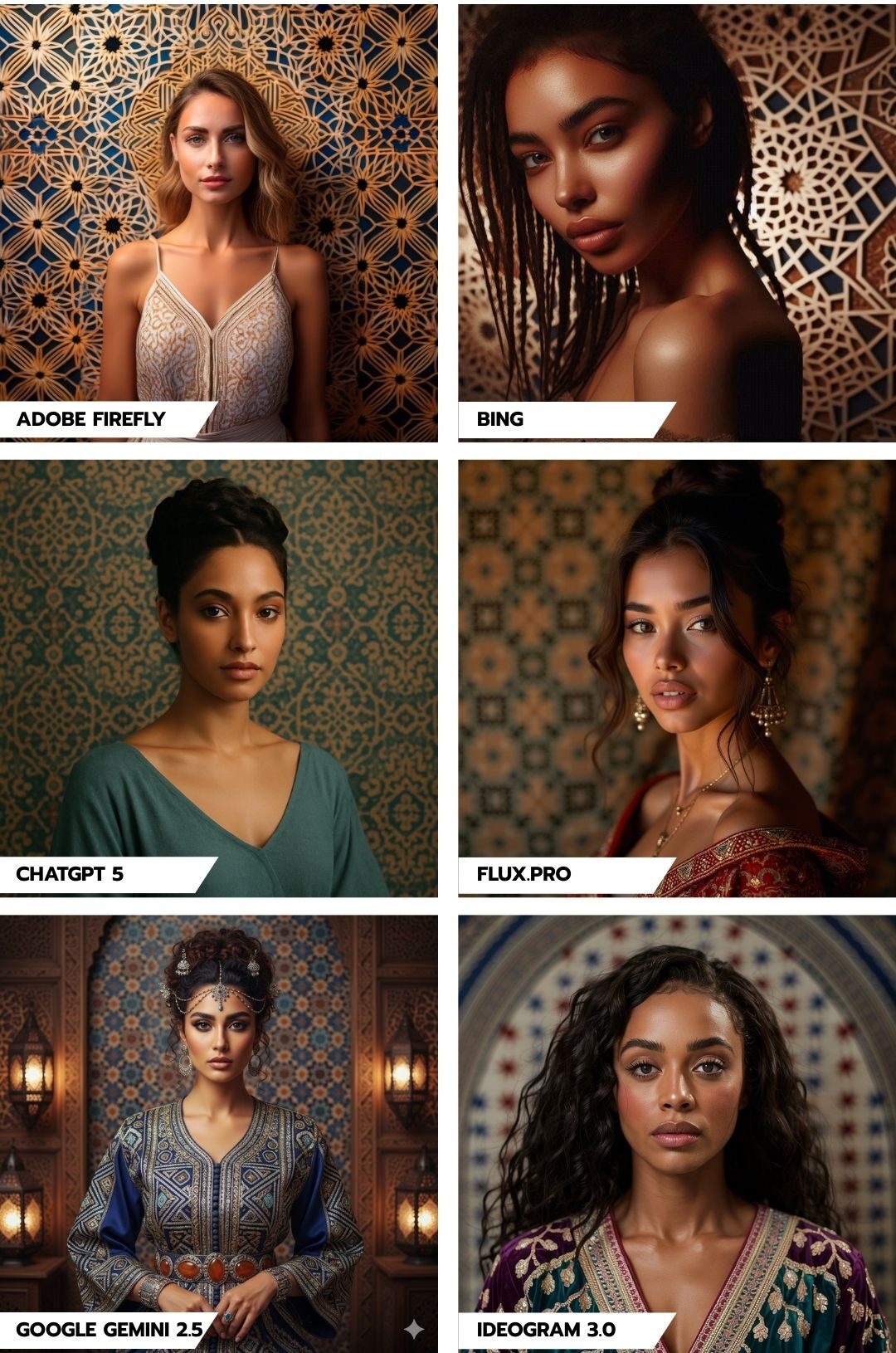
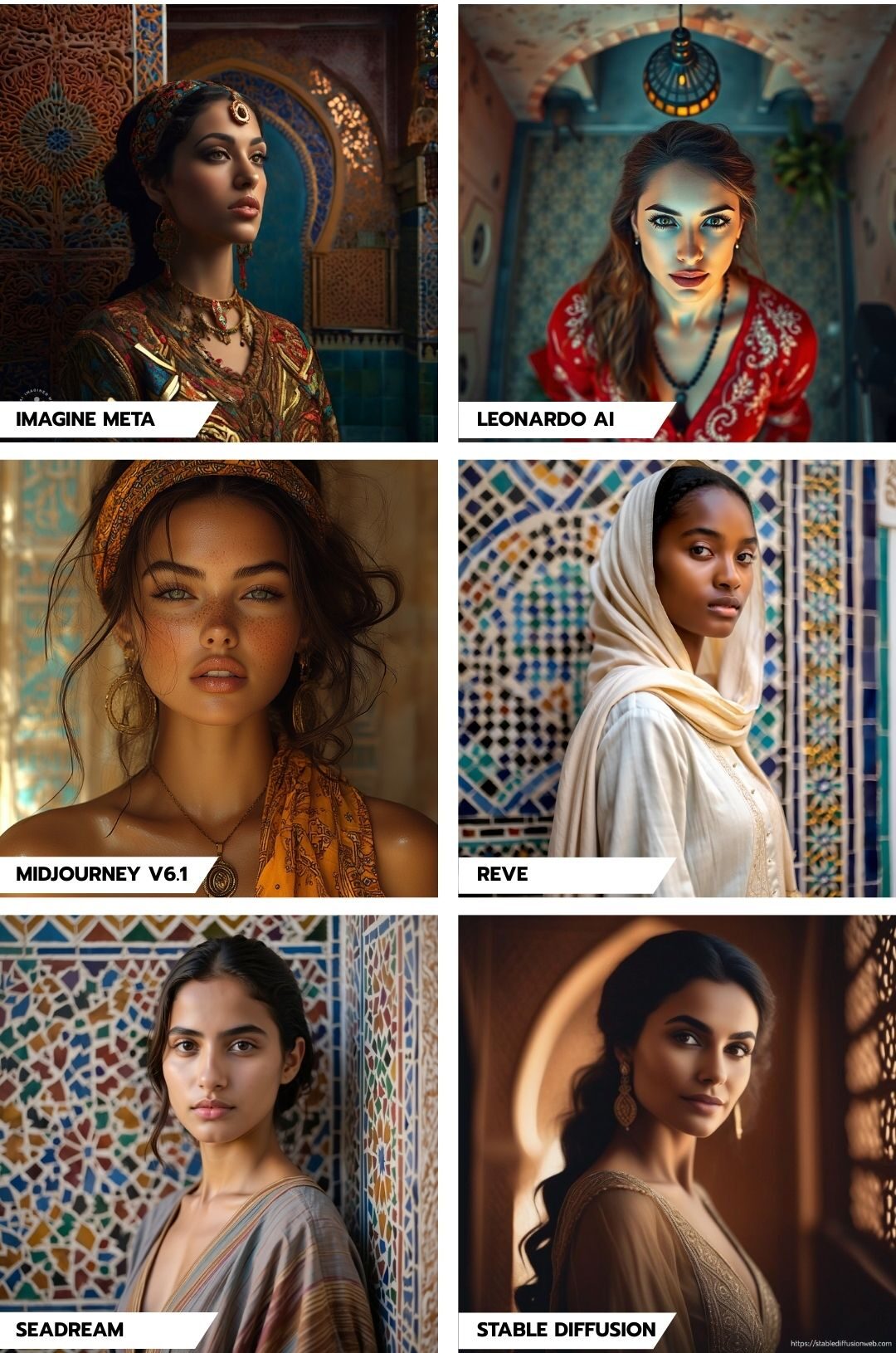
Analysis of Image Generation Results — “Studio portrait”
Winners:
- Reve — Most natural skin + truly diffused light; convincing Moroccan tile texture and depth; editorial-ready.
- Google Gemini 2.5 — Best “set design”: arch, lanterns, wardrobe styling; rich detail without plastic sheen.
Close contenders:
- Flux.Pro — Glamour look with good bokeh tiles and jewelry; light slightly harder than brief.
- Ideogram 3.0 — Clean, realistic portrait; strong backdrop geometry; minor flatness in skin.
Good but not top:
- ChatGPT 5 — Soft, lifelike rendering and accurate backdrop, but styling is minimalist for the “exotic” brief.
- Imagine by Meta — Atmospheric interior; heavier grading and shadow contrast.
- Seedream 4.0 — Natural face and tiles; lighting a bit flat.
Stylized / off-brief elements:
- Midjourney v6.1 — Fashiony, glossy highlights; less “soft diffused.”
- Leonardo AI — Dramatic top light/perspective; breaks the lighting request.
- Adobe Firefly — Graphic symmetry; subject/clothing read less Moroccan.
- Bing — Strong portrait, but rim-lighted/harder look.
- Stable Diffusion — Warm mood, generic background; weaker tile detail.
Verdict: For authentic, softly lit Moroccan portraits, pick Reve or Gemini 2.5; Flux.Pro and Ideogram 3.0 are safe alternates.
Prompt 8: Landing Page Mock
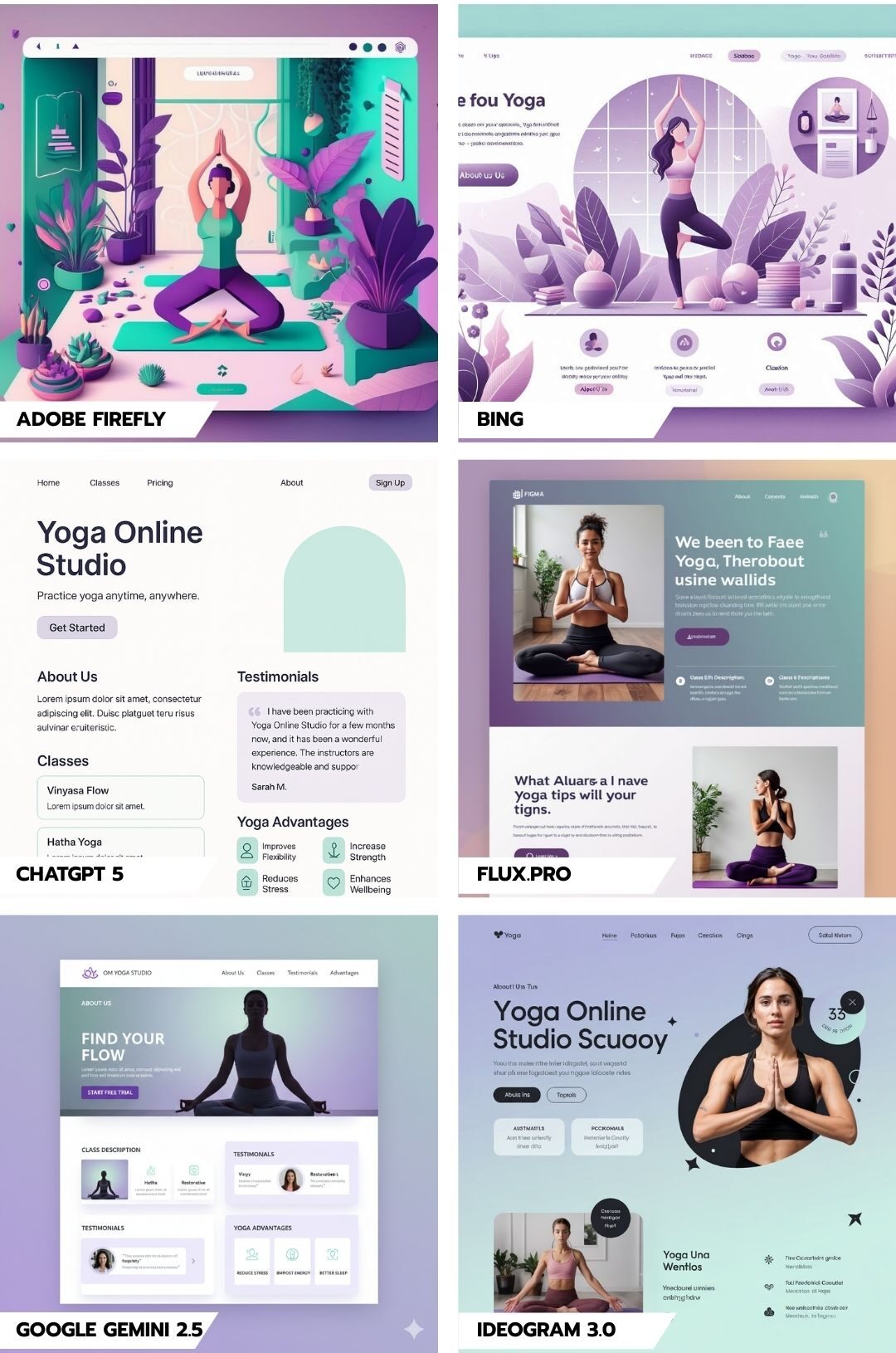
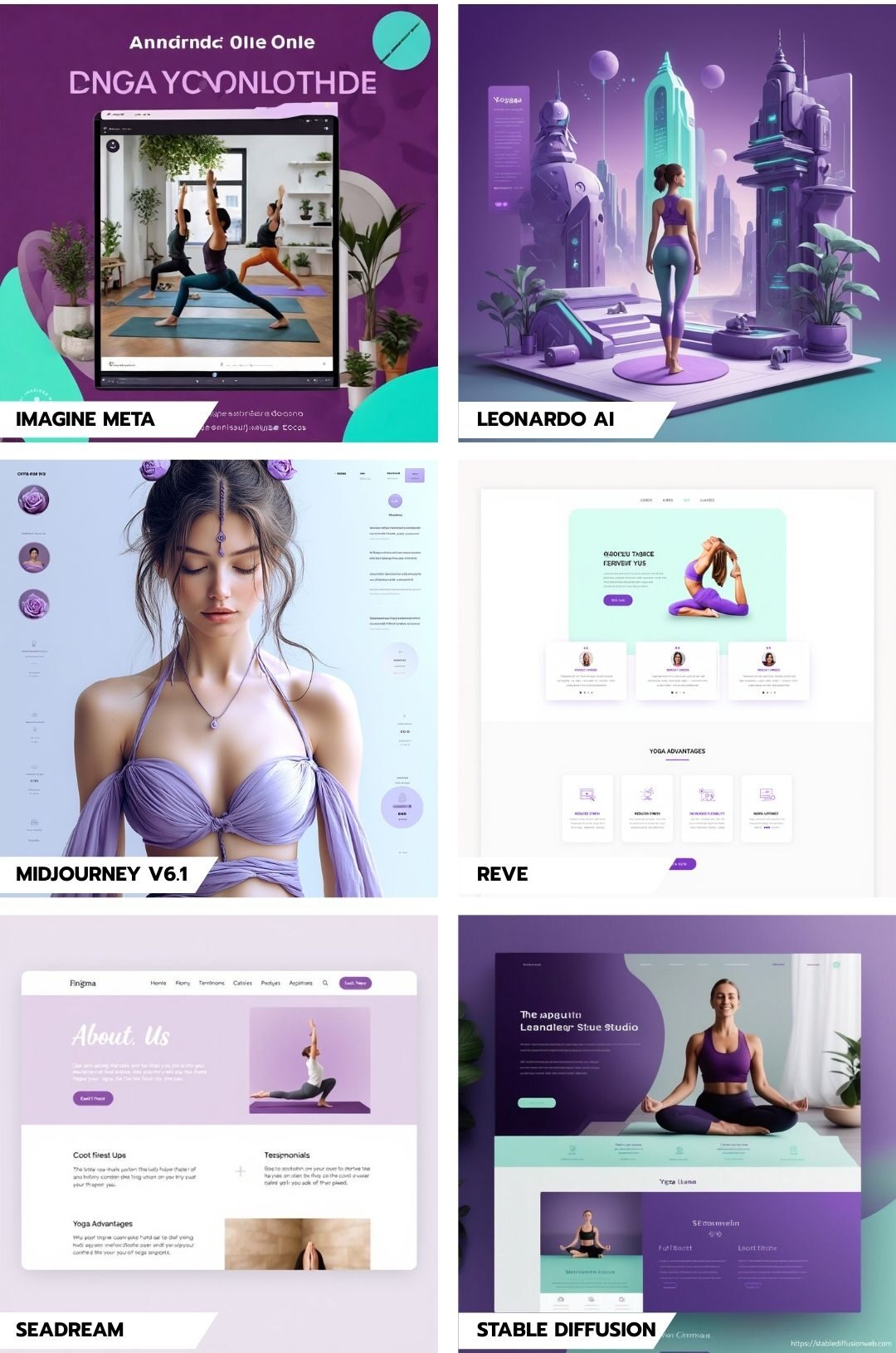
Analysis of Image Generation Results — “Yoga landing page”
Winners:
- Ideogram 3.0 — Solid structure and components; headings drift to gibberish.
- Google Gemini 2.5 — Most polished card/grid system; multiple sections present and mostly legible; production-ready look.
Strong alternates:
- Seedream 4.0 — Coherent template and hierarchy; some copy legibility, good color discipline.
- ChatGPT 5 — Cleanest UX mockup with readable headings and labels; correct sections, tidy spacing, true purple/mint palette.
- Reve
Usable but mixed:
- Flux.Pro — Clear hero + blocks, but text largely nonsense.
- Stable Diffusion— Basic layouts; weaker hierarchy and lorem/gibberish issues.
Off-brief / not real layouts:
- Adobe Firefly and Leonardo AI — Illustrative scenes, not UI.
- Midjourney v6.1 — Fashion poster masquerading as webpage.
- Imagine by Meta / Bing — Banner-style comps with unreadable text or overflow.
Verdict: For practical, deployable landing-page mockups, pick Ideogram 3.0 or Gemini 2.5; for a decent starting wireframe, use Reve or . ChatGPT 5.
Prompt 9: Logo Design
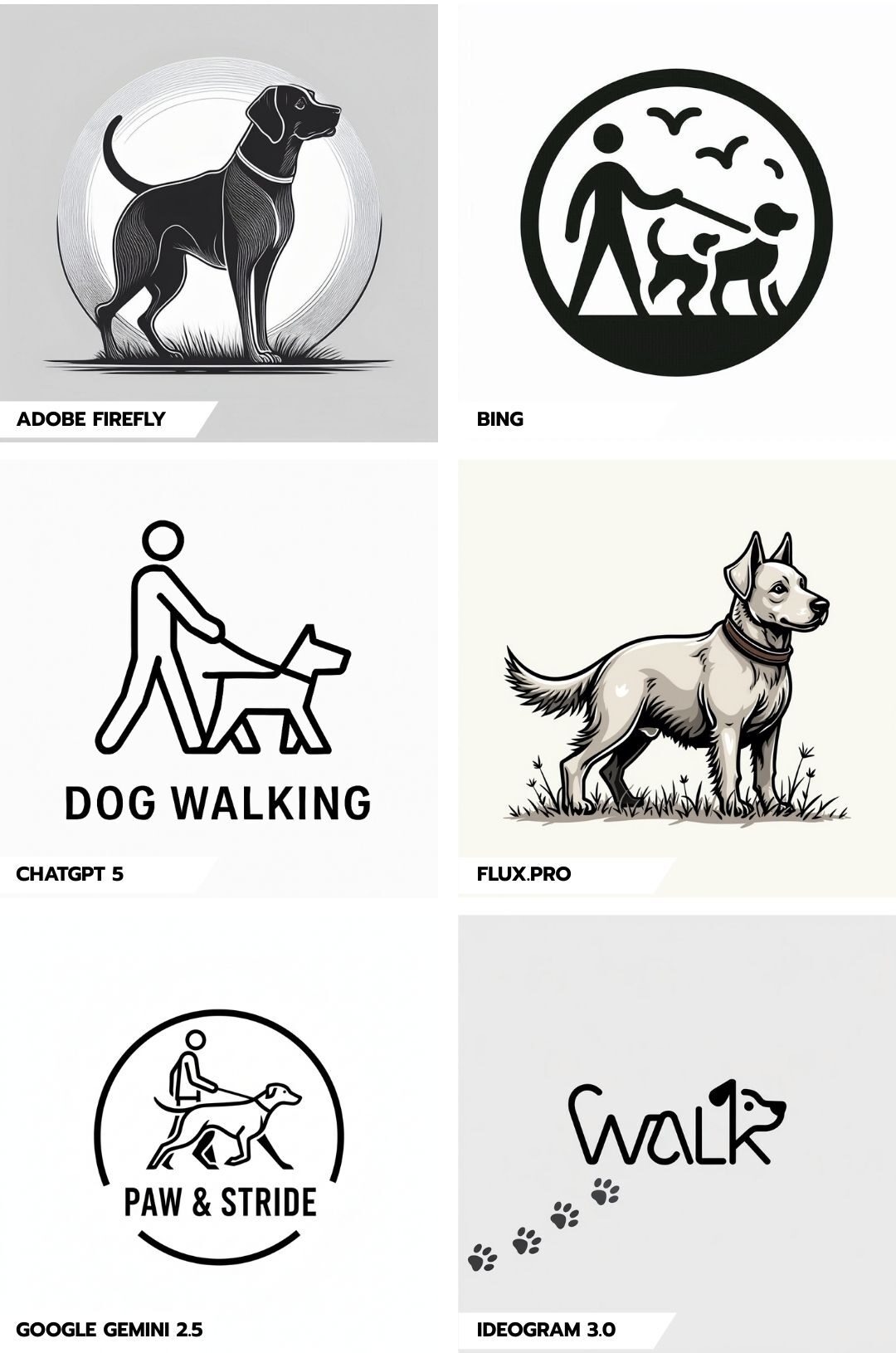
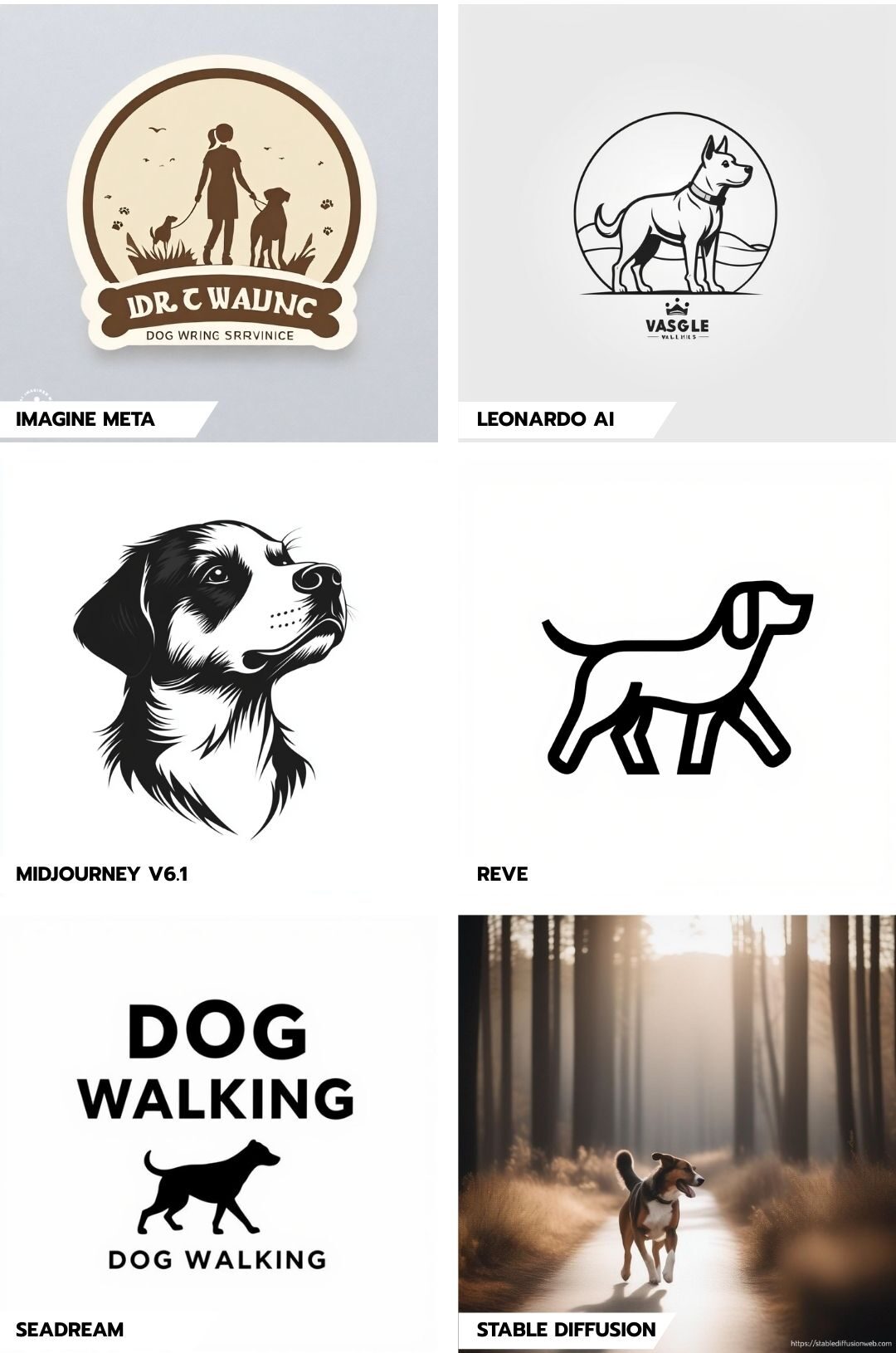
Analysis of Image Generation Results — “BW logo”
Winners (brand-ready, vector-clean):
- ChatGPT 5 — Clear stick-figure + dog mark, correct walking concept, balanced weight, readable “DOG WALKING” wordmark.
- Ideogram 3.0 — Clever wordmark (“walk” with dog head + paw trail); minimal, memorable, scalable.
- Google Gemini 2.5 — Roundel “PAW & STRIDE”; tidy strokes and layout, minor brand invention but usable.
Strong runners-up:
- Bing — Simple circular pictogram of person walking dog; legible and on-brief (extra birds add slight clutter).
- Reve — Very clean canine outline; on style, though doesn’t convey “walking/service” explicitly.
- Seedream 4.0 — Bold text + small dog silhouette; serviceable but generic.
Usable but weaker:
- Leonardo AI — Neat badge, but invented label (“Vasgle…”) + decorative crown distracts.
- Imagine by Meta — Sticker emblem with gibberish text.
Off-brief / illustrative:
- Adobe Firefly and Flux.Pro — Engraved/mascot illustration; not ultra-minimal logo.
- Midjourney v6.1 — Attractive dog head mark, no walking; more mascot than service logo.
- Stable Diffusion XL — Photographic scene, not a logo.
Verdict: For a crisp, production-ready BW logo, choose Gemini 2.5, ChatGPT 5 or Ideogram 3.0. Strong runners-ups: Bing, Seedream or Reve.
Prompt 10: Movie Poster
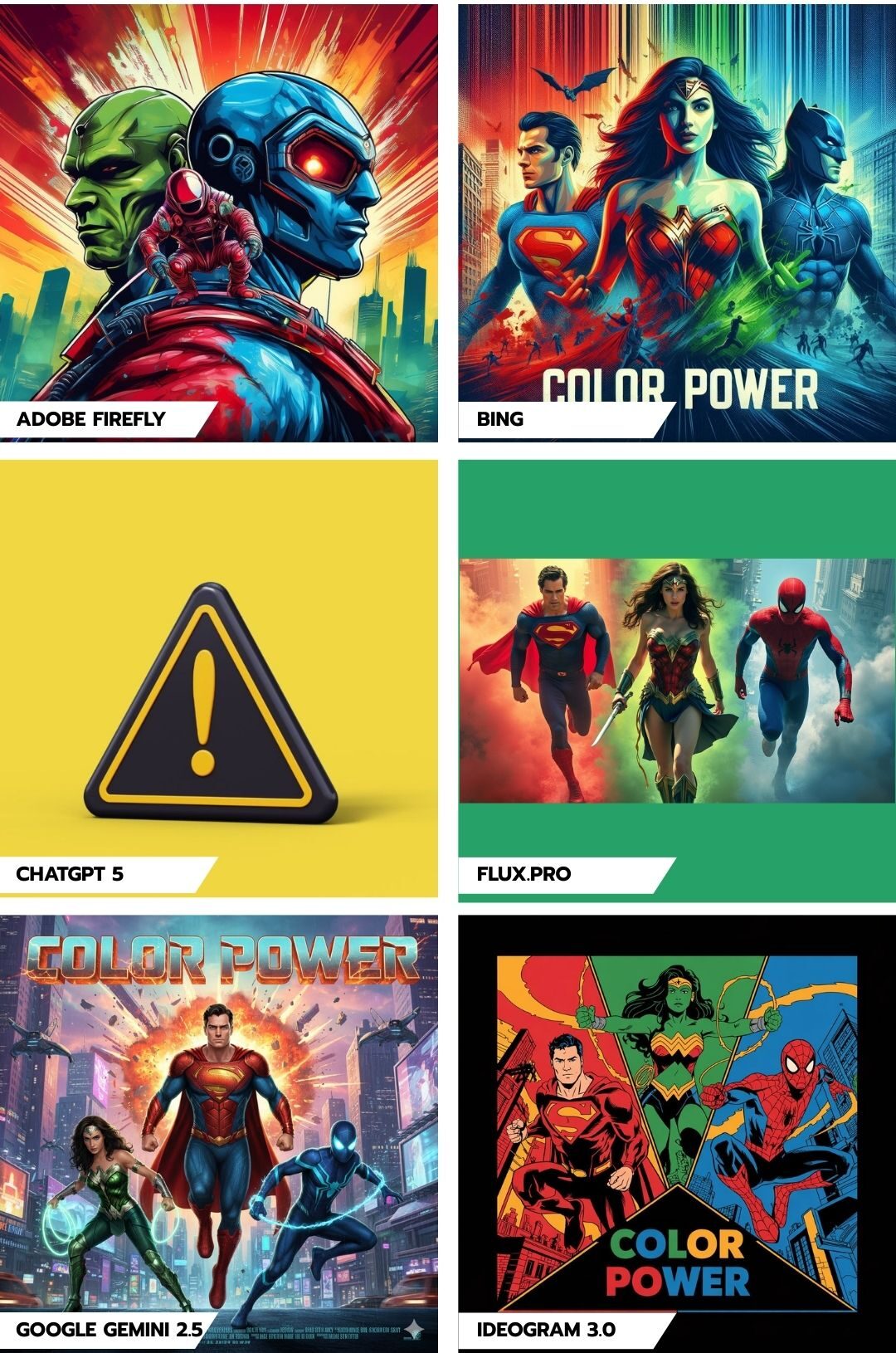
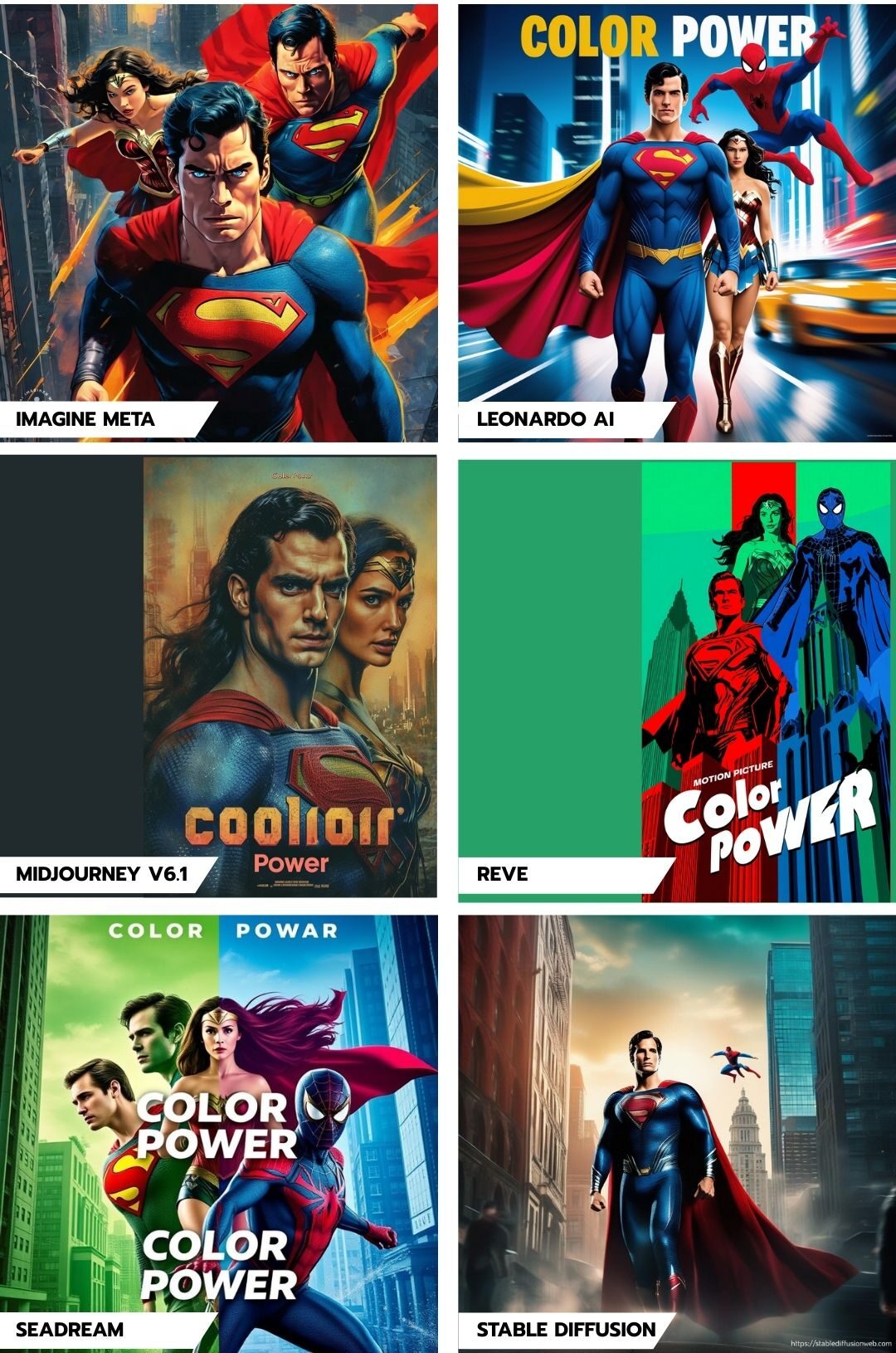
Analysis of Image Generation Results — “Movie poster”
Winners (on-brief + usable poster):
- Bing — Correct title (“COLOR POWER”), all three heroes, clear split-complementary palette, dynamic city backdrop; balanced type/illustration.
- Google Gemini 2.5 — Sharp key art with readable title, full cast, strong urban action scene; minor busyness but very marketable.
- Ideogram 3.0 — Comic-print style nails color mapping and legible title; flatter depth but brandable.
Close but not top:
- Leonardo AI — Energetic composition with the trio and readable title; motion blur is good, palette mapping a bit loose.
- Reve — Graphic concept with partial poster in a large color block; incomplete backdrop/space use.
Mixed / off-brief:
- Flux.Pro — Good trio illustration and colors; missing/weak title area and odd green framing hurt poster utility.
- Midjourney v6.1 — Beautiful rendering but text gibberish (“cooloir”) and usually only two heroes.
- Seedream 4.0 — Multiple title stamps with typos (“POWAR”); otherwise lively.
- Stable Diffusion XL — Solo Superman; doesn’t meet trio requirement.
- Adobe Firefly — Generic look-alikes (avoids IP) -> not the specified characters.
- ChatGPT 5 — Refusal (warning icon).
- Imagine by Meta — Strong comic energy but typography/branding not clean.
Verdict: For deployable poster comps, choose Bing, Gemini 2.5 or Ideogram 3.0 (style choice: comic vs. cinematic). For a bold graphic variant, Leonardo and Reve work well. Others fail on title legibility, missing characters, or IP-safe substitutions.
Prompt 11: Pop Art Illustration
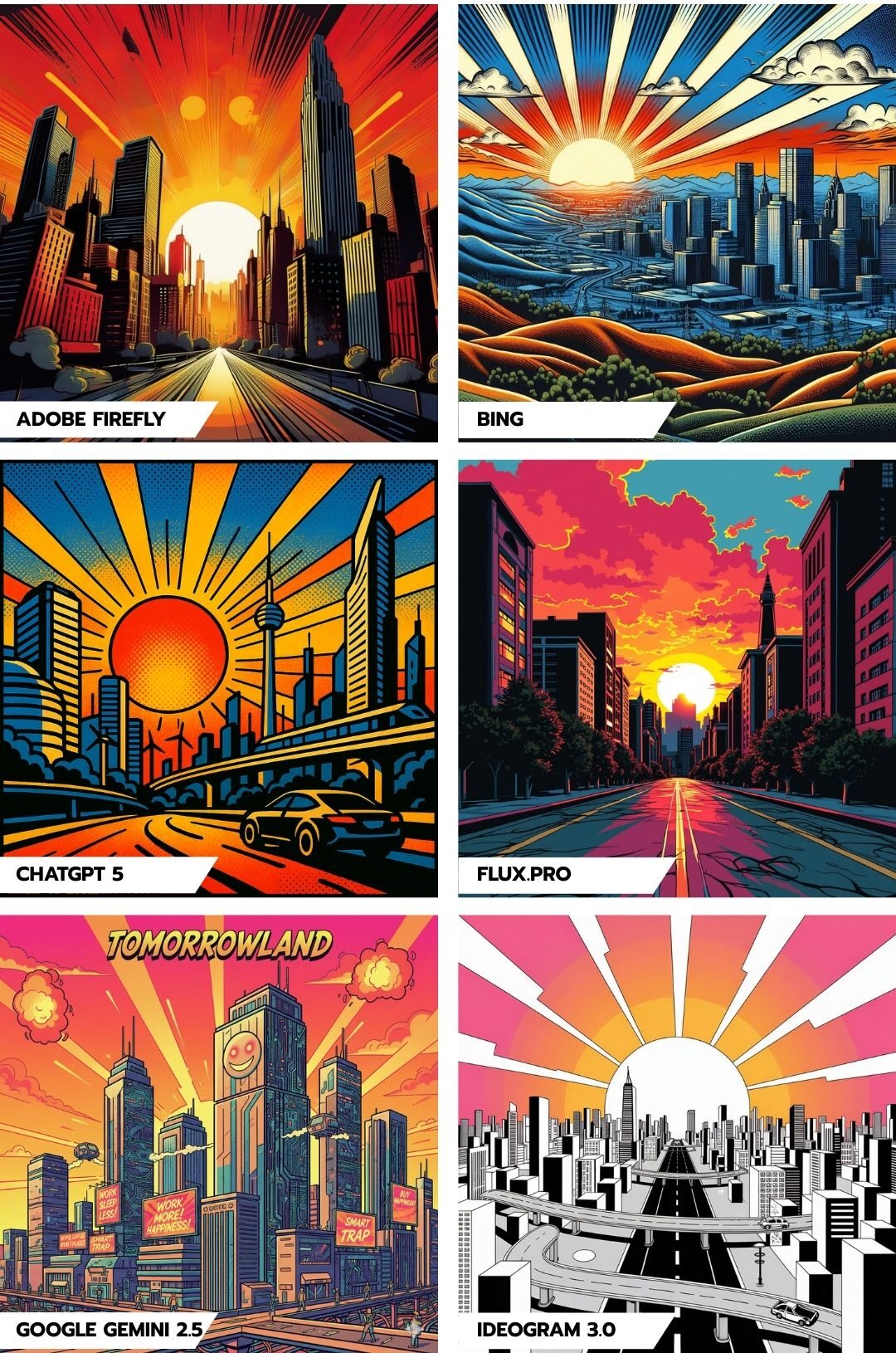
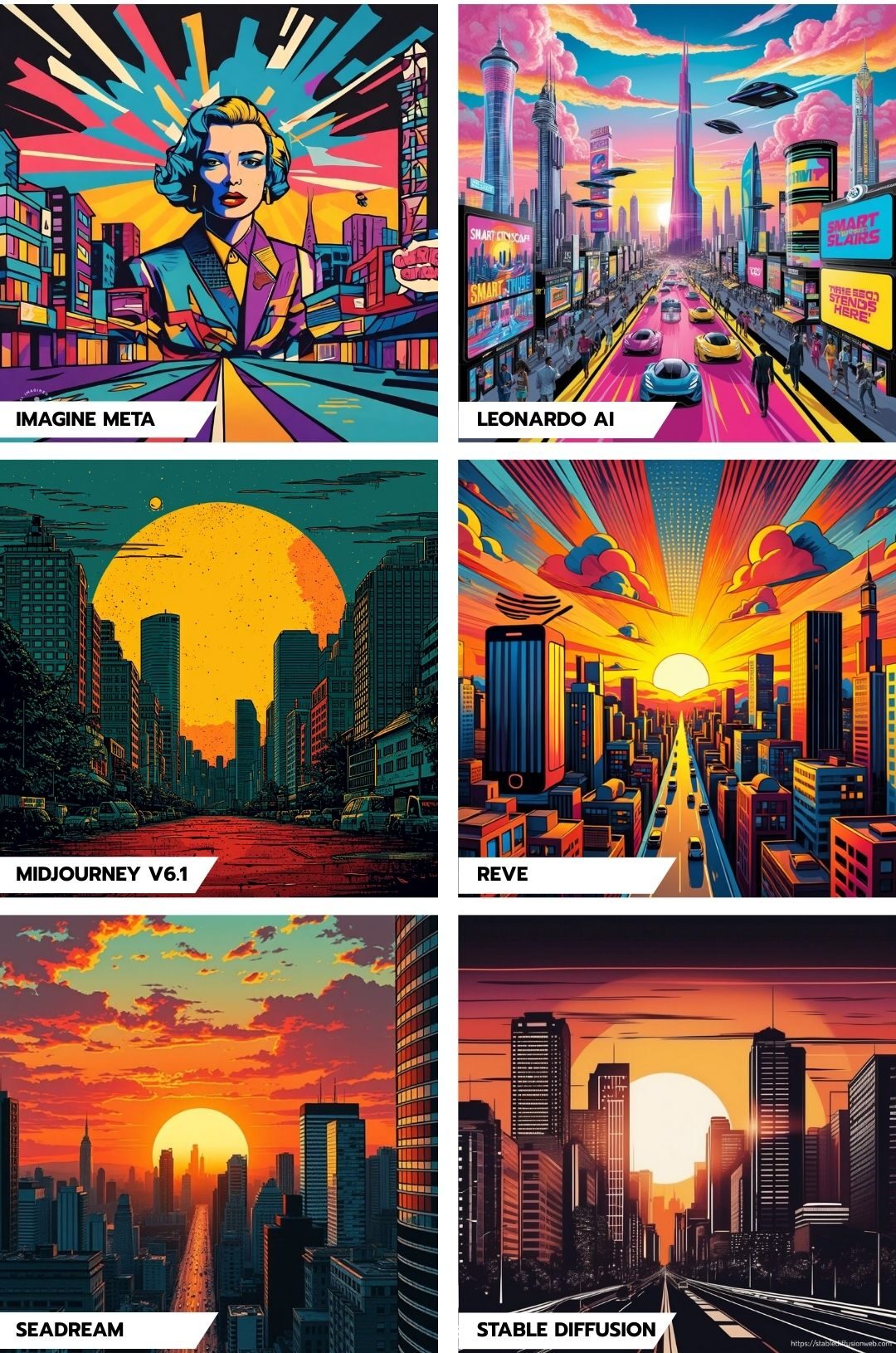
Analysis of Image Generation Results — “Pop-art Illustration”
Winners (on-brief + satirical):
- Google Gemini 2.5 — Poster-ready pop art with satire (billboards/labels), bold outlines, hard-edge rays, and dense “smart city” detail.
- Reve — Clever smartphone-as-skyscraper gag nails the satire; crisp lines, strong sunburst, readable city grid.
Runners-up:
- ChatGPT 5 — Clean Ben-Day/inked look and punchy sunburst; satire is lighter but composition is tight.
- Adobe Firefly — Graphic sting and bold outlines; less “satire” than the winners but very on-style.
- Stable Diffusion XL — Strong hard-edge skyline and sun; simpler idea yet serviceable.
- Midjourney v6.1 — Moody palette and softer edges; weaker “bold outline” feel.
Mixed / off-brief notes:
- Ideogram 3.0 — Excellent line work but limited palette reduces pop impact.
- Leonardo AI — Futuristic spectacle and detail, light on satire.
- Flux.Pro / Seedream 4.0 — Attractive cityscapes, more gradient than hard-edge.
- Imagine by Meta — Portrait-centric composition drifts from “city” brief.
- Bing — Scenic sunrise with halftones, but suburban hills dilute “smart city.”
Verdict: For a true pop-art poster with bite, pick Gemini 2.5 or Reve. For clean graphic punch without the satire emphasis, ChatGPT 5, Adobe Firefly, Stable Diffusion, or Midjourney are strong alternatives.
Prompt 12: Action photography
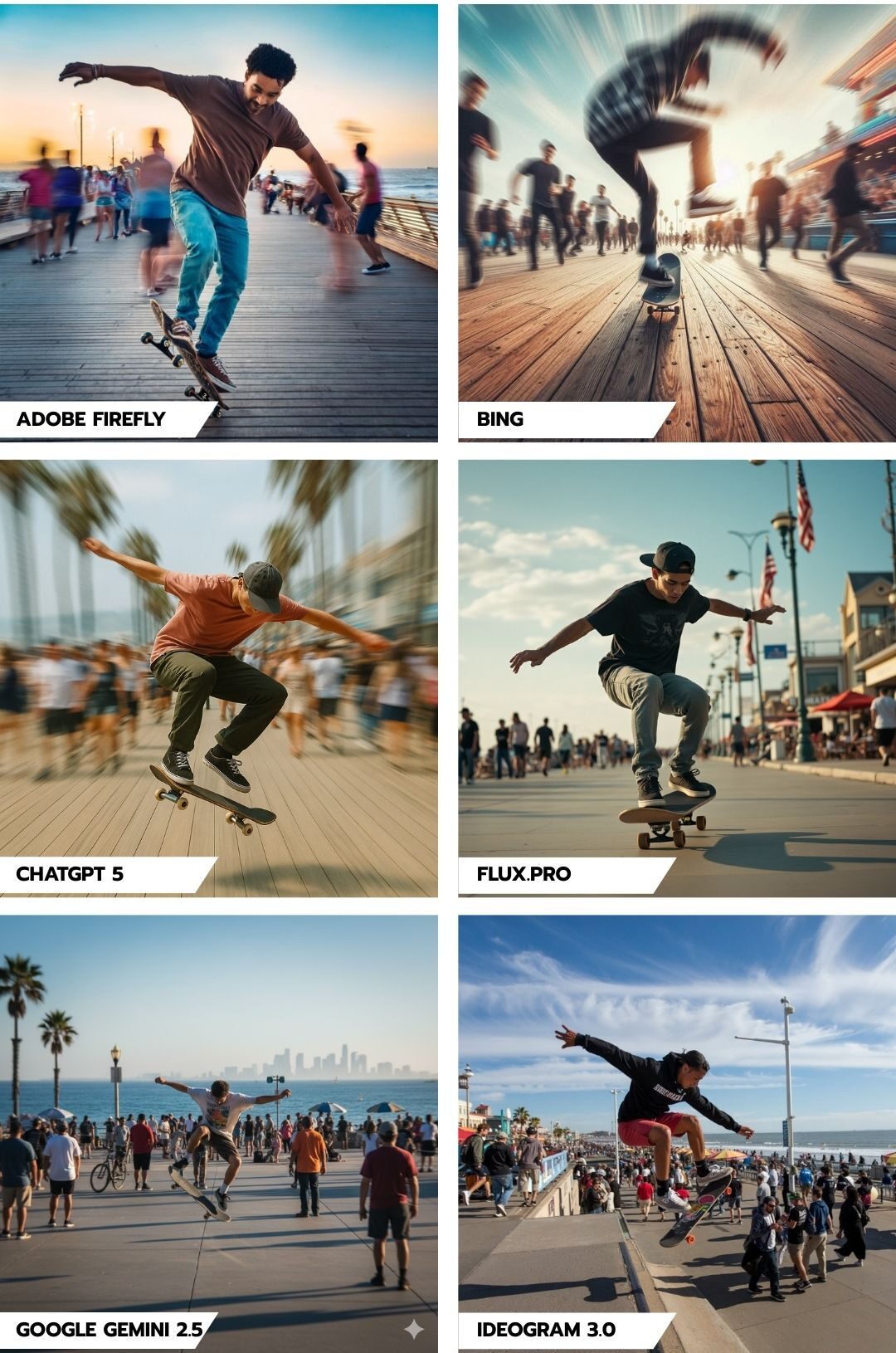
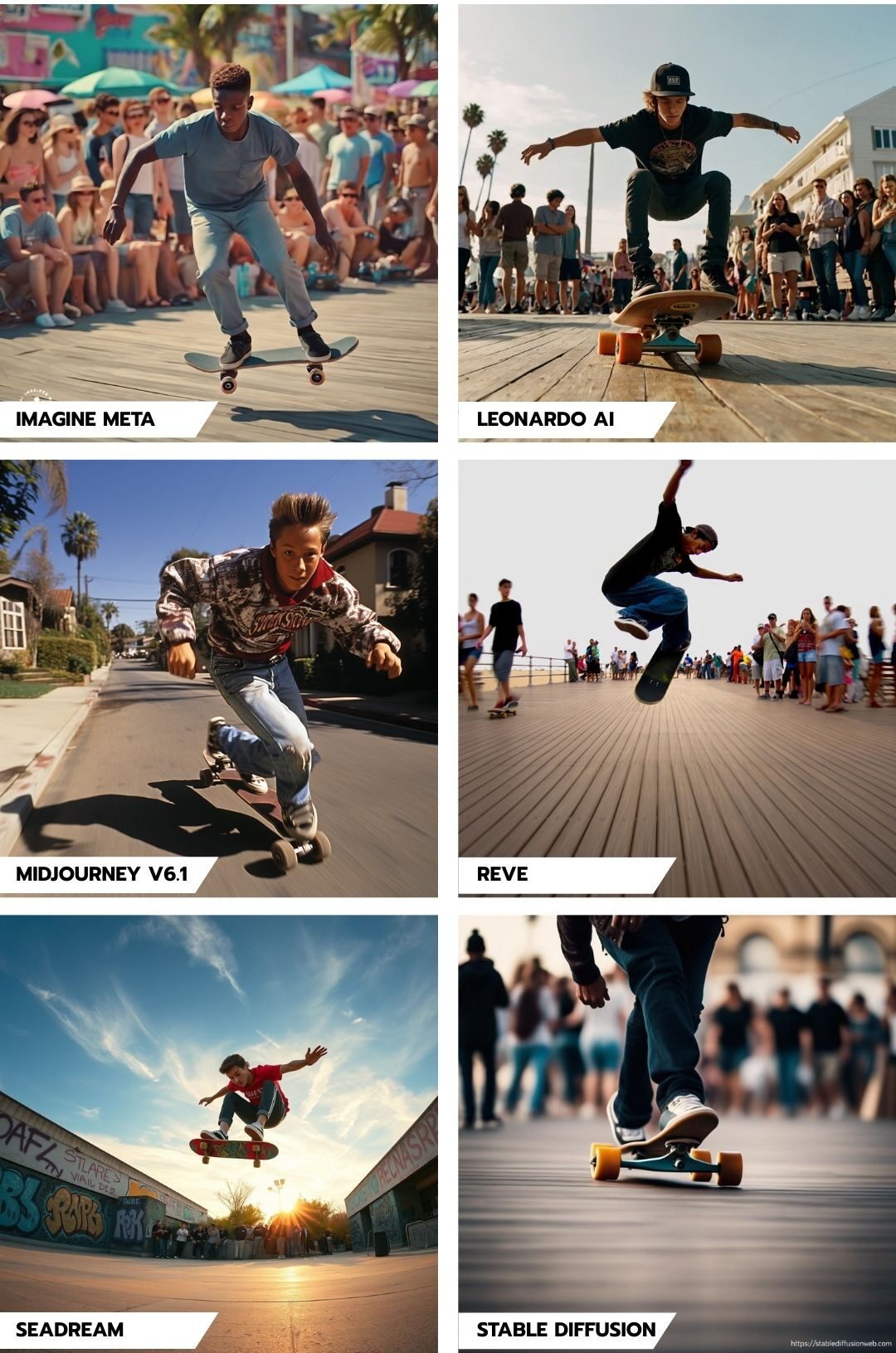
Analysis of Image Generation Results — “Action photography”
Winners (on-brief + motion depth):
- Bing — Strongest faux–dolly-zoom: centered subject, crowd compression, radial/zoom streaks; reads like a festival-busy boardwalk.
- Adobe Firefly — Clear boardwalk + crowd with convincing motion smear around a sharp subject; cinematic energy.
Close contenders:
- ChatGPT 5 — Lively mid-air trick and good crowd streaking; dolly-zoom illusion is lighter but scene feels real.
- Leonardo AI — Dynamic low angle and crisp action; effect is more shallow-DOF than dolly-zoom.
Good composition, weaker effect:
- Flux.Pro — Sharp trick and coastal vibe; lacks crowd energy and zoom compression.
- Ideogram 3.0 — Clean jump and packed promenade; minimal zoom distortion.
- Google Gemini 2.5 — True crowd density and boardwalk context, but the skater is small and the effect is absent.
Off-brief or problematic:
- Imagine by Meta — Usable action frame, but crowd/zoom effect undercooked.
- Midjourney v6.1 — Great speed, but shot is street/suburb, not boardwalk.
- Seadream — Skatepark at sunset, not a boardwalk.
- Stable Diffusion XL — Macro close-up of wheels; misses the scene brief.
- Reve — Cut-out look with blown background; reads composited.
Verdict: For the requested dolly-zoom boardwalk shot, pick Bing or Adobe Firefly. ChatGPT 5 and Leonardo are solid alternatives when you want cleaner action with less aggressive zoom distortion.
Final Verdict: The New Landscape of AI Image Generation
For each prompt, models earned: Gold = 5, Runner-up = 3, Strong/close = 2, Usable = 1, Off-brief = 0. Scores were aggregated across 12 prompts.
Ties were broken by the number of Golds, then by prompt fidelity (how precisely the image matched the brief, including text legibility).
🥇 1st Place – Google Gemini 2.5 — 47 pts (🟡 7 wins)
Dominant in food, product, portrait, UI, movie poster, logo, pop-art; steady realism and legible text. Weakness: teal/ stylized bias in street shots and lighter dolly-zoom effect.
🥈 2nd Place – Ideogram 3.0 — 40 pts (🟡 4 wins)
Exceptionally reliable for graphics/UI/logos/posters; strong street realism and product shots. Skin can read slightly flat.
🥉 3rd Place – ChatGPT 5 — 38 pts (🟡 4 wins)
Best street realism & signage; excellent abstracts, logos, and very clean UI text. Refused the IP-heavy movie-poster brief (counted).
🏅 4th Place – Reve — 37 pts (🟡 4 wins)
Editorial-quality portraits, co-leader in food and product, clever pop-art satire. Sign/text fidelity varies; action prompt looked composited.
5th Place – Seedream 4.0 — 21 pts (🟡 0 wins)
Credible street crowds, decent UI and ramen; occasional prompt drift (robot-dog), weaker poster/text.
6th Place – Flux.Pro — 20 pts (🟡 0 wins)
Corporate-ready illustrations and decent portrait; good adherence but trails in photoreal and logo minimalism.
7th Place – Bing Image Creator — 16 pts (🟡 2 wins)
Big jumps on movie poster and action (dolly-zoom). Elsewhere leans cyberpunk or has legibility issues.
8th Place – Midjourney v6.1 — 16 pts (🟡 1 win)
Tie broken ↓ (fewer golds than Bing). The cinematic king (robot scene), strong art prints; struggles with strict realism/text/UI.
9th Place – Leonardo AI — 17 pts (🟡 0 wins)
Polished lighting; good runner-up in robot and action. Food/product realism and logos are less consistent.
10th Place – Adobe Firefly — 14 pts (🟡 1 win)
- Bold pop-art aesthetics and a top action frame; otherwise tends illustrative over realistic/usable UI.
11th Place – Imagine by Meta — 10 pts (🟡 0 wins)
- Some solid frames, but frequent gibberish/overflow for text-heavy tasks.
12th Place – Stable Diffusion XL — 8 pts (🟡 0 wins)
- Can produce decent pop-art and basic layouts; weaker on photoreal food/product and strict brief adherence.
Category champions (at a glance)
- Street photo realism & legible signs: ChatGPT 5 (alts: Ideogram 3.0, Reve, Flux.Pro)
- Cinematic key art: Midjourney v6.1 (alt: Gemini 2.5 for dynamic motion)
- Abstract/geometric posters: ChatGPT 5 (alts: Ideogram 3.0, Gemini 2.5)
- Food photography: Gemini 2.5 / Reve (alts: Ideogram 3.0, ChatGPT 5)
- Product/clinical “Antibiotics”: Gemini 2.5 / Reve / Ideogram 3.0
- Studio portrait (Moroccan, soft diffused): Reve / Gemini 2.5 (alts: Flux.Pro, Ideogram 3.0)
- UI/landing-page mockups: Gemini 2.5 / ChatGPT 5 (alts: Seedream 4.0, Ideogram 3.0)
- BW logo (ultra-minimal): ChatGPT 5 / Ideogram 3.0 / Gemini 2.5
- Movie poster (Color Power): Bing / Gemini 2.5 / Ideogram 3.0
- Pop-art sunrise: Gemini 2.5 / Reve (alts: ChatGPT 5, Firefly)
- Action (boardwalk + dolly-zoom): Bing / Firefly (alts: ChatGPT 5, Leonardo)
TL;DR:
- Overall winner: Google Gemini 2.5 — most dependable across realism, text, and layout.
- Best duo for design work: Ideogram 3.0 + ChatGPT 5 — unbeatable for logos/UI/graphics plus street realism.
- Portrait & food ace: Reve.
- Cinematic art: Midjourney v6.1.
- Surprise specialists: Bing (posters, action) and Firefly (action, pop-art).
This article provides an unbiased overview of each tool, informed by user reviews and expert insights, aligning with The AI Track’s commitment to offering genuinely helpful, freely accessible resources.