
Key Takeaway:
On October 15, 2025, Anthropic released Claude Haiku 4.5, the newest and smallest model in its lineup. Company tests show it delivers results similar to bigger models like Sonnet 4 and GPT-5, while running at about one-third the cost and more than twice the speed.
Anthropic’s decision to make Claude Haiku 4.5 the default model for all free plans marks a strategic pivot in the AI race. By prioritizing speed, affordability, and accessibility, the company is betting that winning the free tier is key to building long-term market dominance. Haiku 4.5 delivers near-Sonnet performance at a fraction of the cost, giving everyday users a powerful entry point into Anthropic’s ecosystem.

Anthropic Unveils Claude Haiku 4.5 – Key Points
Rapid release cadence and product lineup:
- Haiku 4.5 arrives two weeks after Sonnet 4.5 (late September 2025) and two months after Opus 4.1 (August 2025).
- Anthropic’s range: Opus (most capable), Sonnet (mid-tier), Haiku (fastest and cheapest). An updated Opus is targeted for late 2025 or early 2026.
Performance Claims:
Speed & Cost: Comparable to Sonnet 4 at one-third the cost and 2× faster.
Benchmarks:
SWE-Bench Verified: 73% (coding)
Terminal-Bench: 41% (command-line tasks)
These results place Haiku 4.5 below Sonnet 4.5 but roughly on par with Sonnet 4, GPT-5, and Google’s Gemini 2.5 in those tests.
Strong results are also reported for tool use, “computer use” (controlling a desktop or browser), and visual reasoning. Anthropic says Haiku 4.5 can outperform some larger models that were considered top-tier only months ago.
New capabilities that make it more practical
Extended thinking (first time in Haiku): When switched on, the model can think through multi-step problems, summarize its reasoning, and balance depth vs. speed using a budget you set. It’s off by default but improves coding and reasoning when enabled.
Context awareness: Haiku 4.5 tracks how much working memory (tokens) it has left during a task, helping it stick with longer jobs and manage multi-window workflows. If it hits the limit, it now gives a clear “context window exceeded” signal.
Reliability fixes: Tool-call strings keep their exact formatting, which matters for code and text editing.
Deployment Strategy:
Haiku 4.5 becomes the default for free users; paid users can still pick Sonnet 4.5, but Haiku often offers more capacity because it’s smaller and faster.
It’s designed to run many tasks in parallel or to work as a “sub-agent” alongside a smarter planner like Sonnet 4.5.
- Example from Anthropic: Haiku can monitor high-volume financial data and hand off signals to Sonnet for deeper analysis.
Immediate fit: software development (especially Claude Code) where low latency and cost matter, plus mobile answers that feel instant and high-throughput enterprise monitoring.
Pricing, Availability & Integration:
- Full toolset support: bash, code execution, text editor, web search, and computer use, with parallel tool execution.
- List prices (per 1M tokens): Haiku 4.5 — $1 input / $5 output; Sonnet 4.5 — $3 input / $15 output.
- Relative costs: In paid tiers, Haiku ≈ 1/3 the cost of Sonnet; Sonnet ≈ 1/5 the cost of Opus.
- Cloud endpoints: On AWS Bedrock and Google Vertex AI, choose Global endpoints (no premium) or Regional endpoints (+10%) for guaranteed in-region routing. The Claude API is global-only (no regional premium).
- For developers (model IDs):
- Haiku 4.5:
claude-haiku-4-5-20251001(Claude API) /anthropic.claude-haiku-4-5-20251001-v1:0(Bedrock) /claude-haiku-4-5@20251001(Vertex) - Sonnet 4.5:
claude-sonnet-4-5-20250929(with Bedrock/Vertex equivalents)
- Haiku 4.5:
- Token accounting: Anthropic may add small system optimizations to requests to improve performance; you aren’t billed for those system-added tokens.
Company stance and industry positioning
- Mike Krieger (CPO): Frames Haiku as the fast executor while Sonnet handles complex planning, giving customers a “complete agent toolbox.”
- Andrew Filev (Zencoder CEO): Says Haiku 4.5 opens new use cases.
- Business scale and competition: Anthropic reports 300,000+ business customers, annual run-rate near $7B (Oct 2025), and a ~$183B valuation (Sep 2025); it ranked #4 on CNBC’s 2025 Disruptor 50. It competes with OpenAI (reported $500B valuation, GPT-5 launch in Aug 2025, major infrastructure deals, and Sora video app) and Google (Gemini).
Why This Matters
With over 300,000 business customers, an annual run-rate approaching $7 billion, and a valuation of $183 billion, Anthropic is positioning Haiku as the gateway to its larger Claude family. In a competitive field where OpenAI’s GPT-5 and Google’s Gemini dominate headlines, the real battle may not be at the cutting edge, but in who controls the most widely used free tier. Haiku 4.5 could be Anthropic’s most important move yet in reshaping that landscape.
This article was drafted with the assistance of generative AI. All facts and details were reviewed and confirmed by an editor prior to publication.

Anthropic unveils Claude Sonnet 4.5 with SWE-Bench gains, OSWorld 61.4%, 30-hour autonomy claims, Agent SDK, VS Code integration, checkpoints, and ASL-3 safety.
IBM and Anthropic form a strategic partnership to integrate Claude AI models into its enterprise software suite, starting with an IDE tested by 6,000 staff and reporting 45% productivity gains.
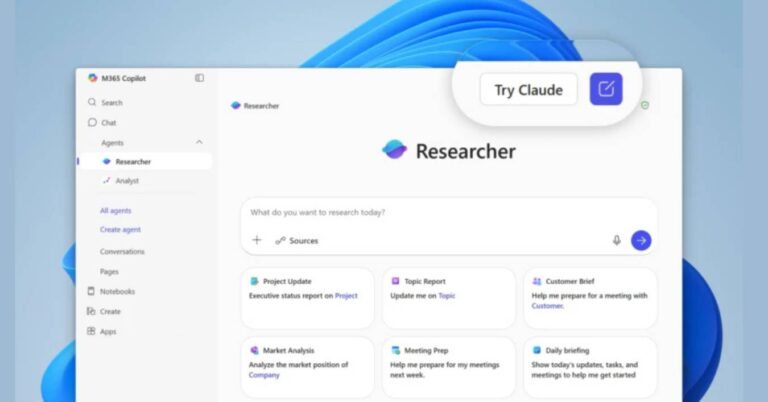
Microsoft Adds Anthropic for Researcher and Copilot Studio, integrating Claude Sonnet 4 and Opus 4.1 while OpenAI remains default in Microsoft 365 Copilot.

Microsoft Adds Anthropic for Researcher and Copilot Studio, integrating Claude Sonnet 4 and Opus 4.1 while OpenAI remains default in Microsoft 365 Copilot.
Read a comprehensive monthly roundup of the latest AI news!