Key Takeaway
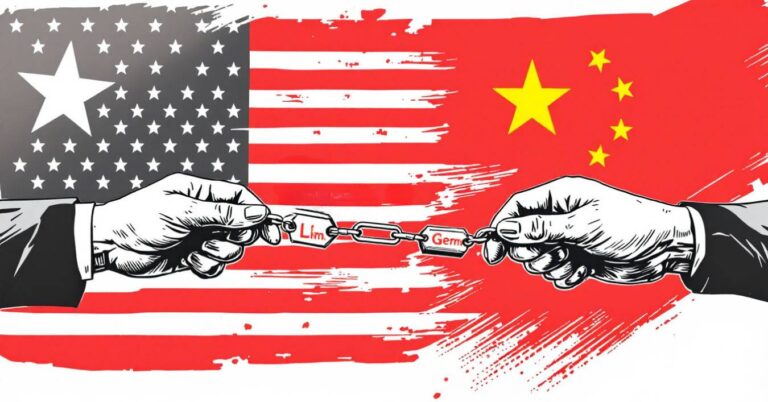
Anthropic has disabled access to Fable 5 and Mythos 5 after a U.S. government export-control directive restricted access by foreign nationals, including foreign-national Anthropic employees. The move marks a major escalation in AI governance because it targets access to frontier AI models, not only the chips used to train them.

Anthropic Disables Fable 5 and Mythos 5 – Key Points
The Story
Anthropic has suspended access to Fable 5 and Mythos 5 after receiving a U.S. government directive citing national security authorities.
The order required the company to suspend all access to the models by any foreign national, whether inside or outside the United States. To comply, Anthropic disabled Fable 5 and Mythos 5 for all customers.
The case is significant because U.S. technology controls have historically focused on semiconductors, supercomputers, and other infrastructure. This action moves the pressure directly onto access to AI models themselves.
The Facts
Models and Access
- Claude Fable 5 launched on June 9, 2026.
- Anthropic described Fable 5 as a “Mythos-class” model made available for general use with safety restrictions.
- Claude Mythos 5 uses the same underlying model as Fable 5 but has some safeguards lifted for trusted partners.
- Mythos 5 was intended for a small group of cyberdefenders and infrastructure providers through Project Glasswing.
- Anthropic priced both models at $10 per million input tokens and $50 per million output tokens.
- Access to all other Anthropic models is not affected.
Government Order
- Anthropic received the directive at 5:21 p.m. ET.
- The directive covered Fable 5 and Mythos 5.
- The order restricted access by foreign nationals, including foreign-national Anthropic employees.
- A U.S. official confirmed that the Commerce Department issued the directive.
- The letter did not provide specific details of the national security concern.
Safety Dispute
- The government concern appears to involve a possible jailbreak of Fable 5.
- Anthropic reviewed a demonstration involving a small number of previously known, minor vulnerabilities.
- Other publicly available models can identify the same types of vulnerabilities without requiring a bypass.
- The government had provided only verbal evidence of a narrow, non-universal jailbreak.
- The disclosed potential jailbreak involved asking the model to read a specific codebase and fix software flaws.
- No testers had found a universal jailbreak that could broadly bypass safeguards and unlock a wide range of cyber capabilities.
- Fable 5 was red-teamed for thousands of hours by Anthropic, the U.S. government, the UK AI Security Institute, private third-party organizations, and internal teams.
- UK AI Security Institute testing found that the model could exploit defences and systems 73% of the time.
- Anthropic argued that recalling a commercial model on the basis of a narrow potential jailbreak would create a standard that could halt frontier model deployment across the industry.
What Changed
The most important change is not simply that Fable 5 and Mythos 5 became unavailable. The larger shift is that model access itself is now being treated as an export-control issue.
Until now, the most visible U.S. controls around AI focused on compute: advanced chips, chipmaking tools, and infrastructure. This case suggests that the next phase of AI regulation may include direct restrictions on who can access the most capable AI systems.
That matters because frontier models are no longer only chatbots. They are increasingly used for software engineering, cybersecurity research, scientific work, financial analysis, code migration, and autonomous digital tasks.
Why Fable 5 and Mythos 5 Matter
Fable 5 was positioned as Anthropic’s most capable generally available model. It improved performance in software engineering, knowledge work, vision, memory, long-context tasks, and life sciences research.
Mythos 5 was more restricted. It was designed for trusted users in sensitive domains, especially cybersecurity. Anthropic described Mythos 5 as having the strongest cybersecurity capabilities of any model it had released.
That difference is central to the dispute. Fable 5 was meant to give broad users access to Mythos-class capability with safeguards. Mythos 5 was meant to give selected partners deeper capability in controlled settings.
The concern is practical, not theoretical. In the wrong hands, models with advanced cyber capability could accelerate attacks against complex systems, including banking, infrastructure, enterprise software, and older interconnected technology environments.
The Core Policy Conflict
The case exposes a difficult policy question: should governments restrict frontier AI models before harm is proven, or only after specific risks are demonstrated?
The U.S. government’s position appears to be precautionary. If a model can help identify software vulnerabilities or support cyber operations, access may need to be restricted before a broader incident occurs.
Anthropic’s position is narrower. The company argues that a limited jailbreak claim does not justify recalling a commercial model, especially when similar capabilities are available in other deployed models. The capability shown in the report was already available from other models, including OpenAI’s GPT-5.5, and is used by defenders who protect software systems.
The company also defended its “defense in depth” strategy. Perfect jailbreak resistance is not currently possible for any model provider, so Fable 5 was designed to make jailbreaks narrow or expensive, combine safeguards with monitoring, and retain customer data for 30 days to help detect and mitigate attacks.
This is the central tension for AI governance: powerful models may create real security risks, but vague or inconsistent restrictions can also damage product access, customer trust, international markets, and developer planning.
Business Impact
The suspension affects Anthropic customers who expected access to Fable 5 and Mythos 5 through API, enterprise, or subscription channels.
It also creates uncertainty for other major U.S. AI developers. OpenAI, Google, Meta, xAI, and other model providers may now face sharper questions about whether the most capable models can remain globally available.
The order also lands during a broader dispute between Anthropic and the Trump administration. Anthropic previously refused to allow use of its AI models for domestic surveillance and fully autonomous weapons systems. The company was later labelled a U.S. supply-chain risk, a designation Anthropic is challenging in court.
International Reaction
The European Commission is assessing Anthropic’s statement and has said the case underlines Europe’s need for technological sovereignty.
The reaction matters because the directive affects foreign nationals inside and outside the United States, not only users in adversarial countries. That makes the order a test case for how U.S. AI controls could affect allies, researchers, companies, and government partners abroad.
Why This Matters
This development matters because it moves AI regulation from broad policy debate into direct product availability. For end users, it shows that access to advanced AI tools may depend not only on pricing or platform rollout, but also on national security decisions, export controls, technical safety disputes, litigation, and regulatory trust.
This article was drafted with the assistance of generative AI. All facts and details were reviewed and confirmed by an editor prior to publication.
Anthropic launched Claude Fable 5 and Mythos 5 with stronger coding, long-context work, guarded access, new pricing, and safety fallbacks.

Anthropic funding round raised $65 billion at a $965 billion valuation, surpassing OpenAI as Claude Code demand grows.
Anthropic IPO filing gives the Claude maker a path to go public after a $965B valuation, testing public-market demand for frontier AI.

Anthropic unveiled dreaming for Claude Managed Agents, letting AI agents review past sessions, update context files, and improve work.
Read a comprehensive monthly roundup of the latest AI news!