
Key Takeaway
John Jumper, co-creator of AlphaFold and co-winner of the 2024 Nobel Prize in Chemistry, is leaving Google DeepMind to join Anthropic. The move gives Anthropic a major AI-for-science hire and highlights the growing talent war between frontier AI labs.
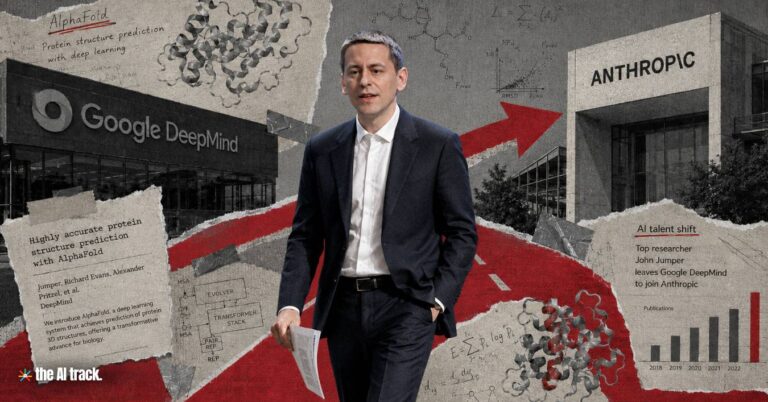
John Jumper Joins Anthropic – Key Points
The Story
John Jumper announced on June 19, 2026, that he is leaving Google DeepMind after nearly nine years and joining Anthropic.
Jumper is best known for helping lead AlphaFold, the Google DeepMind system that predicts the 3D structure of proteins from amino-acid sequences. AlphaFold became one of the clearest examples of AI producing direct scientific value, with its public database now offering access to more than 200 million protein structure predictions.
His next role at Anthropic has not yet been detailed. The timing is notable because Anthropic is expanding its public focus on AI for science, including a June 30 virtual event on how Claude is being used in scientific work.
The Facts
- John Jumper is leaving Google DeepMind for Anthropic after nearly nine years.
- He served as VP, Engineering Fellow at Google DeepMind.
- He helped create AlphaFold, one of the most important AI systems in modern biology.
- Jumper and Google DeepMind CEO Demis Hassabis shared half of the 2024 Nobel Prize in Chemistry for protein structure prediction.
- The other half of the Nobel Prize went to David Baker for computational protein design.
- AlphaFold DB provides open access to more than 200 million protein structure predictions.
- Jumper’s new position at Anthropic has not been publicly specified.
- His departure follows another major Google AI exit: Noam Shazeer, a Gemini model co-lead, is also leaving for OpenAI.
- Anthropic is increasing its science-facing activity, including work around chemistry, biology agents, and enterprise research use cases.
Why Anthropic Gains More Than a Big Name
This is not only a prestige hire.
Jumper brings experience from one of the strongest real-world examples of AI changing scientific research. AlphaFold did not simply improve a consumer app or productivity tool. It helped researchers access structural biology information at a scale that would have been extremely slow and expensive through experimental methods alone.
For Anthropic, that matters because the company is trying to position Claude beyond general chatbot use. Scientific research, coding, enterprise agents, and safety-sensitive workflows all require more than large models. They require domain experts who understand how to connect AI systems with serious technical problems.
What It Means for Google DeepMind
Google DeepMind remains one of the most important AI research organizations in the world. It still has the AlphaFold legacy, major scientific teams, Gemini development, and Google’s infrastructure behind it.
But losing Jumper soon after Noam Shazeer’s departure creates a visible retention problem. The broader signal is that even the largest technology companies are under pressure to keep elite AI researchers when startups can offer sharper missions, less bureaucracy, and potentially large equity upside.
The AI-for-Science Context
AI for science is becoming a strategic frontier for major labs.
The first phase of generative AI focused heavily on chatbots, image generation, coding, and productivity. The next phase is moving toward harder domains: biology, chemistry, medicine, materials, energy, and scientific reasoning.
These fields need models that can assist with literature review, simulation, experimental design, molecular analysis, data interpretation, and hypothesis generation. They also need rigorous validation, because scientific usefulness depends on accuracy, reproducibility, and expert review.
Jumper’s move fits that shift. Anthropic is not just competing for general AI capability. It is also competing for credibility in specialized domains where expert trust matters.
The Regulatory Context
The move also comes during a sensitive period for Anthropic.
The company recently faced U.S. government scrutiny over access to its most advanced models, after access to Claude Fable 5 and Claude Mythos 5 was suspended. That issue is separate from Jumper’s hiring, but it adds context: Anthropic is expanding into high-value scientific and enterprise areas while also navigating pressure over frontier model access, safety, and national-security concerns.
What to Watch Next
The most important unanswered question is Jumper’s role at Anthropic.
If he works directly on AI for science, Anthropic could use his experience to strengthen Claude’s scientific capabilities, build domain-specific tools, or improve how AI systems handle biological and chemical reasoning.
The June 30 AI-for-science event may also clarify how seriously Anthropic plans to compete in this area. The key point to watch is whether Anthropic turns science into a product direction, a research direction, or both.
Why This Matters
For end users, this move will not immediately change Claude or Google DeepMind products. But it could influence the next generation of AI tools for scientific research, drug discovery, biology workflows, coding, and expert work. In frontier AI, competitive advantage increasingly depends not only on compute and models, but on the researchers who know how to turn AI capability into useful systems.
This article was drafted with the assistance of generative AI. All facts and details were reviewed and confirmed by an editor prior to publication.

Anthropic funding round raised $65 billion at a $965 billion valuation, surpassing OpenAI as Claude Code demand grows.
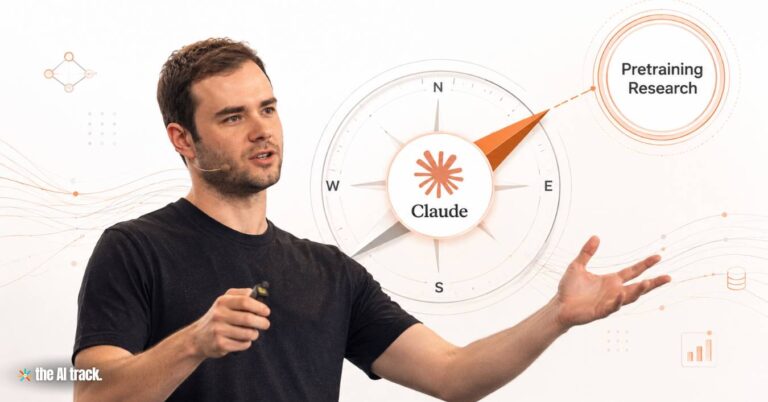
Andrej Karpathy joins Anthropic to work on Claude pretraining, strengthening the company’s AI research team amid rising competition.

Anthropic disabled Fable 5 and Mythos 5 after a U.S. export-control order, raising new questions about AI access and safety.
Anthropic launched Claude Fable 5 and Mythos 5 with stronger coding, long-context work, guarded access, new pricing, and safety fallbacks.
Read a comprehensive monthly roundup of the latest AI news!