
Key Takeaway
Stanford AI Index 2026 says AI is improving quickly across science, coding, reasoning, and adoption, but the systems are becoming more resource-intensive, less transparent, and more disruptive to younger workers. The report also points to a widening disconnect between AI experts and the public on jobs, regulation, and AI’s broader social impact.
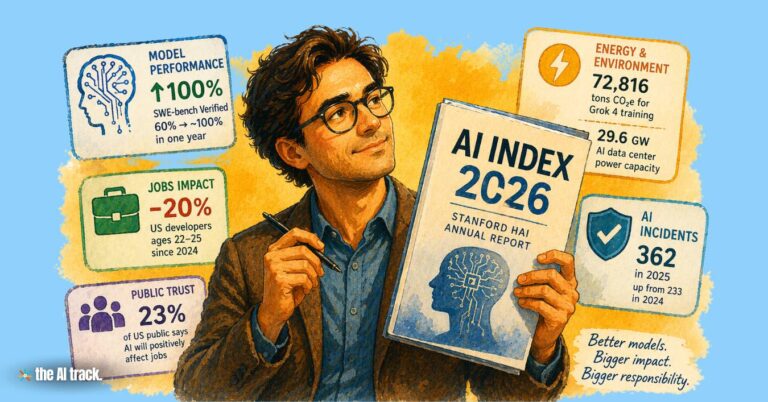
Stanford AI Index 2026 – Key Points
The Story
Stanford AI Index 2026 presents a broad snapshot of how artificial intelligence is evolving across performance, investment, labor, science, education, transparency, and public opinion. The report finds that frontier models are advancing rapidly in complex reasoning, coding, and scientific use, while environmental costs, workforce disruption, rising incident counts, and weak transparency are becoming more visible. It also shows a tighter U.S.-China race in model performance, even as the U.S. remains dominant in private AI investment. At the same time, consumer adoption is spreading quickly while public trust, especially in the U.S., remains weak.
The Facts
AI model capability is still climbing fast.
Frontier systems now meet or exceed human capability on tasks including PhD-level science questions, multimodal reasoning, and competition mathematics, according to the report. On SWE-bench Verified, performance reportedly rose from about 60% to nearly 100% in a year.
Some benchmarks improved sharply, but basic weaknesses remain.
The report says
- the success rate of agents on real-world tasks rose from 20% in 2025 to 77.3% on Terminal-Bench,
- while AI agents handling cybersecurity problems solved issues 93% of the time, up from 15% in 2024.
- At the same time, AI still struggles with learning from video, generating coherent and realistic video, telling time, multi-step planning, financial analysis, and some expert academic exams;
- frontier models reportedly read analog clocks correctly only about 50.1% of the time, versus roughly 90% for unspecialised humans.
- Household robots also remain limited, succeeding in only 12% of real household tasks.
The environmental burden is rising with capability.
Stanford AI Index 2026 estimates
- Grok 4 training emissions at 72,816 tons of CO2 equivalent.
- AI data center power capacity reached 29.6 GW,
- annual GPT-4o inference water use may exceed the drinking water needs of 12 million people,
- cumulative AI power demand is comparable to the national electricity consumption of Switzerland or Austria.
The U.S.-China performance gap has narrowed sharply.
Chinese and U.S. models have traded top positions since early 2025. The report says DeepSeek-R1 briefly matched the top U.S. model in February 2025, and as of March 2026 Anthropic’s leading model was ahead by only 2.7%.
The U.S. still leads in money and top-tier models.
Private AI investment reached $344.7 billion in 2025, up 127.5% year over year, while global corporate AI investment reached $581.7 billion. The U.S. accounted for $285.9 billion in private AI investment versus China’s $12.4 billion, roughly a 23-fold gap.
China remains strong across broader industrial indicators.
The Stanford AI Index 2026 report says China leads in publication volume, citations, patent output, and industrial robot installations, while the U.S. still leads in top-tier model production and private investment.
The U.S. is attracting far fewer AI researchers.
The Stanford AI Index 2026 report says the number of AI researchers moving to the United States has fallen 89% since 2017.
Productivity gains are showing up alongside entry-level job pressure.
The report documents
- productivity gains of 14% to 26% in customer support and software development,
- and up to 72% in marketing teams,
- though effects are weaker or even negative for tasks requiring more judgment.
In software development, where productivity gains are strongest, employment among U.S. developers aged 22–25 has dropped nearly 20% since 2024, while older developers’ headcount has grown.
AI is becoming more embedded in scientific research and clinical workflows.
AI-related publications in the natural, physical, and life sciences rose 26% to 28% year over year. The report also highlights end-to-end AI weather forecasting, astronomy’s first foundation model, and broad 2025 adoption of clinical note-generation tools, with physicians in multiple hospital systems reporting up to 83% less time spent writing notes.
Adoption is spreading faster than past consumer technologies, but harms are also rising.
Generative AI reached 53% population adoption within three years, faster than the personal computer or the internet, according to the report. It also estimates the annual value of generative AI tools to U.S. consumers at $172 billion by early 2026.
At the same time, documented AI incidents rose to 362 in 2025 from 233 in 2024, while 88% of organisations reported using AI.
Public opinion is diverging sharply from expert opinion.
The Stanford AI Index 2026 report says AI experts and the U.S. public disagree on nearly every major question about AI’s future. A Pew study cited in the report found only 10% of Americans were more excited than concerned about AI in daily life, while 56% of AI experts surveyed said AI would have a positive impact on the U.S. over the next 20 years. On jobs, 73% of experts said AI would positively affect how people work, compared with 23% of the public; 64% of Americans said AI would lead to fewer jobs over the next 20 years.
Gen Z sentiment is turning more negative even as usage stays high.
A Gallup poll conducted for the Walton Family Foundation and GSV Ventures in February and March 2026 found the share of people aged 14–29 who said they were excited about AI fell from 36% in 2025 to 22% in 2026, while those feeling hopeful fell from 27% to 18% and those feeling angry rose from 22% to 31%. About half of Gen Z uses AI daily or weekly.
Numbers that Matter
- 72,816 tons — estimated CO2-equivalent emissions from training Grok 4
- 29.6 GW — AI data center power capacity
- 2.7% — lead held by Anthropic’s top model over the nearest Chinese rival as of March 2026
- $581.7 billion — global corporate AI investment in 2025
- $344.7 billion — private AI investment in 2025
- $285.9 billion — U.S. private AI investment in 2025
- 53% — generative AI population adoption within three years
Background / Context
The AI Index has tracked the field since 2017 and is produced by the Stanford Institute for Human-Centered AI with input from academic and industry experts. The 2026 edition frames AI as a field where technical gains are accelerating faster than society’s ability to measure, govern, and absorb their effects.
Why This Matters
The report shows AI is no longer just a story about better models. It is now simultaneously a story about infrastructure strain, labor-market pressure, weak disclosure, fast consumer uptake, rising incident counts, and a widening gap between expert optimism and public anxiety. That combination matters because it shifts the debate from whether AI is advancing to whether institutions can govern it credibly and whether the benefits will reach the people most exposed to the disruption.
This article was drafted with the assistance of generative AI. All facts and details were reviewed and confirmed by an editor prior to publication.

The global race for AI supremacy is reshaping geopolitics. Nations are deploying competing strategies across compute, capital, and talent, defining a new, multipolar technological world order.

Artificial intelligence (AI) is transforming the way we work, learn and live. According to a new study by IBM, 40% of the global workforce will need to be reskilled in the next three years due to AI. Reskilling is not only a necessity but also an opportunity to enhance human potential and create more value for businesses and society.
AI predictions 2026 focus on measurable ROI – not demos. Explore 12 evidence-backed trends across enterprise workflows, agents, wearables, data scarcity, chips, robotics, and trust.

An Extensive Analysis of the Impact of Artificial Intelligence on the Environment: AI’s Role in Environmental Solutions Versus Its Carbon Footprint
Read a comprehensive monthly roundup of the latest AI news!