Key Takeaway
SK Hynix has crossed $1 trillion in market value for the first time, lifted by surging demand for high-bandwidth memory chips used in AI data centers. The milestone confirms that memory has become one of the most valuable layers of the AI infrastructure boom.
SK Hynix Hits $1 Trillion Market Cap – Key Points
The Story
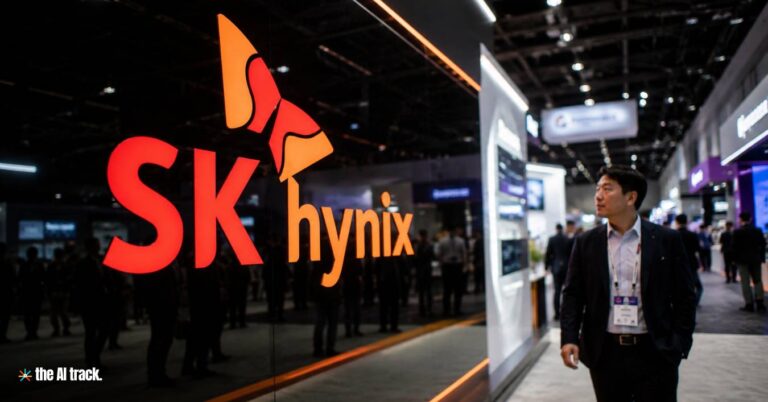
SK Hynix reached a $1 trillion market capitalization on Wednesday, May 27, 2026, after its shares closed about 9.3% higher on the Korea Exchange.
The South Korean chipmaker briefly rose as much as 14.9% during the session, pushing its market value to a record 1,680 trillion won, or about $1.12 trillion. The rally placed SK Hynix alongside Samsung Electronics and Micron Technology, which also crossed the $1 trillion threshold during the same AI-driven memory boom.
The company’s rise reflects a sharp shift in investor focus. AI chips need advanced memory to move data quickly inside data centers, and SK Hynix has become a leading supplier of high-bandwidth memory, known as HBM. It has also emerged as a key HBM supplier to Nvidia, placing it near the center of the global AI server supply chain.
The Facts
- SK Hynix topped $1 trillion in market value for the first time on May 27, 2026.
- Its shares closed about 9.3% higher after rising as much as 14.9% during the session.
- The company’s market value reached a record 1,680 trillion won, equivalent to roughly $1.12 trillion.
- Samsung Electronics crossed the $1 trillion mark on May 6, 2026.
- Micron Technology reached the milestone one day before SK Hynix.
- SK Hynix, Samsung, and Micron are the three dominant suppliers of high-bandwidth memory.
- Counterpoint Research data cited by Bloomberg put SK Hynix at 57% of global HBM revenue in the fourth quarter of last year.
- Samsung held 22% of HBM revenue, while Micron held 21%.
- SK Hynix reported that quarterly profit multiplied fivefold in its April earnings.
- The company expects HBM demand to exceed available supply over the next three years.
- SK Hynix shares have risen more than 200% so far this year, with some market estimates putting the gain closer to 250%.
- Micron shares are up about 245%, while Samsung shares have gained about 149%.
- SK Hynix is separately pursuing a U.S. listing through American depositary receipts, which could broaden access for international investors.
Why AI Memory Is So Valuable
High-bandwidth memory is essential for advanced AI systems because it helps processors handle large volumes of data at high speed. Nvidia-style AI accelerators depend on fast memory stacks to train and run large models efficiently.
That makes HBM a bottleneck in the AI supply chain. Cloud providers, AI labs, and server companies are expanding data-center capacity, but memory supply cannot scale instantly. Production requires advanced packaging, specialized manufacturing capacity, and long qualification cycles with major chip customers.
The result is pricing power for the largest memory suppliers.
The Market Impact
SK Hynix’s rally lifted South Korea’s broader stock market. The KOSPI index rose as much as 5.1% intraday before closing 2.3% higher. Samsung and SK Hynix together now account for more than 40% of the benchmark index by market capitalization, making the KOSPI increasingly tied to global demand for AI-related semiconductors.
The KOSPI has nearly doubled so far this year, making South Korea one of the largest public-market beneficiaries of the AI infrastructure cycle.
The surge also triggered strong interest in leveraged exchange-traded funds. Single-stock leveraged ETFs tied to Samsung and SK Hynix debuted on the Korea Exchange on the same day. A leveraged SK Hynix ETF targeting twice the stock’s daily return rose 18% on its first trading day.
What Changed for the Memory Industry
Memory chips were historically treated as cyclical commodities. Prices often surged during shortages, then collapsed when manufacturers added too much capacity.
AI may be changing that pattern. Demand is no longer coming mainly from consumer electronics such as smartphones, laptops, and PCs. It is increasingly coming from AI data centers, where memory supply is becoming a strategic constraint.
Analysts now expect memory demand to keep exceeding supply through 2028. That has led investors to revalue the sector, especially companies with strong exposure to HBM. Some analysts also argue that SK Hynix’s earnings forecasts are rising faster than its share price, which has helped support the stock despite its rapid climb.
Risks to Watch
The KOSPI’s growing dependence on a small number of AI-linked chip stocks could heighten market volatility. Supply-chain disruptions, customer concentration, or a slowdown in global data-center investment would now have a larger effect on South Korea’s broader equity market.
The ETF-driven trading surge adds another layer of risk. Leveraged products can amplify daily moves and increase short-term pressure on both futures and spot markets.
Why This Matters
The companies supplying memory, servers, power, cooling, and data-center infrastructure are becoming central to the AI economy, with direct effects on chip prices, consumer device costs, cloud capacity, and the pace of AI deployment.
This article was drafted with the assistance of generative AI. All facts and details were reviewed and confirmed by an editor prior to publication.
Alibaba introduced Qwen3.7-Max, the Zhenwu M890 AI chip, and Panjiu AL128 server for agentic AI, coding, and domestic infrastructure.

All you need to know about the critical components of AI infrastructure, hardware, software, and networking, that are essential for supporting AI workloads.

Trump says the U.S. and China discussed AI guardrails as Washington weighs cyber, biological and nuclear risks.
Explore the vital role of AI chips in driving the AI revolution, from semiconductors to processors: key players, market dynamics, and future implications.
Huawei could take 60% of China’s AI chip market in 2026 as Nvidia H200 shipments stall and DeepSeek V4 boosts Ascend demand.
Read a comprehensive monthly roundup of the latest AI news!