Key Takeaway
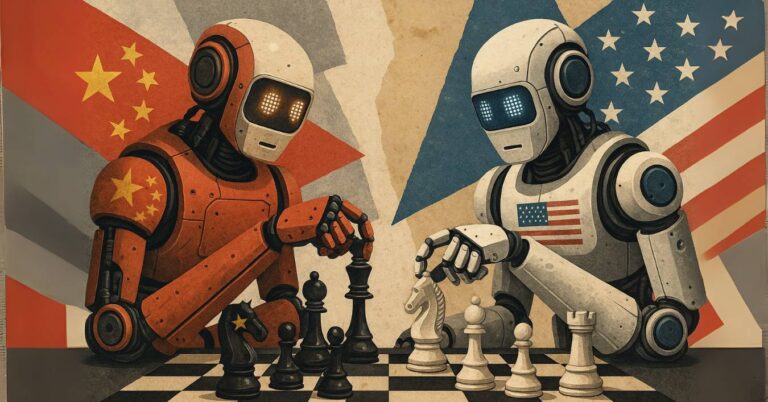
G7 AI Talks are highlighting a growing split between China’s push for open global AI governance and the G7’s debate over trusted access to advanced U.S. AI models. The divide shows how AI safety is becoming a geopolitical contest over access, standards, security, sovereignty, and influence.

G7 AI Talks – Key Points
The Core Shift
Beijing used a new global governance white paper to emphasize international cooperation, safe AI development, and broader access to artificial intelligence. China’s message was aimed beyond the West, with repeated references to the Global South, the United Nations, BRICS, and the Shanghai Cooperation Organization.
The timing matters. China’s push came as G7 leaders met in Evian, France, without Beijing and discussed a trusted-access plan for advanced U.S. AI models, after Anthropic took Fable 5 and Mythos 5 offline following a U.S. directive restricting foreign-national access.
The G7 AI Talks captured the new shape of AI politics: the United States is moving toward controlled access to frontier models, Europe and Canada are pushing harder for technological sovereignty, and China is positioning itself as a supporter of wider AI sharing, capacity building, and multilateral governance.
The Facts
- China’s Foreign Minister Wang Yi said China is stepping up preparations for the World AI Cooperation Organization.
- The comments came during the release of China’s white paper, More Just and Equitable Global Governance: China’s Principles, Proposals and Actions.
- Chinese officials said Beijing supports the United Nations as a central channel for global governance and wants the Global South to have a stronger role.
- China also pointed to cooperation through BRICS and the Shanghai Cooperation Organization.
- China plans to host the 2026 World Artificial Intelligence Conference and High-Level Meeting on Global AI Governance in Shanghai in July.
- G7 leaders met in Evian, France, from June 15 to 17, 2026.
- The G7 AI Talks asked finance ministers, central bank governors, financial supervisors, global financial institutions, tech companies, and cyber experts to examine the opportunities and risks from frontier AI models, including implications for financial stability, productivity, labour markets, and cybersecurity.
- AI executives at the summit included OpenAI CEO Sam Altman, Google DeepMind CEO Demis Hassabis, Anthropic CEO Dario Amodei, and leaders from Cohere, Mistral, Black Forest Labs, Domyn, Sakana AI, and Synthesia.
- G7 leaders discussed a “trusted partners” scheme that could give selected countries or companies access to advanced U.S. AI models.
- The talks followed U.S. restrictions on foreign-national access to Anthropic’s latest models, Fable 5 and Mythos 5, over national security concerns.
- Anthropic took Fable 5 and Mythos 5 offline after the U.S. directive.
- G7 leaders also issued a separate call for a safer digital space for minors, including age-assurance systems, parental controls, safer conversational AI tools for children, and stronger action against harmful synthetic content.
- The U.S. and China said in May that they would discuss AI guardrails, but few concrete details have been made public.
Two Competing AI Governance Models
The U.S. approach is increasingly shaped by security concerns. Advanced AI models are being treated not only as commercial software, but also as strategic assets that can affect cybersecurity, infrastructure, financial systems, and national security.
China’s public position is different. Beijing is emphasizing openness, international cooperation, technology sharing, and support for developing countries. Chinese officials have also criticized closed, exclusive, and monopolistic approaches to technology development.
Europe and Canada are not simply choosing between the two models. Both are trying to keep access to leading U.S. systems while reducing dependence on American technology platforms. That makes AI governance a three-way problem: security controls, open access, and sovereign capability.
For Europe, the sovereignty problem is practical as well as political. European AI firms still rely heavily on U.S.-controlled cloud infrastructure, chips, and foundation models, while the European Commission is assessing the impact of the U.S. export-control directive and pushing AI gigafactories, large-scale computing infrastructure, and policies to strengthen domestic cloud, AI, and semiconductor capacity. The Anthropic restrictions sharpened that concern by showing how foreign-policy decisions can affect access to advanced AI systems.
Why Access Is Becoming the Main Issue
AI safety debates used to focus mostly on model behavior, misinformation, bias, and harmful outputs. Now the bigger question is access.
Who can use the most powerful models?
Who decides which countries are trusted?
Can companies safely release models that can find software vulnerabilities?
Should advanced systems be restricted like sensitive infrastructure, or shared more widely so more countries can benefit?
These questions are no longer theoretical. The Anthropic restrictions showed that allies, companies, researchers, and paying customers can lose access if frontier AI systems are treated as national-security assets.
What China Wants to Signal
China is trying to present itself as a leader in global AI governance, especially for countries that do not want to depend only on U.S. technology platforms.
That message has three parts:
- AI should be shared more broadly, especially with developing economies.
- Global AI rules should be shaped through multilateral institutions, not only by the U.S. and its allies.
- Open-source and low-cost AI ecosystems can give China influence, particularly where governments and businesses cannot afford expensive subscription-based systems.
This framing is likely to appeal to countries looking for cheaper AI tools, technical training, and alternatives to U.S.-led technology standards.
What the G7 Is Trying to Balance
The G7 faces a different problem. Its members want access to the strongest AI models for productivity, science, cybersecurity, and economic growth. But they also want to avoid uncontrolled access to systems that could be misused.
That is why the “trusted partners” idea matters. It suggests a middle path between full restriction and full openness: selected access for approved countries, companies, or institutions.
The G7 is also connecting AI governance with online safety. Its statement on minors points to a wider regulatory direction: AI chatbots, synthetic content, recommendation systems, and age-sensitive digital services are likely to face more pressure for safeguards, verification systems, and clearer responsibility from technology companies.
The difficulty is implementation. A trusted-access system would need clear rules on eligibility, monitoring, data protection, export controls, cybersecurity use, child safety, and what happens if access is withdrawn.
Why This Matters
AI users may soon experience global AI politics directly through model availability, pricing, restrictions, cybersecurity rules, child-safety features, and regional access. For businesses and governments, choosing an AI system is no longer only a technical decision; it is also a question of trust, compliance, sovereignty, safety, and long-term dependence.
This article was drafted with the assistance of generative AI. All facts and details were reviewed and confirmed by an editor prior to publication.
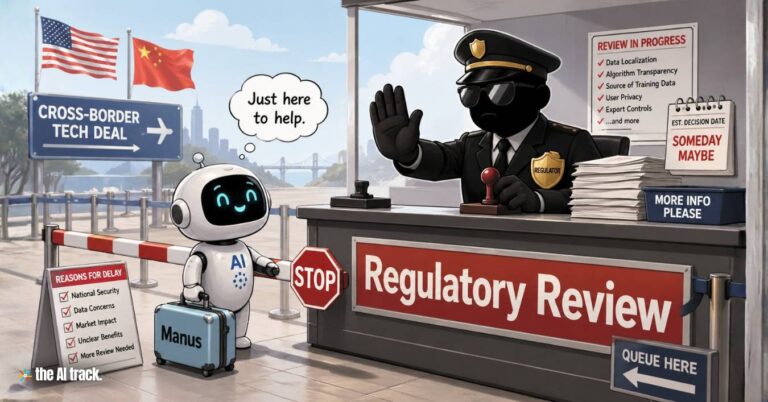
China blocked Meta’s estimated $2bn deal for AI startup Manus after a months-long probe, tightening scrutiny of US investment in AI.

China announces five-year plan for 2026–2030 with AI infrastructure, semiconductors, digital economy growth, and tighter focus on orderly AI development.

Trump’s $500B Stargate AI project faces funding scrutiny as SoftBank, Oracle, and NVIDIA drive tech stock rallies amid China rivalry.

Japan invests for semiconductor and AI leadership with a $65 billion plan by 2030, aiming to drive tech innovation and strengthen economic resilience.
Read a comprehensive monthly roundup of the latest AI news!