Key Takeaway
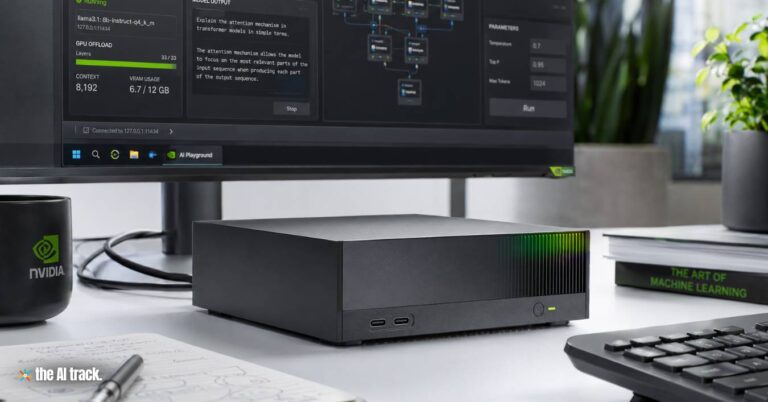
Microsoft has introduced the Surface RTX Spark Dev Box, a compact NVIDIA-powered Windows 11 mini-PC built for developers working on local AI agents, model fine-tuning, and long-running AI workloads.
The Surface RTX Spark Dev Box – Key Points
What Is New
Microsoft is expanding its Surface lineup with a developer-focused mini-PC built around NVIDIA’s RTX Spark platform. The Surface RTX Spark Dev Box is designed for local AI development rather than general consumer computing.
The device targets developers building agentic AI systems on Windows. That includes workflows where AI agents run locally, use tools, execute multi-step tasks, and handle sensitive data without relying entirely on cloud infrastructure.
The Dev Box also sits alongside Microsoft’s Surface Laptop Ultra, a high-performance RTX Spark-based laptop aimed at developers, creators, and technical professionals who need more AI compute in a portable form. Together, the two devices show Microsoft’s attempt to turn Windows into a stronger platform for local AI agents, model work, and secure developer environments.
Key Points
- The Surface RTX Spark Dev Box is a compact Windows 11 mini-PC for AI developers.
- It uses NVIDIA RTX Spark hardware with a Blackwell RTX GPU and Grace CPU.
- Microsoft says the system delivers up to 1 petaflop of AI compute.
- It includes 128GB of unified memory.
- Microsoft says the Dev Box can run 120B+ parameter models with up to 1 million tokens of context locally at interactive speeds.
- The system is built for sustained workloads with a 100W thermal envelope.
- Microsoft lists use cases such as long-running training jobs, agentic AI pipelines, and local model fine-tuning.
- The device includes Visual Studio Code, GitHub Copilot, WSL 2 with NVIDIA CUDA support, Developer Mode, PowerShell 7, and Windows 11 Pro.
- Ports include USB-C, HDMI, USB-A, Ethernet, and a headphone jack.
- Microsoft has not announced pricing.
- Availability is planned for later this year in the United States through microsoft.com.
- NVIDIA says RTX Spark-powered laptops and compact desktops will be available this fall from ASUS, Dell, HP, Lenovo, Microsoft Surface, and MSI, with Acer and GIGABYTE models to follow.
- Surface Laptop Ultra brings the same RTX Spark direction to a 15-inch mobile workstation-style Surface device, with up to 128GB unified memory and a focus on on-device AI workflows.
- NVIDIA also unveiled Nemotron 3 Ultra at Computex on June 1, a 550-billion-parameter open-weight model designed for agentic reasoning and enterprise AI workflows.
How It Works
The main difference between the Surface RTX Spark Dev Box and a standard AI laptop is sustained performance.
AI development workloads can run for long periods. Fine-tuning, local inference, agent testing, and multi-step AI pipelines often need more thermal headroom than a thin laptop can provide. Microsoft’s 100W thermal envelope gives the desktop-style box more room to maintain performance under heavier AI workloads.
The 128GB unified memory pool is also central. Large models and agent workflows can require substantial memory, especially when developers are testing local inference, tool use, retrieval systems, or multi-agent workflows.
RTX Spark combines a Blackwell RTX GPU with 6,144 CUDA cores, fifth-generation Tensor Cores with FP4 precision, and a 20-core NVIDIA Grace CPU connected through NVIDIA NVLink-C2C. The platform is designed to bring NVIDIA’s CUDA, RTX, TensorRT, OptiX, DLSS, Reflex, and G-SYNC ecosystem into compact Windows PCs.
Microsoft’s broader RTX Spark device strategy also points to tighter Windows support for Arm-based AI PCs. The new Windows agent foundation includes security primitives for identity, containment, policy, and end-to-end security, while NVIDIA OpenShell adds policy controls for what agents can do, how queries are routed, and how personal information is handled when cloud models are used.
Who It Is For
The Surface RTX Spark Dev Box is mainly for:
- AI developers building local agents
- Windows developers testing AI-native applications
- Teams experimenting with local model fine-tuning
- Enterprise developers working with sensitive workloads
- Researchers and technical users who need compact AI hardware
- Developers who want CUDA support inside a Windows workflow
- Creators building AI-assisted media, 3D, video, or generative workflows
It is not positioned as a mainstream home PC. The likely audience is technical, enterprise, creative, and developer-focused.
Surface Laptop Ultra broadens that same direction for developers, creators, and power users who need RTX Spark-class AI performance in a portable machine rather than a desk-based dev box.
What You Can Use It For
The device is designed for practical AI development tasks, including:
- Running large models locally
- Testing AI agents before cloud deployment
- Fine-tuning smaller or mid-sized models
- Building agentic workflows on Windows
- Running CUDA-based AI tools through WSL 2
- Developing AI apps with Visual Studio Code and GitHub Copilot
- Testing secure local AI workloads before enterprise rollout
- Running creative AI and 3D workflows that benefit from RTX acceleration
NVIDIA says RTX Spark systems can support tasks such as rendering 90GB+ 3D scenes, editing 12K 4:2:2 video, generating 4K AI video, running 120B-parameter large language models with 1 million tokens of context, and playing AAA games at 1440p above 100 frames per second.
The most important use case is local development. Instead of sending every model call or agent action to the cloud, developers can prototype more directly on a local machine.
Why NVIDIA Matters Here
NVIDIA is not only supplying the hardware foundation. The RTX Spark platform connects Microsoft’s Windows strategy with NVIDIA’s AI software ecosystem, including CUDA, TensorRT, RTX graphics, and local AI acceleration.
That matters because many AI developers already rely on NVIDIA tools. Bringing that stack into compact Windows devices makes local AI development more accessible for teams that do not want to depend entirely on remote servers.
NVIDIA’s broader Nemotron 3 work shows the same direction. Nemotron 3 Ultra uses a mixture-of-experts design with roughly 550 billion total parameters and about 55 billion active parameters per token. The model is built for multi-step reasoning, planning, coding, and agentic workflows.
Independent evaluator Artificial Analysis ranked Nemotron 3 Ultra at 48 on its Intelligence Index, ahead of other U.S. open-weight models but behind Moonshot AI’s Kimi K2.6 at 54. That gives NVIDIA a stronger open-model position, while also showing that Chinese open-weight models remain highly competitive.
For Microsoft’s Surface RTX Spark Dev Box, the relevance is clear: NVIDIA is building both the hardware layer and the model ecosystem for local and hybrid agentic AI. The device is one hardware answer to a larger shift toward AI systems that can reason, plan, use tools, and run closer to the user.
The Wider RTX Spark Ecosystem
RTX Spark is not limited to Microsoft Surface. NVIDIA says slim laptops and compact desktops using the platform will arrive from ASUS, Dell, HP, Lenovo, Microsoft Surface, and MSI this fall, with Acer and GIGABYTE to follow.
Adobe is also reworking Photoshop and Premiere for RTX Spark, with NVIDIA saying the partnership will deliver up to 2x faster AI, editing, coloring, and effects performance. Blackmagic Design, Blender, CapCut, ComfyUI, OTOY, KRAFTON, NetEase, Remedy Entertainment, Riot Games, and Xbox are also among the software and gaming names supporting the platform.
That wider ecosystem matters because local AI hardware is only useful if the tools people already use can take advantage of it.
Access and Pricing
Microsoft has not announced pricing for the Surface RTX Spark Dev Box.
The company says the device will be available later this year in the United States through microsoft.com. Pre-orders are not open yet, but Microsoft is allowing users to sign up for updates on the product page.
Surface Laptop Ultra is also expected later this year. Pricing has not been announced for that device either.
What to Watch Next
If Microsoft can combine local AI hardware, Windows security, developer tools, and NVIDIA acceleration into compact and portable Surface devices, the Surface RTX Spark Dev Box could become an important reference device for agentic AI development.
Why This Matters
The Surface RTX Spark Dev Box shows where AI PCs are heading. The next phase is not only about adding chatbots to laptops. It is about giving developers enough local compute to build, test, and secure AI agents directly on personal and enterprise machines, while connecting that work to a broader ecosystem of NVIDIA models, creative tools, developer software, and cloud infrastructure.
This article was drafted with the assistance of generative AI. All facts and details were reviewed and confirmed by an editor prior to publication.

Microsoft, Google DeepMind and xAI will join U.S. AI model testing for national security risks before advanced systems are released.
Microsoft introduced MAI-Thinking-1 and a wider family of in-house AI models as it reduces strategic dependence on OpenAI and builds a broader AI stack.
NVIDIA launched Ising open models for quantum calibration and error correction, claiming faster decoding, higher accuracy, and lower data needs.
Huawei could take 60% of China’s AI chip market in 2026 as Nvidia H200 shipments stall and DeepSeek V4 boosts Ascend demand.
Read a comprehensive monthly roundup of the latest AI news!