Key Takeaway
OpenAI raised $122 billion and reached an $852 billion valuation, cementing its position as one of the world’s most highly valued private companies. The company now generates $2 billion in monthly revenue and plans to use the capital to expand its infrastructure, products, and unified AI platform.

OpenAI Raised $122 Billion – Key Points
The Story
OpenAI raised $122 billion in a new funding round at an $852 billion post-money valuation. The capital is intended to fund broader infrastructure, deeper enterprise expansion, and a “unified AI superapp” combining ChatGPT, Codex, browsing, and agentic tools into one system. The company also disclosed stronger consumer and enterprise metrics, including more than 900 million weekly active ChatGPT users, over 50 million subscribers, and enterprise revenue representing more than 40% of total revenue. The announcement underscores OpenAI’s scale ambitions as pressure grows around profitability, cost control, competition, and legal exposure.
The Facts
OpenAI raised $122 billion in a new funding round at an $852 billion post-money valuation.
The round closed with $122 billion in committed capital, making it one of the largest private funding rounds in Silicon Valley.
The round was backed by major strategic and financial investors.
It was anchored by Amazon, Nvidia, and SoftBank, with Microsoft continuing to participate. CNBC reported that Amazon agreed to invest up to $50 billion, while Nvidia and SoftBank each committed $30 billion. SoftBank also co-led the round alongside a16z, D. E. Shaw Ventures, MGX, TPG, and accounts advised by T. Rowe Price Associates, Inc.
Investor access expanded beyond institutions.
More than $3 billion came from individual investors through bank channels, the first time participation had been opened that way. The company also said it will be included in several ARK Invest-managed ETFs.
Additional financing flexibility was disclosed beyond the equity raise.
OpenAI expanded its revolving credit facility to about $4.7 billion. The facility remains undrawn at close and is backed by a syndicate including JPMorgan Chase, Citi, Goldman Sachs, Morgan Stanley, Wells Fargo, Mizuho, Royal Bank of Canada, SMBC, UBS, HSBC, and Santander.
Revenue has climbed sharply since ChatGPT launched.
OpenAI said it reached $1 billion in revenue within a year of launching ChatGPT, was generating $1 billion per quarter by the end of 2024, and is now at $2 billion per month. CNBC also reported that the company generated $13.1 billion in revenue last year.
ChatGPT has reached enormous user scale.
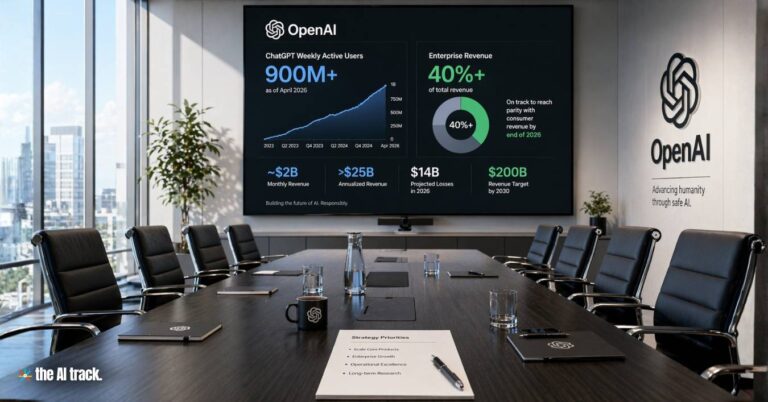
The platform now has more than 900 million weekly active users and over 50 million subscribers. OpenAI also said ChatGPT has six times the monthly web visits and mobile sessions of the next-largest AI app.
Consumer engagement continues to deepen.
Total AI time spent on ChatGPT is described as four times that of the next-largest AI app and four times all others combined. Search usage has nearly tripled in a year, the ads pilot passed $100 million in ARR in under six weeks, and revenue is growing four times faster than Alphabet or Meta did at comparable stages.
Enterprise has become a much larger part of the business.
Enterprise now accounts for more than 40% of revenue and is on track to reach parity with consumer revenue by the end of 2026.
Developer and API usage are also rising fast.
The APIs now process more than 15 billion tokens per minute. Codex serves more than 2 million weekly users, up fivefold in three months, with usage growing more than 70% month over month.
The funding is tied directly to a broader infrastructure push.
OpenAI describes durable access to compute as its core strategic advantage and says it has expanded beyond a small number of core providers over the past 15 months. Its infrastructure now spans cloud partners including Microsoft, Oracle, AWS, CoreWeave, and Google Cloud; silicon including Nvidia, AMD, AWS Trainium, Cerebras, and a custom chip effort with Broadcom; and data center partnerships with Oracle, SBE, and SoftBank.
The company is building a unified AI superapp around ChatGPT and Codex.
The strategy is to combine ChatGPT, Codex, browsing, and broader agentic capabilities into a single agent-first experience designed to work across apps, data, and workflows.
The business remains under significant pressure despite the new capital.
OpenAI has previously indicated that profitability is unlikely before 2030. CNBC also reported that it has been pulling back from some spending plans and shutting down certain features and products, including Sora, as it tries to rein in costs.
Timeline
- Within a year of launching ChatGPT: OpenAI reached $1 billion in revenue.
- End of 2024: Revenue had reached $1 billion per quarter.
- Last year: CNBC reported that OpenAI generated $13.1 billion in revenue.
- February 2026: The company said it expected to raise $110 billion.
- March 2026: OpenAI raised $122 billion as the final round increased above the earlier target.
- Past 15 months: Its infrastructure strategy expanded beyond a small number of core providers.
- Now: ChatGPT has more than 900 million weekly active users, over 50 million subscribers, and OpenAI is generating $2 billion in revenue per month.
Risks / Limitations
The new funding does not resolve OpenAI’s core challenges. The company is still burning cash, has previously signaled that profitability is unlikely before 2030, faces rising competitive pressure from Anthropic and Google, and remains exposed to legal and market risks as it scales.
Background
OpenAI is positioning itself less as a single chatbot company and more as a full-stack AI platform spanning consumer products, enterprise tools, developer APIs, and infrastructure. Its latest announcement frames that strategy around a flywheel in which more compute improves models, better models improve products, and stronger products drive more revenue and reinvestment.
Why This Matters
This is no longer just a chatbot growth story. OpenAI raised $122 billion to strengthen its position across consumer AI, enterprise deployment, developer tools, and compute infrastructure, while trying to show investors that its valuation can eventually be matched by sustainable economics.
This article was drafted with the assistance of generative AI. All facts and details were reviewed and confirmed by an editor prior to publication.

OpenAI is shutting down the Sora video generator and its API after fading app momentum and a shift toward robotics and world simulation.

OpenAI updated Codex with computer use, memory, SSH access, plugins, image generation, and long-running task automation for ChatGPT desktop users.
OpenAI loses three senior executives as it shuts down Sora, folds OpenAI for Science into other teams, and pushes harder into enterprise AI.
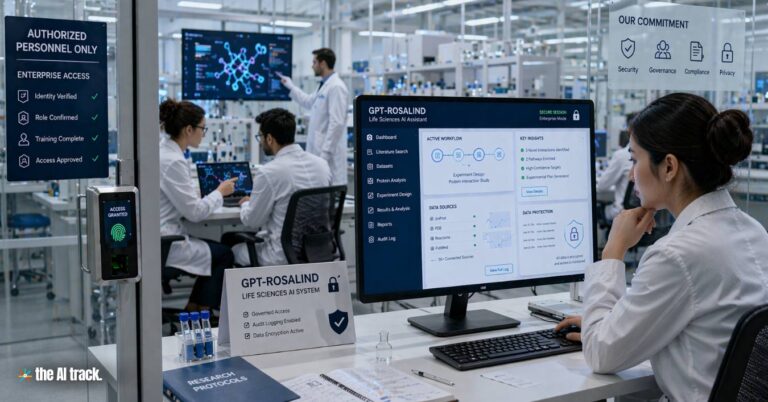
OpenAI launched GPT-Rosalind, a life sciences AI model and Codex plugin for biology research, drug discovery, and translational medicine.
Read a comprehensive monthly roundup of the latest AI news!