Key Takeaway
Microsoft has introduced MAI-Thinking-1, its first in-house reasoning model, as part of a broader effort to reduce strategic dependence on OpenAI and lower the cost of AI deployment. The launch signals a more independent Microsoft AI stack built around proprietary models for reasoning, coding, image generation, speech, voice, agentic tools, developer hardware, and enterprise-focused AI systems.
Microsoft Launches MAI-Thinking-1 – Key Points
The Story
Microsoft used Build 2026 to show that its AI strategy is no longer centered only on OpenAI’s models.
The company unveiled MAI-Thinking-1, a reasoning model designed for complex instructions, long-context reasoning, mathematical tasks, software engineering, and code generation. Microsoft says the model was trained from scratch on clean data, without distillation from third-party frontier models.
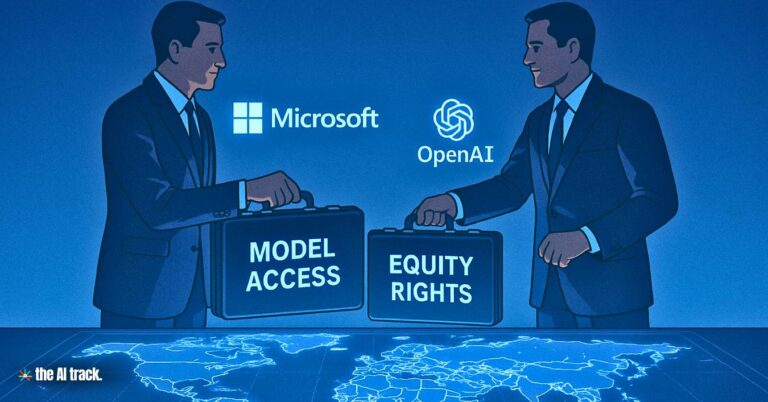
The announcement comes after Microsoft and OpenAI revised their partnership. Microsoft still has access to OpenAI models and products through 2032, but that license is now non-exclusive. OpenAI can also offer its products through other cloud providers, while Microsoft can keep building its own AI systems.
For users and businesses, the practical message is clear: Microsoft wants Copilot, GitHub, Windows, Azure, and future AI devices to rely more on Microsoft-built models and infrastructure.
The Facts
- Microsoft introduced MAI-Thinking-1 at Build 2026.
- It is Microsoft AI’s first advanced reasoning model.
- Microsoft describes it as a medium-sized model with 35 billion active parameters.
- The model is designed for multi-step instructions, long-context reasoning, software engineering, and code generation.
- Microsoft says it was trained from the ground up on clean data, without distillation from third-party models.
- MAI-Thinking-1 is available in private preview through Microsoft Foundry.
- Customers can register interest in testing the model before broader availability.
- Microsoft says customers will be able to improve the reasoning model’s accuracy by incorporating their own data.
- Microsoft announced seven new MAI models at Build 2026.
- The new model family includes tools for reasoning, coding, image generation, image editing, transcription, and synthetic voice.
- MAI-Image 2.5 and its flash version support text-to-image generation and image editing.
- MAI-Transcribe-1.5 is described as five times faster than competing models.
- MAI-Voice-2 and its flash version add 15 new languages and new voice options.
- MAI-Code-1-Flash is an inference-efficient coding model integrated with GitHub Copilot and Visual Studio Code.
- Microsoft is also introducing small Aion models that can run on Windows PCs.
- Several MAI models are available through Microsoft Foundry and MAI Playground.
- Microsoft’s OpenAI license now runs through 2032 on a non-exclusive basis.
- Microsoft has invested $13 billion in OpenAI and $5 billion in Anthropic.
- Microsoft is also pushing local AI development with the Nvidia-powered Surface RTX Spark Dev Box.
What Is New
The most important new product is MAI-Thinking-1.
Reasoning models are designed to break problems into intermediate steps before producing an answer. They are commonly used for coding, mathematics, planning, research, and complex business workflows.
Microsoft is positioning MAI-Thinking-1 as a more efficient alternative to frontier reasoning models. Kyle Daigle, Microsoft’s developer marketing chief and GitHub operating chief, described it as built for “high efficiency and performance” at a low token cost. Tokens are the units developers pay for when they use AI models through APIs and cloud platforms.
The launch also expands the MAI model family across practical AI tasks. MAI-Code-1-Flash targets coding inside GitHub Copilot and Visual Studio Code. MAI-Image 2.5 adds text-to-image generation and image editing. MAI-Transcribe-1.5 focuses on faster speech-to-text. MAI-Voice-2 adds multilingual synthetic voice capabilities.
This matters because Microsoft is not only releasing models. It is building a full AI product layer around them.
The Bigger Strategy
Microsoft’s relationship with OpenAI remains important, but it is no longer enough on its own.
The company invested heavily in OpenAI and integrated OpenAI technology across Copilot, Azure, GitHub, and Microsoft 365. It has also invested in Anthropic while making both companies’ models available through Azure. But the revised OpenAI partnership gives Microsoft more flexibility to build, tune, and deploy its own AI models.
That shift reduces three strategic risks.
- First, Microsoft avoids relying too heavily on one external AI supplier.
- Second, it can optimize models for its own products, pricing, hardware, and enterprise customers.
- Third, it can compete directly in the model market rather than acting mainly as a distributor of another company’s technology.
The cost issue is central. By running its own models on Azure infrastructure, Microsoft can avoid paying third-party model providers for some workloads and potentially pass lower costs to developers and enterprise customers.
This is especially important as AI moves from chatbots to agents that can perform work across apps, files, browsers, calendars, codebases, and enterprise systems.
Agentic AI Becomes the Product Layer
Microsoft also showed Scout, an always-on assistant for tasks such as meeting preparation, schedule management, and email drafting.
Scout is based on OpenClaw, an open-source agentic AI project that became popular in late 2025. The move is notable because Microsoft previously treated autonomous agents as a security risk. Now it is turning that same category into a business feature.
The broader direction is clear: Microsoft wants AI to become an operating layer for work, not just a chatbot window.
That means AI agents could increasingly sit across Microsoft 365, Windows, GitHub, and enterprise software. Instead of asking a model a question, users may assign a task and let the system work across tools.
Hardware Is Part of the Plan
Microsoft also announced the Surface RTX Spark Dev Box, a compact Nvidia-powered machine for developers who want to run and test AI models locally.
The device is designed for prototyping, fine-tuning, and running capable models on a desk before moving larger workloads to the cloud. This fits a wider trend in AI: some workloads are moving closer to the user, especially where privacy, latency, cost, or developer control matters.
Microsoft is also introducing small Aion models that can run on Windows PCs, extending the same local-AI direction beyond dedicated developer hardware.
Microsoft also presented Android-based AI device concepts built around voice interaction with AI agents. The prototypes included a desk speaker with a screen and a wearable badge developed with Qualcomm.
What It Means for Developers
For developers, Microsoft’s announcements point to a more integrated AI stack.
MAI-Code-1-Flash is designed for GitHub Copilot and Visual Studio Code. MAI-Transcribe-1.5, MAI-Voice-2, and MAI-Image 2.5 expand Microsoft’s model options inside Foundry and related tools.
The coding model targets the fast-growing “vibe coding” market, where developers and non-technical users use text prompts to generate applications, websites, and software features. Microsoft describes MAI-Code-1-Flash as “inference ultra-efficient,” which matters because inference cost directly affects how expensive AI coding tools are to run at scale.
This could give developers more choice inside the Microsoft ecosystem. It may also reduce cost if Microsoft can run smaller, specialized models more efficiently than large general-purpose systems.
What It Means for OpenAI
The launch does not mean Microsoft is leaving OpenAI behind.
Microsoft still has rights to OpenAI technology through 2032, and OpenAI remains a major force in Microsoft’s AI product stack. But Microsoft is clearly reducing single-partner dependency.
The relationship is becoming less exclusive and more competitive. Microsoft can use OpenAI models where they make sense, while also building its own models for cost control, product integration, and strategic independence.
That makes Microsoft both OpenAI’s partner and a growing model competitor.
What to Watch Next
The most important test will be deployment.
MAI-Thinking-1 is currently available in private preview through Microsoft Foundry. Its real impact will depend on how quickly it appears inside Copilot, GitHub, Microsoft 365, Microsoft Foundry, and enterprise workflows.
The next questions are:
- whether MAI-Thinking-1 can compete with frontier reasoning models in everyday use
- how Microsoft prices MAI models against OpenAI, Google, Anthropic, and open-source alternatives
- whether lower token costs become a real advantage for developers
- whether developers adopt Microsoft Foundry as a serious model platform
- whether MAI-Image 2.5, MAI-Transcribe-1.5, and MAI-Voice-2 become default Microsoft product features
- whether local AI hardware and small Windows models become useful beyond developer experiments
Why This Matters
Microsoft is trying to control more of the AI stack: models, agents, developer tools, enterprise platforms, hardware, and user-facing assistants. For end users and businesses, that could mean more AI features inside Microsoft products, more model choice for developers, lower AI operating costs, and stronger competition among the largest AI companies.
This article was drafted with the assistance of generative AI. All facts and details were reviewed and confirmed by an editor prior to publication.

Microsoft, Google DeepMind and xAI will join U.S. AI model testing for national security risks before advanced systems are released.
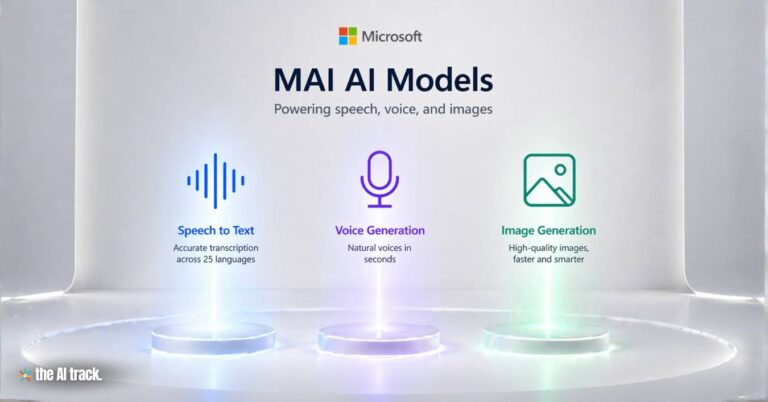
Microsoft launched MAI AI Models including MAI-Transcribe-1, MAI-Voice-1, and MAI-Image-2 to expand its in-house multimodal AI stack.

Microsoft and OpenAI end cloud exclusivity, keep Azure first and remove AGI-linked terms from their revised AI partnership.
OpenAI defeated the Elon Musk lawsuit after a jury found he filed too late, leaving its governance fight unresolved as IPO scrutiny grows.
Read a comprehensive monthly roundup of the latest AI news!