Key Takeaway
An internal OpenAI reasoning model produced a counterexample to Paul Erdős’s 1946 conjecture about the unit distance problem, marking one of the strongest examples so far of AI contributing a publishable mathematical result. The full unit distance problem is not solved, but a long-standing assumption about the best possible point arrangements has been overturned.
OpenAI Model Disproves Unit Distance Problem – Key Points
The Story
The unit distance problem asks how many pairs of points in the plane can be exactly one unit apart. For nearly 80 years, many mathematicians believed Erdős’s grid-based intuition gave the right asymptotic behavior, but no proof had settled the conjecture. On May 20, 2026, OpenAI announced that an internal general-purpose reasoning model had found a construction that disproves the conjectured upper bound of n^(1+o(1)). The result provides an infinite family of point configurations with a polynomial improvement over the long-believed near-linear limit.
The Facts
The result concerns the planar unit distance problem.
The question is: given n points in a plane, what is the maximum number of pairs that can be separated by exactly one unit?
The conjecture dates back to 1946.
Erdős proposed that the best arrangements for the unit distance problem should behave roughly like carefully spaced grids, producing only slightly more than a linear number of unit-distance pairs.
OpenAI’s model found a counterexample, not a complete solution.
The result disproves Erdős’s conjectured n^(1+o(1)) limit by showing that some point sets can do significantly better than the expected grid-style construction. It does not determine the exact maximum possible number of unit-distance pairs.
The construction gives a polynomial improvement.
The model produced an infinite family of point configurations with at least n^(1+δ) unit-distance pairs for some fixed δ greater than zero. A refinement by Princeton mathematician Will Sawin made the improvement explicit, giving sets of arbitrarily large n points with more than n^1.014 unit-distance pairs.
The model was general-purpose, not built only for this problem.
The proof came from an internal reasoning model rather than a system trained specifically for mathematics, scaffolded to search through proof strategies, or targeted only at the unit distance problem. OpenAI tested the model on a collection of Erdős problems as part of a broader effort to evaluate whether advanced models can contribute to frontier research.
The construction uses algebraic number theory.
The model’s approach moved beyond the usual square-grid intuition and used tools from algebraic number theory, including ideas connected to Ellenberg–Venkatesh, Golod–Shafarevich, and Hajir–Maire–Ramakrishna. The result connects an elementary-looking geometric question to deep number-theoretic machinery.
External mathematicians reviewed a human-digested version.
A companion document by Noga Alon, Thomas F. Bloom, W. T. Gowers, Daniel Litt, Will Sawin, Arul Shankar, Jacob Tsimerman, Victor Wang, and Melanie Matchett Wood presents a short, human-verified version and expert reflections.
The original AI output was not reviewed in full by outside experts.
External reviewers saw an edited and digested version of the reasoning, not the model’s full raw output. That matters for transparency and for how mathematical credit should be assigned.
The previous upper bound remains much higher.
The best-known upper bound, O(n^(4/3)), dates to work by Spencer, Szemerédi, and Trotter in 1984 and has remained essentially unchanged despite later refinements.
The result is significant because it was mathematically interesting on its own.
Unlike many AI math demonstrations that solve benchmark-style problems, this counterexample addresses a real open problem at the center of discrete and combinatorial geometry.
The achievement still required human cleanup and verification.
The model generated the key construction, but mathematicians had to digest, check, refine, contextualize, and publish the argument in a form the field could evaluate.
The episode raises attribution questions.
Several experts noted that similar ideas existed in prior literature, making citation and academic credit an unresolved issue when AI systems recombine or rediscover advanced mathematical techniques.
What Is the Unit Distance Problem?
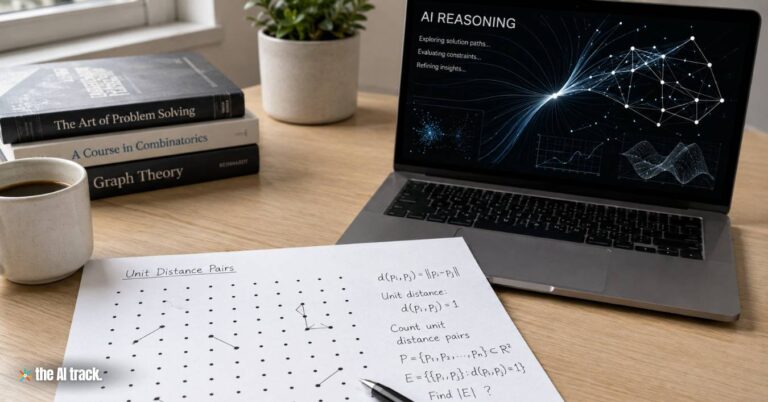
Imagine placing dots on a sheet of paper. Some pairs of dots may be exactly one unit apart. The unit distance problem asks how to place many dots so that the number of exact unit-distance pairs is as large as possible.
For nine dots, a three-by-three grid gives several unit-distance pairs. For very large numbers of dots, the problem becomes much harder: mathematicians want to know how the maximum number grows as the number of points increases.
What OpenAI’s Model Changed
The model did not simply improve a known grid pattern. It found a different mathematical construction that creates more unit-distance pairs than Erdős’s conjecture allowed.
That means the long-held belief was false: grid-like arrangements were not the whole story. The result also matters because the model connected the unit distance problem to tools from algebraic number theory, showing how AI may surface technical routes that human experts considered unlikely or did not pursue.
What This Does Not Mean
This is not proof that AI has “solved mathematics.” It is also not proof that current models can reliably generate entirely new mathematical theories.
The more precise conclusion is stronger and narrower: a modern reasoning model found a non-obvious counterexample to a serious open problem, and humans were able to verify and develop it.
Why This Matters
This result shows that AI can now contribute to frontier mathematics in a way that goes beyond tutoring, symbolic computation, or benchmark problem solving. For researchers, the unit distance problem suggests that AI systems may be useful for exploring neglected paths, testing counterexamples, and searching through technical constructions that humans may avoid because they look too tedious or unlikely to succeed. It also raises practical questions for journals, universities, and research institutions about verification, authorship, citation, and how AI-generated mathematical work should enter the academic record.
This article was drafted with the assistance of generative AI. All facts and details were reviewed and confirmed by an editor prior to publication.

OpenAI defeated the Elon Musk lawsuit after a jury found he filed too late, leaving its governance fight unresolved as IPO scrutiny grows.

OpenAI launched Workspace Agents in ChatGPT for team workflow automation, with Slack, Salesforce, scheduling, memory and Codex execution.

OpenAI launches Daybreak, a GPT-5.5 cybersecurity platform for authorized threat modeling, vulnerability triage, patch validation, and malware analysis.

OpenAI is rolling out GPT-5.5 Instant as ChatGPT’s default model, with better accuracy, low latency and memory-source controls.
Read a comprehensive monthly roundup of the latest AI news!